
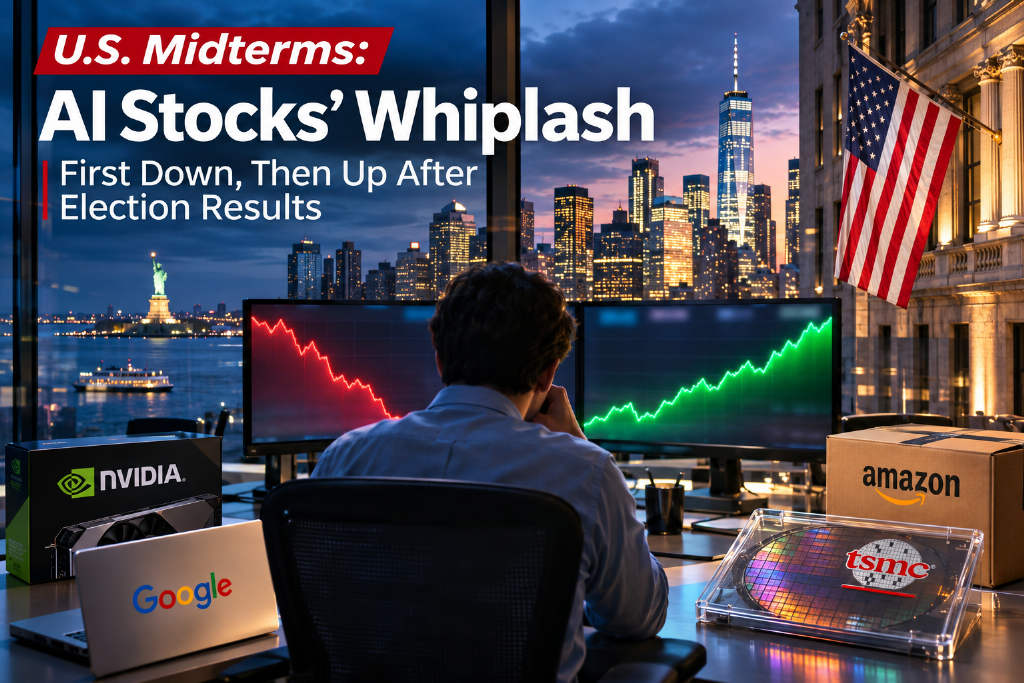
AI stocks got hit first, then bounced, after the U.S. midterm result became clear. Investors went from shock to a second look in just a few hours.
The original article says markets around the world went through a full emotional swing in almost no time. In China, A-shares were soft in the morning, then money swung back into tech in the afternoon. The STAR 100 index surged 10.14%, its biggest one-day gain in nearly two years, while the ChiNext index climbed 6.4%, its strongest single-day move in nearly a year. In U.S. equity futures, Nasdaq futures were down more than 2% at one point and S&P 500 futures fell more than 1%. The early selling was selective, not a blind dump: CoreWeave fell as much as 7% after hours, while NVIDIA, Alphabet, Amazon, and TSMC each dropped more than 2%.
But that move didn’t stick. The article says the market then turned on a dime, with major indexes going from sharp losses to small gains. U.S. Treasuries firmed, gold climbed back above $4,000, and South Korea’s KOSPI flipped from a 4% drop to positive territory.
The piece calls the election result a historic Democratic sweep that sparked a sharp selloff first, then a deep V-shaped reversal.
Elon Musk became one of the biggest talking points in that backdrop. According to the article, he spent $445 million backing Republicans, making him the largest individual donor, only to end up with what it describes as a home-run-scale defeat. Tesla fell more than 5% premarket and SpaceX dropped more than 4%. Musk also poked fun at himself on social media, writing, “Looks like my laser communications effort to influence the election may not have worked this time.” The article’s point was blunt: the money went out, but the political return never showed up.
What the market feared at the open
The article says the first leg lower had less to do with the result itself and more to do with how far it overshot expectations. Before the vote, markets had already put a 99% probability on Democrats taking both chambers. Even so, the scale of the Senate reversal and the losses across deep-red states still came in beyond what most institutions had penciled in. Once that gap opened up between what people expected and what actually happened, capital headed for the exit first.
The piece says investors were mainly worried about three things.
- Tighter regulation. The market worried Democrats would move fast on tougher AI oversight, including stricter data-center approvals and heavier antitrust pressure on large technology companies. In the article’s framing, that would strike at the heart of the AI trade: capital spending on computing infrastructure. AI infrastructure names had already been retreating for weeks, while the argument over whether all that spending could produce adequate returns was still alive. Then came a negative trigger. And those names became ground zero for the selloff.
- A fiscal shift. Investors also feared that a Democratic Congress would block Trump’s tax-cut and deficit-expansion agenda. If fiscal tightening turned out harsher than expected, it could drag on growth and corporate earnings. The article says that was the main reason broader indexes came under pressure.
- State-level policy uncertainty. With major computing hubs such as Texas and Ohio turning blue, the market could not tell whether local governments might roll out restrictive policies in a concentrated way. The article says this kind of state-by-state regulation is tougher to predict and tougher to hedge than a federal bill.
Why the panic faded quickly
Once the result was fully priced in, investors took another look at how the shock would actually travel through the market. The article says the election’s impact on AI was concentrated in valuation and sentiment, not in cash flow or the industry’s long-term path.
It gives two main reasons for the rebound.
First, Democrats won both chambers, but they did not get the two-thirds majority needed to override a veto. In plain terms, even if they wanted to push restrictive AI legislation, getting it passed and turning it into law would still be hard.
Second, Trump had said publicly that he still held full veto power and could use it, if needed, to force Democrats into a bipartisan compromise. In the article’s wording, if Trump does not sign, even a harsh AI regulatory bill cannot become law.
The article is careful here. It does not present a veto as a direct positive for AI. What it does do, in the author’s view, is knock the odds of an extreme scenario back toward zero after panic had briefly given that scenario real weight.
Then it pushes the argument a bit further. Wall Street, the article says, does not really fear divided government. What it fears is one side gaining enough power to force abrupt policy shifts. Under a divided structure, Democratic AI regulation becomes harder to pass, but Trump’s own tax-cut and fiscal-expansion agenda also runs into walls. So you get policy inertia: corporate tax rates stay where they are, the tariff framework stays where it is, and the current regulatory agenda mostly remains in place.
For richly valued technology assets, that kind of “don’t change anything” setup can be support in itself, because investors do not have to tack on an extra risk premium for sudden tax increases or sudden new regulation.
Democrats are not anti-AI, the article argues
The piece also pushes back on the idea that Democrats are fundamentally against AI. It says the two parties may fight over plenty, but they are closely aligned on one point: AI sits at the center of U.S. technological dominance. The article notes that the CHIPS legislation and the national AI research strategy were both pushed forward during Democratic rule.
It then points to stock holdings by several Democratic figures as evidence that the party establishment is not hostile to the sector.
According to the article, the Pelosi family’s U.S. equity portfolio is worth about $134 million, with more than 70% tied to technology and AI-related names. NVIDIA is the largest single position at 37.3%, and disclosed historical position ranges reached as high as $5 million to $25 million. Microsoft, Alphabet, Amazon, and Broadcom are also listed among the holdings.
The article also names New Jersey Representative Josh Gottheimer, who serves as co-chair of the Democratic AI and Innovation Economy Committee and helps lead the party’s AI legislative agenda. His family holdings are said to range from $8.5 million to $38 million. Microsoft alone makes up about 69% of his personal portfolio, and he also holds NVIDIA, TSMC, and Applied Materials.
Other names cited include Ro Khanna from Silicon Valley, Senator Cory Booker, and Adam Schiff, all described as holding large-cap technology stocks or semiconductor and Nasdaq-themed ETFs. The NANC ETF, which tracks trading by Democratic lawmakers, has an information technology weighting close to 45%, with NVIDIA, Microsoft, and Alphabet as its top three holdings.
Based on those examples, the article says Democrats want regulation, not the industry wrecked. That’s the frame. It says they want to compete for AI leadership inside a “safety guardrail” structure, make large companies pay more tax and carry more responsibility, and impose order on the sector. A bill harsh enough to seriously damage AI, the article argues, would face resistance not just from Trump’s veto but from inside the Democratic camp too.
That leads to the article’s main policy takeaway: even with Democrats controlling both chambers, the next two years are unlikely to produce a hard law from Washington that can seriously damage global computing-capacity expansion. A narrower route looks more likely, focused on model safety testing and restrictions on specific high-risk applications. Measures that can actually make it through are more likely to be softer requirements such as disclosures, voluntary compliance, and safety standards.
In that sense, the broad rebound in AI stocks was the market closing that expectations gap.
The medium-term driver is still the industry itself
The article says the policy risk created by the midterm election is, at its core, a short-term sentiment shock. What will really decide AI’s medium-term direction are industry fundamentals: higher financing costs in a high-rate environment and weaker returns on AI capital spending as pricing competition gets tougher.
Even so, the author argues those are still shorter-cycle pressures when viewed across a longer horizon, and the long-term narrative room for AI has not yet hit its ceiling.
What this means for China’s AI sector
For Chinese investors, the article says the near-term effect is simple enough. Domestic AI hardware leaders still count many overseas tech giants among their major customers, so their share prices are likely to keep tracking offshore sentiment in the short run.
Over the medium to long term, though, the article says the case for self-reliance becomes even clearer.
It argues that concerns about a Democratic administration tightening AI restrictions on China are directionally fair, but the bigger point is that technological competition with China is a bipartisan consensus in the U.S. The difference is in the method. Republicans prefer unilateral sanctions and faster moves. Democrats are more likely to work with allies, write rules, and build a more systematic containment framework. The goal, the article says, is the same either way: preserving the lead in high-end computing power.
From there, the article says export scrutiny on high-end AI chips, high-speed interconnect chips, and EDA tools could keep tightening after the Democratic transition is complete. It also says gray areas such as re-export trade and remote access to cloud computing power could be narrowed step by step.
At the same time, the piece argues that these restrictions will probably come with clearer boundaries. High-end products may stay tightly blocked, while mid- and lower-end segments remain open, rather than shifting toward full decoupling. The reason given is straightforward: U.S. technology companies also depend on revenue from the Chinese market to fund research and development. If the cut gets too clean, the blowback hits them too.
The article then turns to China’s domestic base. It says China has built a globally competitive set of capabilities in intelligent computing-center construction, server manufacturing, optical-module capacity, and deployment of industry-specific large models. From the East Data, West Computing program to local AI industrial policies and digital upgrades in finance, industry, and government services, the long-term case for domestic computing-capacity buildout remains solid.
That is why, in the article’s view, the pace of intelligent computing centers and industry computing clusters in China is decided mainly by domestic industrial policy and digital demand, not by the U.S. midterm election.
Within that frame, the article highlights several areas as the clearest winners from the self-reliance trend: domestic AI servers, domestic computing chips, domestic memory, and supporting companies in power systems, cooling, and optical modules. It describes them as the part of the AI complex with the clearest order visibility and even calls them “counter-cyclical assets” within the sector, arguing that pullbacks caused by external volatility often create windows for long-term positioning.
As for the application layer, the article says the election matters even less. Industry large models and tracks such as AI plus industrials, healthcare, and autonomous driving are driven mainly by domestic demand, data, and use cases. Their key challenge is commercialization. In the article’s view, performance there depends on technology iteration, whether customers are willing to pay, and whether deployment cases are strong enough, not on a single election result.
Markets still return to fundamentals
The article closes by describing the election as a large-scale reset of expectations. It stripped out the most extreme regulatory risks that investors had projected onto the market and pulled trading back from panic to a more rational footing. But it did not create a fresh incremental positive catalyst either, so the piece does not treat it as the start of a new speculative surge.
Once the excitement cools, the market still goes back to fundamentals. In the article’s own framing, the first half of the AI rally was about expectations, imagination, and who could expand faster. The second half has to come back to deployment, profitability, and real demand. Same story, it says, for China’s AI industry.



