

Odaily published a long-form market analysis translated from Saurabh Deshpande that starts with a basic question: if perpetual futures already work so well in crypto, why does the market still need options?
The answer in the piece is time. A trader may believe Bitcoin will be higher three months from now, but a leveraged perp can still be liquidated tomorrow. A call option gives that view more room to play out. The buyer can still lose the full premium, but one bad afternoon does not automatically force the position out.
That leads to the next question: why are on-chain options still so small. The article says most roads lead back to the same issue. Is selling options worth the trouble? Perpetual DEXs may change that because they can give sellers a place to hedge and a pool of traders that is already there.
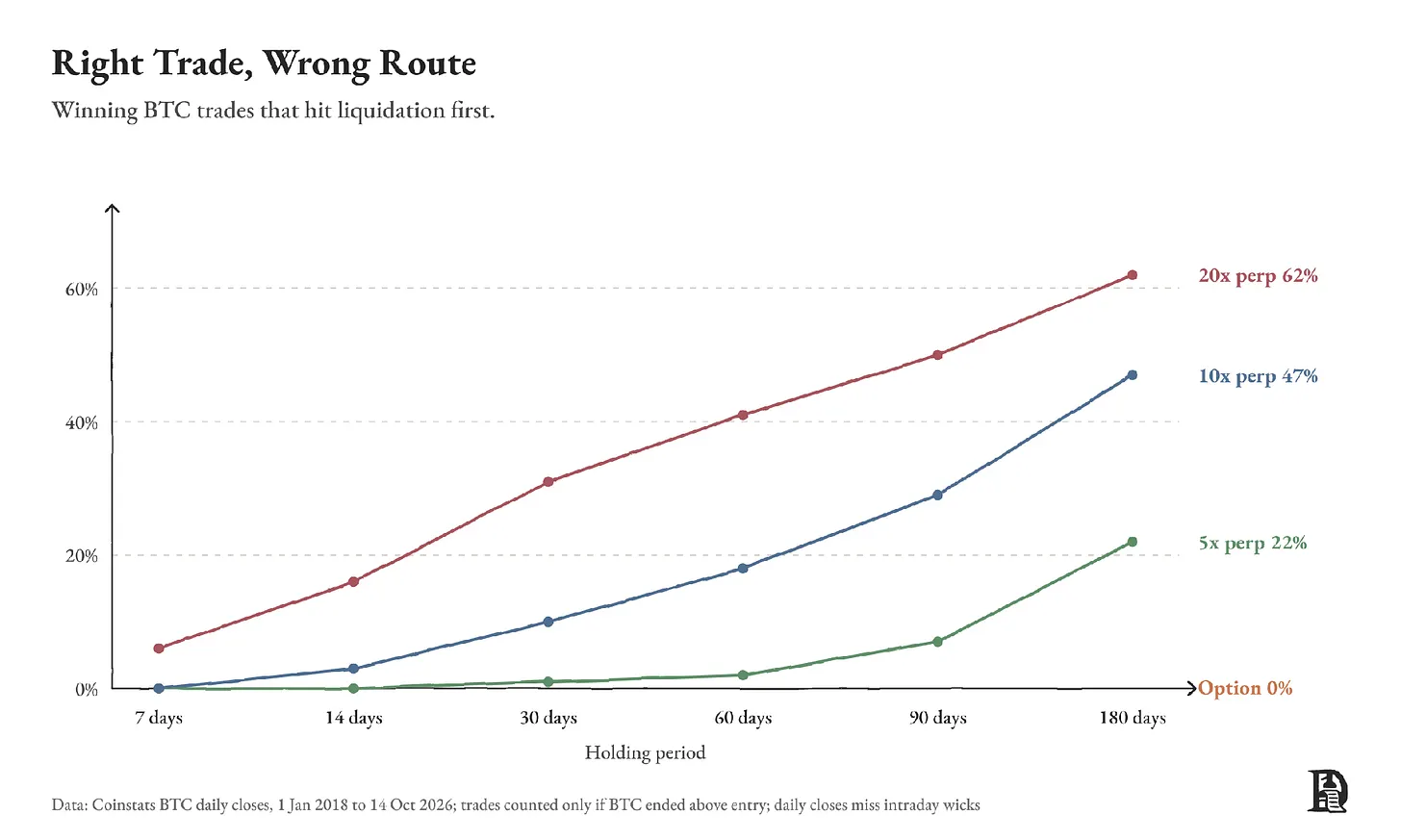
Being right on direction is not enough if a perp gets liquidated first
The article notes that in July 2025, the author argued in an earlier piece that options would follow perps on-chain and could grow 100x in three years. Fifteen months later, options are still below 1% of perp DEX volume. In traditional markets, by contrast, options volume is roughly three times futures volume.
To measure the cost of being early with a perp, the author took BTC daily closing prices from January 2018 to October 2026 and treated every day as a possible long entry. The sample kept only trades that closed above entry after 7 to 180 days, meaning the directional call was correct, and then checked whether BTC fell enough during the holding period to liquidate a 5x, 10x, or 20x perp.
A 10x perp had a 47% chance of liquidation over 180 days, 29% over 90 days, and 18% over 60 days. An option covering the same time window would not be closed before expiry. The article adds that daily closes miss intraday wicks, so the real probability may be higher.
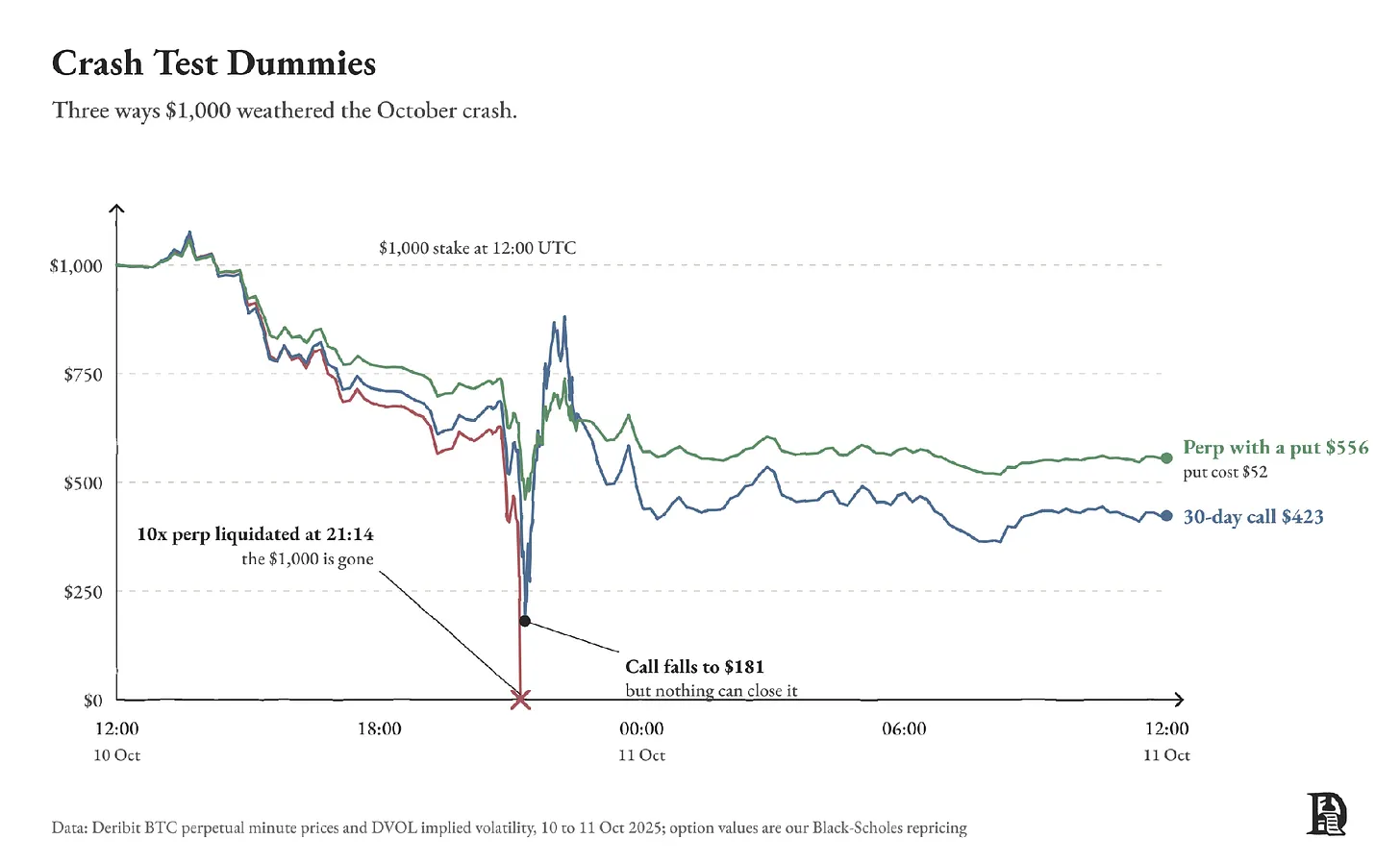
It also walks through a case study from Oct. 10, 2025. At 12:00 UTC, the author opened three $1,000 BTC longs: a 10x perp, a 30-day call bought with the same $1,000, and another 10x perp paired with a 7-day put struck 5% below entry, with the premium paid out of that same $1,000.
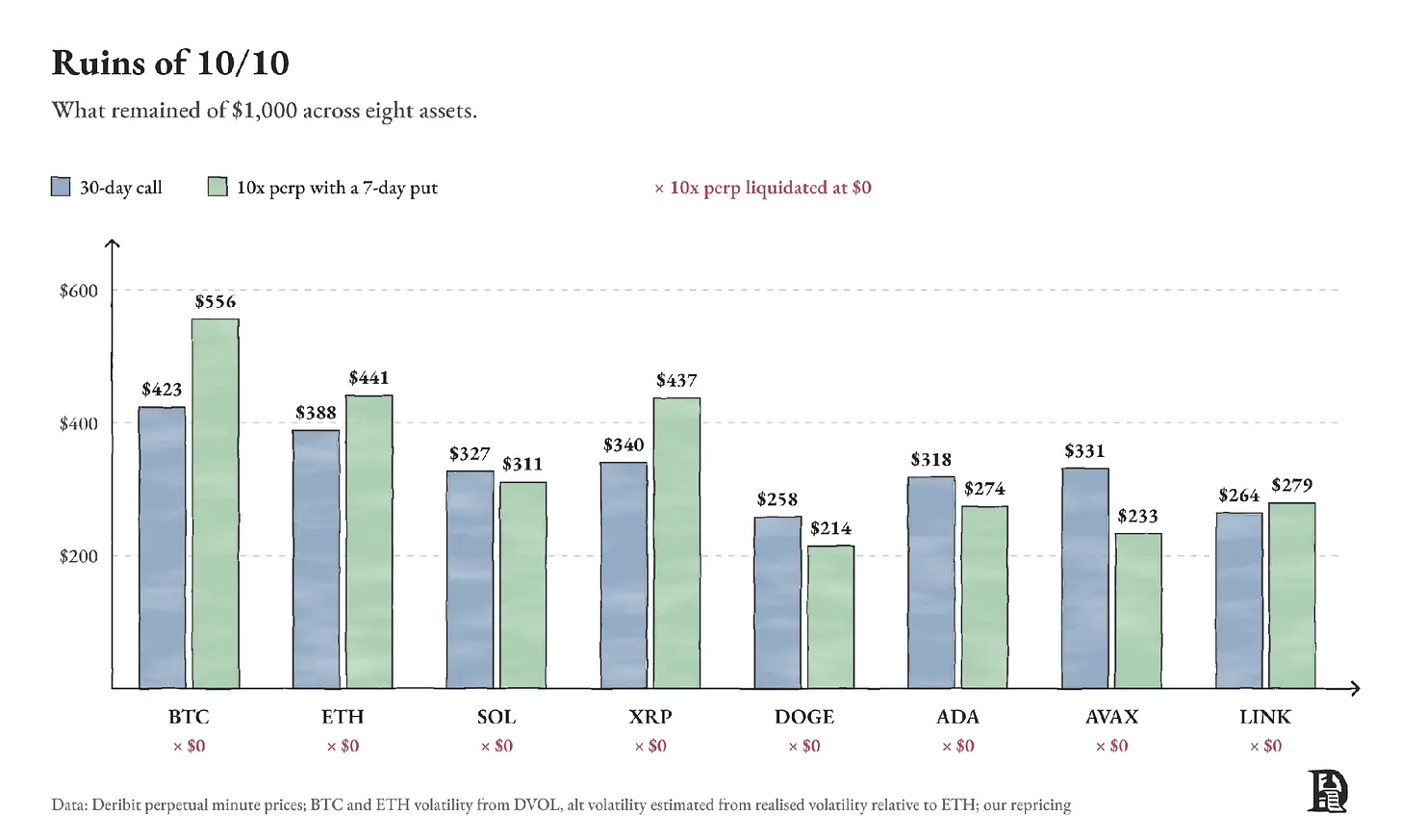
The perp was liquidated at 21:14. The call fell to $181 at the low, then climbed back above $800 in less than an hour. The put cost $52 and kept the 10x long alive through the crash. The author says the same test was repeated across eight assets using Deribit prices, with similar results.
On smaller tokens, though, that protection is much more expensive. The article says the hedge can consume $250 to $340 out of the $1,000 because option pricing on those assets carries much higher volatility.
Three lines are converging
The piece describes three ways traditional finance and crypto are borrowing from each other.
Traditional finance is importing crypto tools
CME now offers around-the-clock crypto futures and options trading. Hyperliquid perp prices appear on Bloomberg Terminal. Hyperliquid’s policy team and trade.xyz have also filed for rules with the U.S. Securities and Exchange Commission for pre-IPO perps. Polymarket launched perps for users outside the United States in September.
Crypto is importing traditional assets
On Hyperliquid, traders can already trade the S&P 500, Nvidia, gold, and crude oil as perps at any hour of the day. The article repeats a broader claim made in an earlier essay: Treasuries, equities, compute, and attention will all trade on-chain, and perps are the format through which that shift is happening now.
One example in the article is trade[XYZ], where WTI and Brent crude perps did a combined $2.3 billion in daily volume on March 23. The market has also produced a perp tied to Nvidia H100 GPU hourly rental rates and another tied to a Pokemon card index. CME and ICE are waiting for Commodity Futures Trading Commission approval to list compute futures.
As more prices become tradable, the ways people want to trade them will split. Someone may use a GPU perp to bet on a compute shortage. An AI startup exposed to the same price may simply want protection against a higher bill next quarter. Buying an option gives that startup a known cost for protection: if rental rates rise above an agreed level, the option pays out; if rates fall, the company gets cheaper compute and only loses the premium. The perp gives the option seller a hedge.
The article’s point is direct: every new perp market creates room for an options market next to it.
Traditional tools are now serving crypto-native assets
In April, open interest in BlackRock’s Bitcoin ETF options climbed to $27.6 billion, above BTC options open interest on Deribit. Around the same time, Coinbase acquired Deribit for $2.9 billion.
The article argues that one venue could eventually offer spot, perps, options, and binaries across everything from Bitcoin to equities and commodities. Whoever gets there first could pull in most of the traffic. It gives two reasons crypto may have a head start.
First, listing is a software decision. IBIT launched in January 2024, but its options did not begin trading until November that year because exchanges, clearinghouses, and the SEC had to sign off one by one. Hypercall listed SpaceX options on June 3, 2026, nine days before SpaceX listed on Nasdaq, using Hyperliquid’s pre-IPO perp as the reference price.
Second, the market never closes. Hypercall lets users trade Nvidia and SpaceX options on Sunday because the perps used to hedge them also trade on Sunday. The article says spreads outside U.S. equity hours widen by 1.5x to 2x, but traditional venues do not offer Nvidia options at all during that window.
That is why the author calls the rise of perps the best thing that could happen to on-chain options. Perps are where option sellers hedge. The deeper the perp market, the cheaper it becomes to sell options on top of it. Every new perp market is a potential options market.
Why on-chain options have struggled since 2019
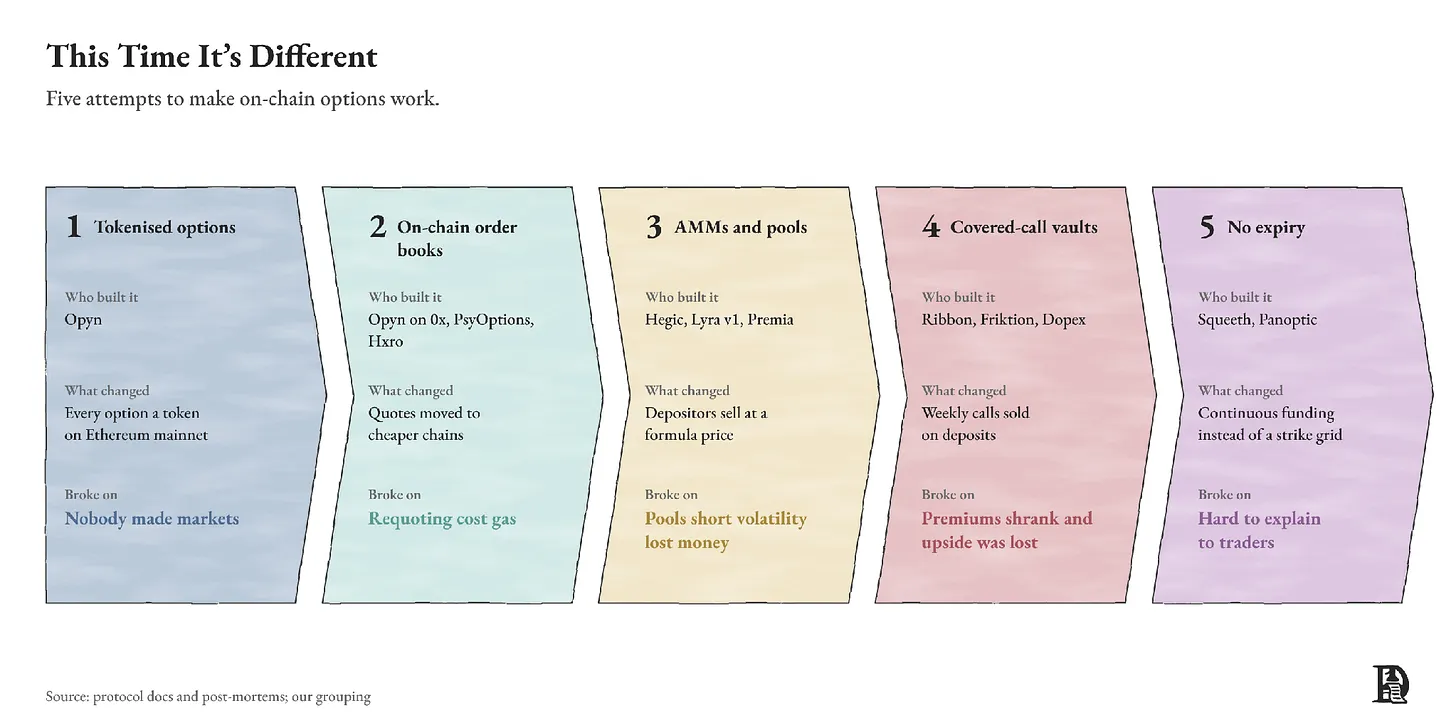
The article says dozens of protocols have tried to bring options on-chain since 2019, and almost all either shut down, pivoted, or failed to generate meaningful volume. It reduces the problem to three structural constraints.
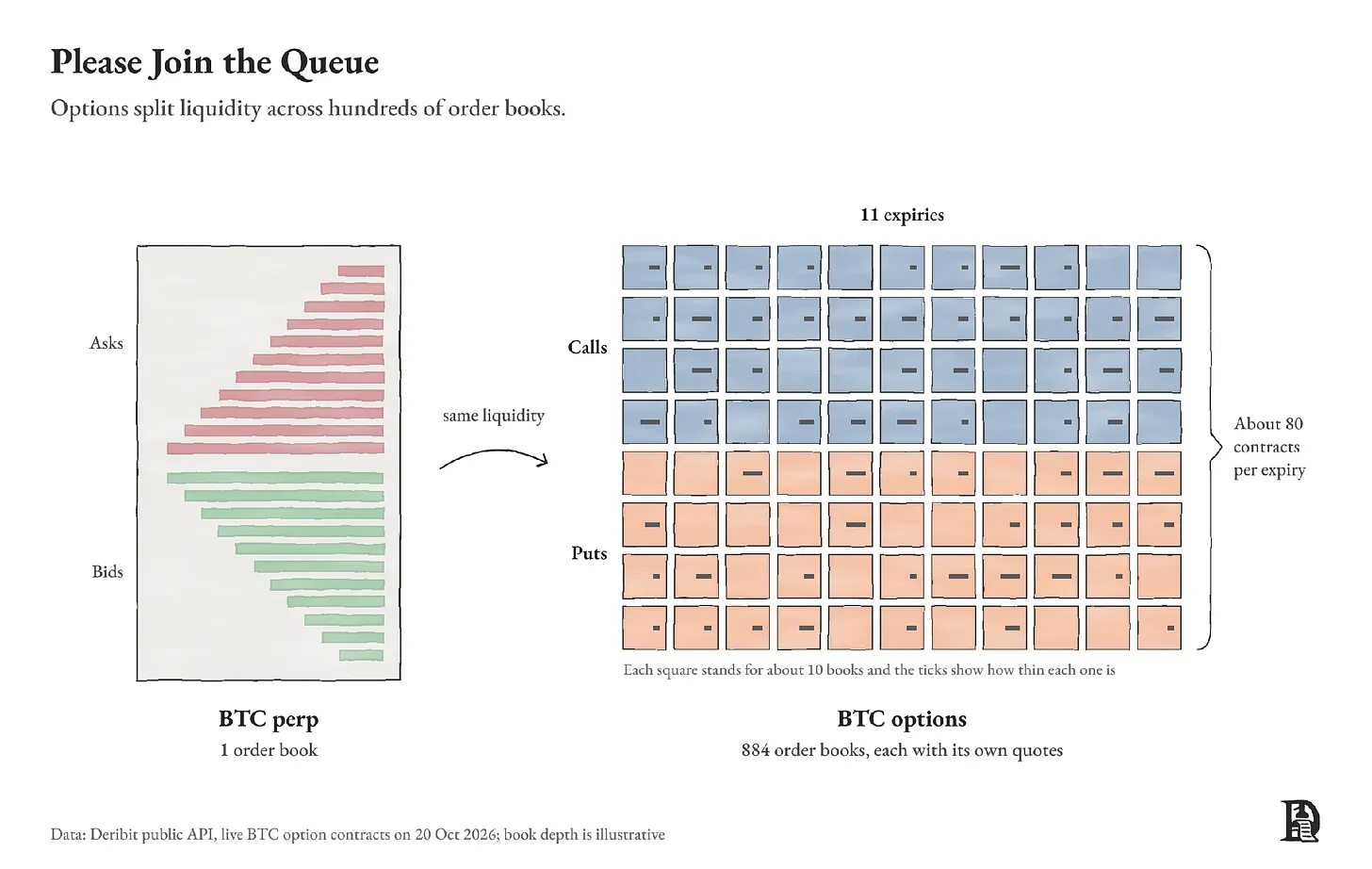
- Liquidity is split across hundreds of order books for a single asset. BTC perps have one order book. Deribit listed 884 BTC options across 11 expiries, and each one needs two-sided quotes around the clock.
- Sellers cannot hedge cheaply. They need to trade the underlying continuously to stay neutral, which requires a deep market right next to the options venue.
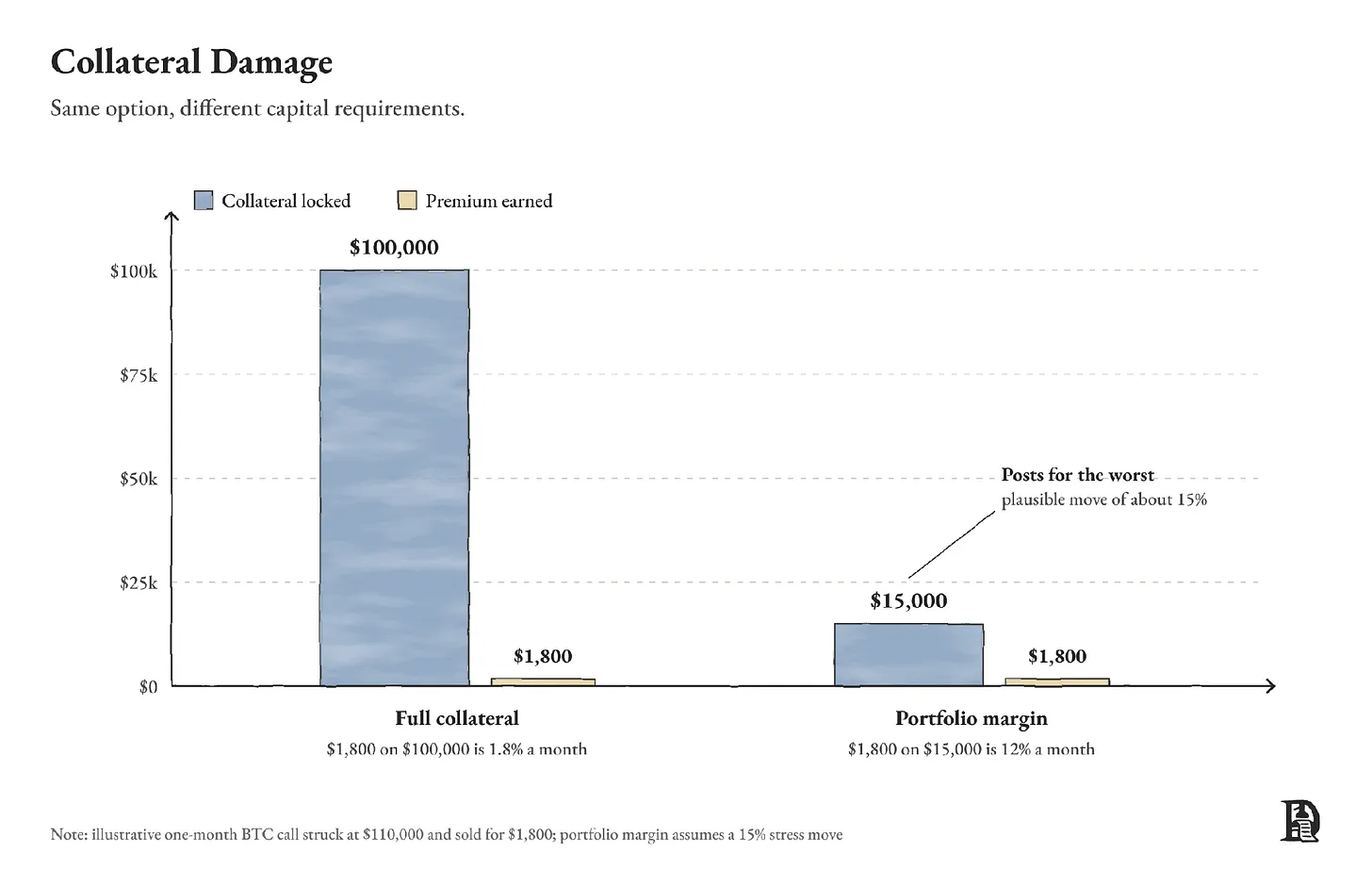
- Selling ties up capital. Early protocols required sellers to lock the maximum theoretical payout. The article gives one example: selling a BTC call with a premium of $1,800 on a $110,000 BTC reference means locking $100,000 to earn 1.8% a month. Professional market makers will not line up for that trade.
Each generation solved one of those problems and then failed on another. In May 2021, Hegic depositors lost most of roughly $80 million. Lyra depositors lost 4.9% in the BTC pool and 17.6% in the ETH pool over seven months. PsyOptions shut down its product in June 2024.
The article also explains why market makers stay away. Before retail flow arrives, most of the volume hitting quotes on a new venue comes from traders arbitraging it against Deribit. They only trade when the new venue’s quotes go stale. That means even if the platform works perfectly, market makers can still lose on almost every fill. A venue then has only two choices: pay the first market makers to absorb those losses, or bring in retail flow that does not already exist.
What current platforms changed
The platforms that work today share the same base design. Orders are matched off-chain, so updating quotes does not cost money. Collateral, margin, and settlement stay on-chain, so users keep control of funds.
But the article says architecture alone is not enough. A better design still has to answer one question: why should anyone sell options there? The strongest answer is cheap hedging inside the same account.
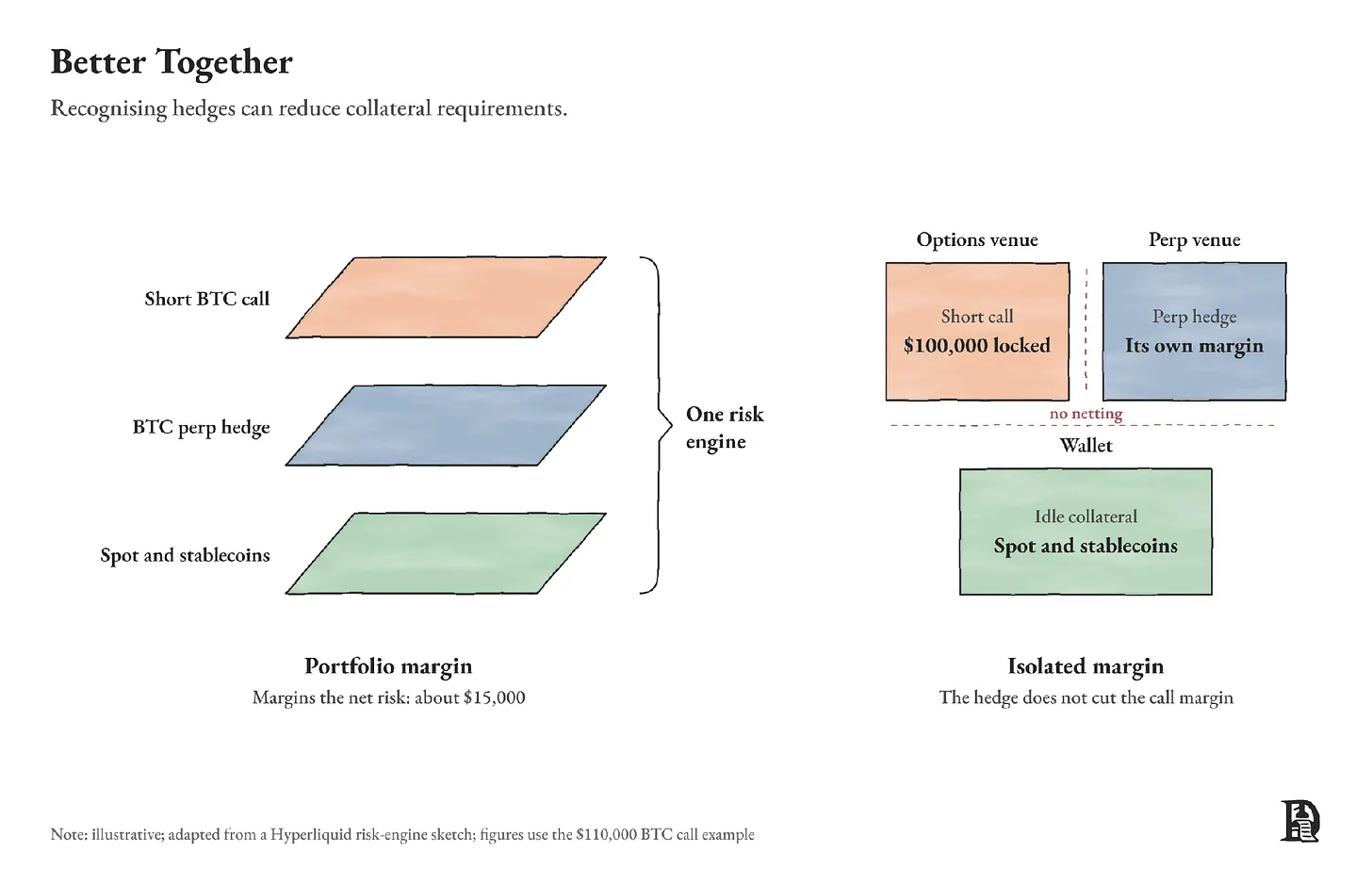
It returns to the earlier example of the seller who had to lock $100,000 to write a BTC call. A portfolio margin engine calculates the maximum possible loss across all positions and then sets collateral accordingly. If the worst reasonable move is 15%, the seller may need to post about $15,000 instead of $100,000. The premium is still $1,800, so the monthly return on locked capital jumps from 1.8% to roughly 12%.
That is why the author thinks options will take off where perp liquidity already exists, and today that means venues such as Hyperliquid and Lighter. On Hyperliquid, an options seller can get three things at once:
- Depth. Hyperliquid has the deepest on-chain perp order books, and builder codes let any application plug into them.
- One account. A trader selling a put can reuse collateral to open a perp long, while spot, perps, and event contracts share the same risk engine.
- Users. Platforms that combine liquidity, users, and distribution usually keep more of the value they create.
Hypercall is described as the first options platform built on that stack. A market maker selling a Nvidia call can buy the Nvidia perp on Hyperliquid in the same account, and that hedge lowers the margin required for the option. Its founder estimates there are 10 to 100 times more market makers quoting perps than quoting options. Hypercall gives that perp market-making base a reason to quote options too.
How different platforms are sourcing sellers
Derive pays for sellers
Derive, formerly Lyra, is effectively buying its sell side. Over the year through Oct. 19, it cleared about $18 billion in options notional, and FalconX is its only publicly named market maker. FalconX keeps its funds with its custodian, while Derive represents that balance as a tradable token, allowing institutions to quote on-chain without moving collateral on-chain.
Paradex borrows sellers
On Sept. 15, Paradex connected to Paradigm’s network, which handles about one quarter of Deribit’s block trading. Its daily options volume jumped from under $3 million to $58.7 million within a week, but open interest fell from above $250 million to about $96 million by Oct. 14. The article’s reading is simple: block traders come for a trade and then leave.
Rysk turns holders into sellers
Rysk lets users deposit HYPE, BTC, or ETH and sell covered calls to whitelisted market makers in exchange for upfront premium. Over the 30 days through Oct. 14, it did $148 million in notional. Volume then stalled once buyers of those calls had capped their own HYPE exposure.
Front ends hide the option chain
Front ends built on top of these venues try to remove complexity. Dream lets users top up with Apple Pay, choose a direction and position size, and then buys the option for them. Tacticalls, built on Derive, offers three-click bets and copy trading. That kind of packaging can bring users in, but it cannot create sellers if the order book underneath is empty.
Record month, but liquidity is still narrow
September 2026 was the best month on record for on-chain options. Notional roughly doubled to $5 billion, premium rose by one third to $85 million, and peak open interest approached $2.5 billion. Even so, that was only about 7% of Deribit’s monthly volume, and most of it ran through Derive.
The article warns that notional can be misleading. A venue that only sells cheap, far out-of-the-money contracts can generate large face value with very little cash changing hands. Premium, the actual cash paid by buyers, is a better yardstick. On that basis, Derive’s share is even higher, above 90%.
Hypercall’s notional, by contrast, mostly came from cheap, far out-of-the-money S&P 500 options bought as lottery tickets. Pink Brains found that $1 of premium on Hypercall could buy about $1,000 of notional, versus only about $50 on Derive. The article offers three possible reasons:
- Volatility. One-year volatility for the S&P 500 is about 16%, versus 43% for BTC, so the options are much cheaper.
- Contract structure. Short-dated calls far from spot cost only a fraction of a percent of notional.
- Rewards. When Hypercall was distributing $1,000 of HYPE per day, notional rose 50x while premium barely moved, suggesting traders were buying the cheapest contracts available to farm rewards.
That is why the author says Derive is where traders are actually paying for real options exposure.
The article then compares quote quality on Derive and Deribit. On the evening of Oct. 19, the author pulled every listed BTC and ETH option on both venues, excluding deep out-of-the-money contracts and those expiring within three days. Deribit had both bids and offers on all 346 strikes included in the sample. Derive had two-sided quotes on 206 of them. Where Derive did quote, its asks were within 0.2% of Deribit, and its bid-ask spread was about 3.8% of option price, versus 2.6% on Deribit.
That is a clear improvement from the findings in the July 2025 piece “Trading Optionality,” where Derive’s spreads were often 2x to 5x wider than Deribit’s.
Outside BTC and ETH, the picture changes sharply. Derive lists options on 12 assets. The author pulled every strike for the Dec. 25, 2026 expiry from its public API. Across PUMP, LIT, ADA, VVV, and CC, there were 220 strikes and one quote. When the author tried to buy a December PUMP call, the order took a long time to fill. Even where quotes existed, spreads widened quickly as strikes moved away from spot. HYPE, the most liquid mid-cap asset on Derive, showed how fast that deterioration happens.
The article says the same pattern appears across every platform reviewed. Aevo only quotes memecoin options through its OTC desk. Dream moved its PUMP and LIT trades to a single OTC counterparty. Listing an option costs almost nothing for a platform. Selling one is expensive and risky.
What demand is still left for on-chain options
In traditional markets, 88.65 billion options contracts traded in 2025, versus 30.64 billion futures contracts. On-chain, over the 30 days through Oct. 19, 2026, options did $4.9 billion in notional while perp DEXs did $627 billion. That is about 0.8%.
The author does not expect on-chain options to reach the same ratio as traditional finance because part of crypto’s options demand is already being met by other products. Prediction markets sell binary versions, and perp venues now do too. On Oct. 19, Lighter launched BTC and ETH binary options.
Even so, the article says three demand pockets remain:
- Assets traditional finance cannot list quickly, including HYPE, pre-IPO companies, GPU rental rates, and stocks and oil that can trade on Sunday.
- Users traditional finance does not serve well, including anyone outside the United States, anyone without a brokerage account, and anyone who wants to trade with $1. The article points to India’s retail options culture, where weekly options account for 95% of National Stock Exchange volume.
- Options embedded inside other products, such as downside protection attached to a perp, covered calls for treasury management, and liquidation insurance for loans. On-chain, an option can be inserted into any application through an API.
Who benefits if volume grows
The article says the easiest way to answer that is to follow the fees generated by an options trade. The options venue charges a small fee once when the option trades. The platform where the hedge sits charges repeatedly every time the market maker adjusts that hedge. That is why options can enlarge perp volume.
Deribit has more than $2 billion in futures open interest, and the article says much of that exists to hedge options on the platform. From that logic, it identifies three positions worth watching.
- Landlords such as Hyperliquid, which control the hedge market, the margin account, and the user base. Its HIP-4 binary contracts already share the same account, and HIP-4 was designed for “bounded option-like instruments,” which means they could also eat into Hypercall’s market. Either way, the hedge volume lands on Hyperliquid.
- The engine that enables options trading, namely Derive. It has the deepest books, a risk engine, a professional user base, and an API shipped with V3 that others can build on. If wallets, vaults, and agents route options flow there, Derive could become the backend for on-chain options. If not, it remains a venue supported by subsidies with one publicly named market maker.
- Block desks such as Paradex, which have access to institutional flow from Paradigm. That matters for large trades, and the market makers who show up for that flow also deepen the book for everyone else.
The article adds that platforms that do not give sellers a hedge are already losing ground. While the category grew 4x, Aevo’s options business shrank by more than 90%. Standalone options products have a hard time competing with products that can combine with perps, spot, and other primitives.
The market has already started pricing one version of that outcome. Citrini Research’s “Breaking The Wall” portfolio allocates 10% to DRV, and DRV is up more than 1,000% this year. On Oct. 22, DRV’s market capitalization was about $390 million. Over the 30 days through Oct. 20, net revenue was $486,000, equal to roughly 66x annualized revenue.
The article then runs a scenario. If on-chain options reach 5% of perp volume, and October perp volume comes in around $660 billion, options notional would be about $33 billion. If Derive keeps roughly 80% notional share and charges about 1.1 basis points, annualized fees would be around $35 million, or about 11x fees at today’s market cap. In other words, DRV’s price is betting that the category grows another sixfold while Derive holds share, even as Hyperliquid, Lighter, and Paradex chase the same flow.
Two designs the article thinks could help
Putting options into liquidity pools
Option sellers do not all have to come from options venues. The article points to Metric, a DEX whose active pools resemble Uniswap concentrated liquidity. The difference is how ranges are set. On Metric, a curator plugs in a price provider, usually an oracle, and bins are defined as percentage bands around that reference price. As the price moves, the bins move too. Over the 30 days through Oct. 21, Metric did $4.4 billion in volume on about $12 million in deposits.
The article asks what happens if those pools quote option prices. Metric’s documentation lists Black-Scholes with volatility input as one possible pricing model for a price provider. A curator could feed in a live volatility stream and price a tokenized ETH call.
It gives a concrete example: an ETH call struck at $2,600 and expiring on Oct. 30. If ETH is around $2,430 and implied volatility is near 50%, Black-Scholes gives a price of about $18. If ETH rises to $2,500, the same call is worth about $35, and all bins shift upward with it. Because Metric pools can be routed through aggregators such as 0x, 1inch, CoW Swap, and PancakeSwap, traders could buy option tokens through the same swap front ends they already use.
The problem is capital efficiency. Every strike and expiry becomes its own token and its own pool. That ETH call pays holders the amount by which ETH finishes above $2,600 at expiry. The next expiry needs a fresh set of tokens. Market makers on Deribit quote hundreds of instruments from one margin account. On Derive, selling that same $2,600 call under standard rules requires about $330 in margin before hedge offsets. Selling a fully collateralized version means locking 1 ETH, about $2,430, to earn $18. Each Metric pool also needs its own inventory, so five strikes across two expiries means ten separate capital buckets.
The article’s proposed fix is to let Derive issue the token. Derive already allows sellers to post margin and hedge on perps, so selling that $2,600 call through Derive would require about $330 rather than a full ETH. Metric would keep doing what it does best: pricing the token and distributing it to traders.
A Papertrade-style model for options
The article then returns to Papertrade, where the house takes the other side of every trade and users mint PAPER in proportion to every dollar they lose. The token shares in a portion of house fee revenue. The author says this kind of tokenized compensation for losses maps neatly onto what on-chain options still lack: incentives for sellers.
In the proposed options version, a house vault would sell calls and puts at posted strikes. When an option expires worthless, the buyer would mint house tokens in proportion to the premium lost, while stakers in the token would earn the house surplus.
The article says option buyers usually lose often. From January 2018 to October 2026, buyers of a weekly BTC call struck 10% above spot lost the premium in 87% of weeks. Papertrade itself is presented as an obvious candidate to build such a system.
But the risk is clear. A house that sells calls can win small for months and then lose big in one violent move. The author ran a cold-start simulation on BTC history in which a pool starts from zero and sells weekly calls struck 10% above spot. In that model, the house collected about $1,300 in premium per $100,000 of BTC on average, pricing those calls 50% above their average cost. In 12% of weeks, 57 out of 458, BTC finished above the strike and the house paid out about $6,900 on average. Netting it out, the house collected about $1,300 per call, paid about $860 on average, and earned about $440.
Over eight years, the house made money. But in March 2021, it owed winners an amount equal to 30 weeks of premium income and did not clear the queue until April 2022. In its worst single week, it paid out about 20 weeks of premium income at once.
That means the design has to keep the queue as short as possible. Stakers who earn the house surplus in good weeks should also absorb losses in bad weeks so winners get paid on time instead of waiting in line. The house should also hedge on an existing perp market. As BTC rises toward the strike, it buys BTC perps on Hyperliquid. In a volatile week, that hedge can cover much of what it owes winners.
When the author added daily hedging to the same simulation, the cost of the worst week fell from 20 weeks of premium income to about 10 weeks, and during the 2021 rally that had previously left winners owed 30 weeks of income, the pool never went into debt.
The article sketches a second design as well. Instead of only selling, the house would take the opposite side of every trade. If a trader wants to sell, the house buys. If a trader wants to buy, the house sells. When buyers and sellers match, the house is flat and earns the spread, so it only needs to fund and hedge the imbalanced side.
The token design is the hard part. If losses on both sides mint tokens, a trader could buy a call in one account and sell the same call in another, knowing one side must lose. The article says token minting would have to be based on each account’s net loss for a single expiry, and the spread would need to be wider than the token’s value. It compares that to the way some users partially hedge their own positions on Papertrade today.
The closing view
The article ends on a cautious but more constructive note than earlier cycles. This round of on-chain options has a better chance of surviving because sellers now have deeper hedge markets, better capital efficiency, and more paths to reach buyers. Incentives can help bootstrap the market.
What remains unresolved is whether sellers will still earn enough to keep quoting once rewards shrink and market conditions turn. Even so, the foundation is stronger than in prior attempts. If these platforms hold up, more traders may finally be able to put a price on how long they are willing to wait for a thesis to play out. Crypto already made leverage easy to buy. The next thing it may price is time.



