

A translated commentary published by MarsBit argues that data centers have become one of the clearest fault lines between the U.S. tech industry and rural communities now being asked to host the physical build-out behind artificial intelligence. The article, written by Hip City Reg and translated by TechFlow, says resistance is no longer marginal: opposition in some host communities reaches 70%, and more than 300 local bans or moratoriums have already been put in place.
The author’s point is blunt. Whether every argument made by supporters or opponents is fully accurate is not the decisive issue. What matters is that the political and cultural mood around AI, its leaders, and the future it promises has already turned sharply negative in many places. State-level pauses are appearing. Local groups are organizing. Proposed projects are being met with collective resistance.
Two competing stories around data centers
The piece opens by laying out two rival narratives.
On one side are technology accelerationists. In that view, data centers are essential in what the author describes as an AI-related Cold War-style race. They create positive spillovers by generating demand for construction labor and for energy production. They are also treated as the infrastructure bottleneck on the way to cheap intelligence, which could eventually produce enormous consumer surplus, including outcomes such as curing cancer or discovering new physics. In that frame, building them is simply necessary for progress.
On the other side are Americans who see something very different. They ask why they should support infrastructure for AI if AI looks foolish to them and threatens their jobs at the same time. The article links job loss to a loss of American dignity. It also captures the local question directly: why should these facilities be built near my home and inside my community instead of somewhere else? In this account, data centers serve wealth creation on the coasts while extracting value from the communities that host them. They consume large amounts of water, raise electricity bills, and extend the reach of an industry many people already believe exerts too much control.
The article says a Soon Media investigation into Abilene, Texas, is especially persuasive on this point. It then makes a deliberate pivot: the key fact is not whether each argument is right in every detail or offered in good faith. The key fact is that the backlash is real and already shaping policy and project timelines.
Reading the problem through Rem Koolhaas
To explain why data centers trigger this kind of reaction, the author turns to architect Rem Koolhaas and his work on the countryside. The article says the discussion that follows is not a conventional essay so much as a chain of points, and that Koolhaas’s writing provided the main spark for the whole line of thought.
As the piece recounts it, Koolhaas built his early career on the city, citing Delirious New York from 1978 and OMA, founded in 1975. But from roughly 2012 to 2020, he spent about a decade arguing that architecture and culture had become blindly obsessed with urbanization.
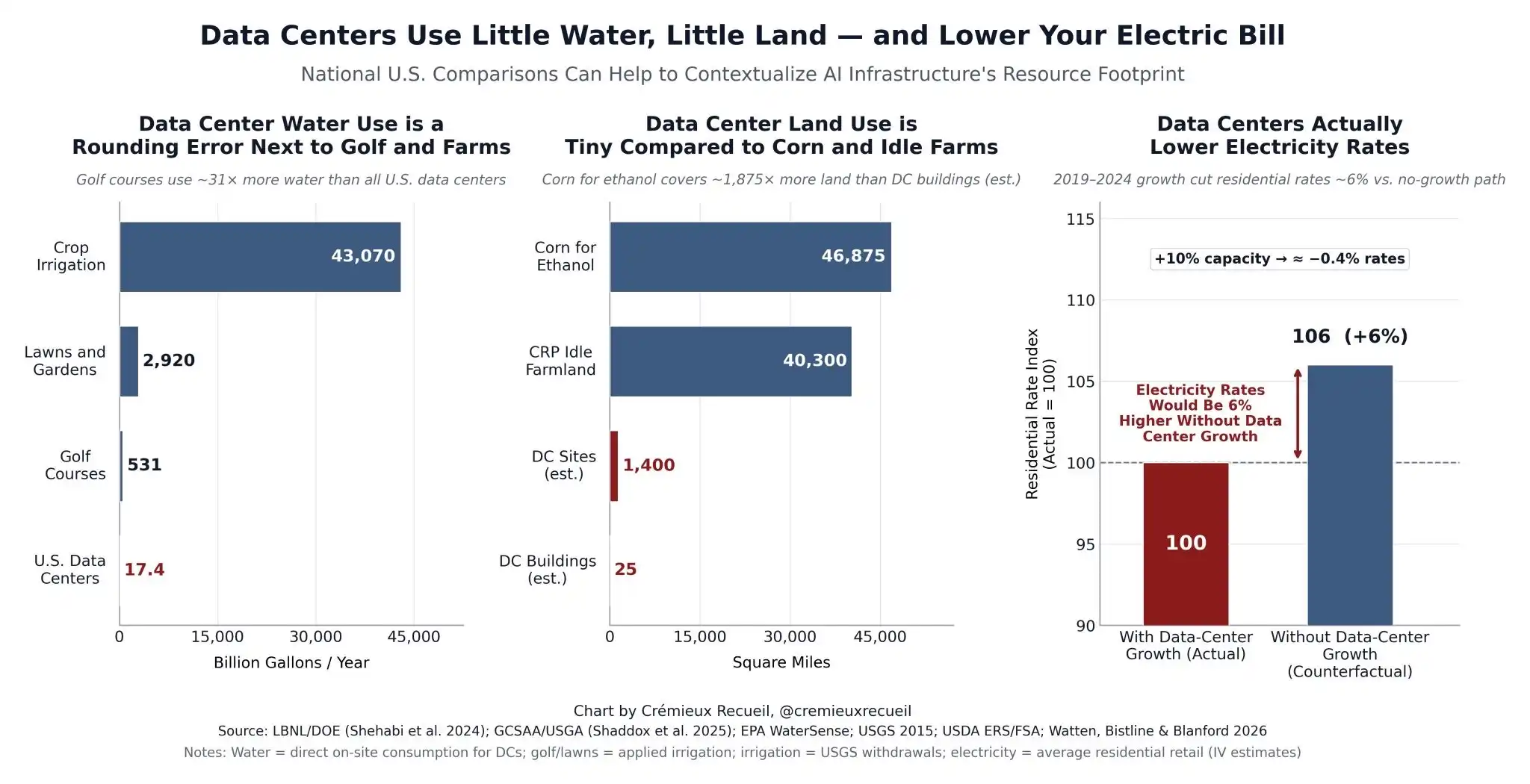
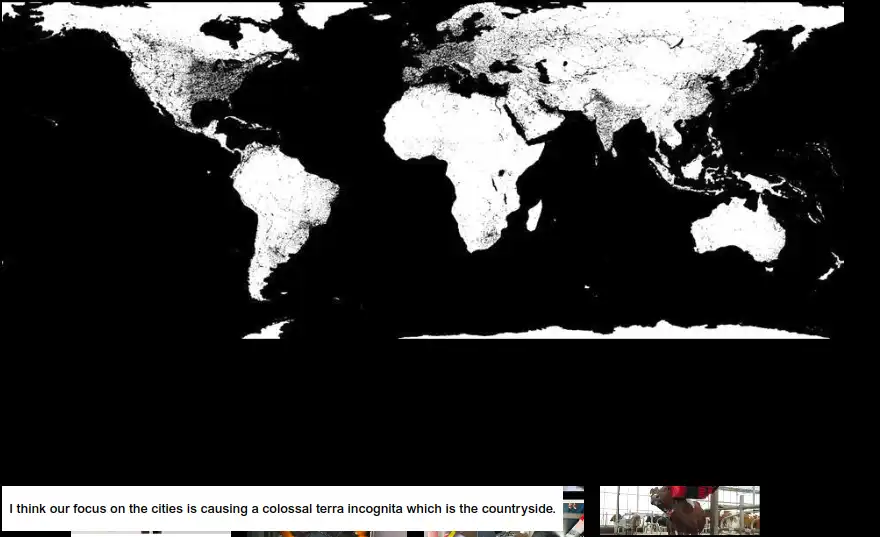
In Koolhaas’s framing, “the countryside” is an intentionally broad term that covers rural, remote, deserted, and wild territories, which the article says make up 98% of the earth’s surface. It is not a fixed, nostalgic backdrop. It is where some of the most radical transformations of the present era are taking place: automation, climate change, migration, genetic experimentation, political radicalization, and the physical infrastructure of the digital economy.
The article adds that this neglect of the countryside is itself historically unusual. For much of history, from Thomas Jefferson to Mao Zedong, the countryside was a central political project. Urban triumphalism reversed that. Urbanization became the dominant statistical image of progress, and the countryside was recast as a service zone for expanding urban centers.
The countryside as a machine zone
The article says city dwellers usually imagine the countryside in one of two ways.
The first is pastoral: slow, authentic, unchanging, suitable for leisure and retreat. Koolhaas counters that image with his own observations of a Swiss village that expanded in scale while losing the life that once defined it. In an Icon article, he described the real condition as an “intermediate state,” a polished surface whose appearance had almost nothing to do with what was happening on the land and inside the buildings. He insisted that the countryside had become the front line of transformation and, in some respects, more volatile than the fastest-moving cities.
The second image is openly hostile. The author connects it to what Wendell Berry called a prejudice against country people and treats it as crucial to understanding the psychology behind the hidden siting of data centers. At its core is a belief that placing these structures around “those people” is acceptable. The coastal elites building AI and promoting it as an engine of progress do not, in this telling, usually look at flyover communities with the same refined attachment they reserve for their own cultural environments.
The article then returns to Koolhaas’s argument that the countryside is increasingly ruled by Cartesian order: gridded, mechanized, optimized for maximum output. In The Cut, he made the causality explicit, according to the article. Because cities have become “massive machines of caprice” centered on fun, pleasure, and interaction rather than need, society has had to install an “ultra-Cartesian” organizational infrastructure across territories once known as the countryside as a counterweight. The rational geometry and disciplined abstraction modernism once promised to the city have moved outward onto the land itself: pivot irrigation circles, greenhouse cities, server farms, logistics hubs, and robotic agriculture. What people once associated with the lightness of rural life has migrated to the city. The countryside got the machine logic instead.
From human scale to post-human infrastructure
The article also points to a 2017 Strelka conversation with Benjamin Bratton in which Koolhaas embraced a sharp reformulation. The old model said the city was where machines lived and the countryside was nature’s garden. That has been reversed. The city is where humans are; the countryside is where machines live. Koolhaas suggested that the line between urban and rural may now be better understood as dense versus non-dense, or human-occupied versus machine-occupied. The article says this is where his use of the term “post-human” for new rural types comes from.
The author sees the same logic in Christopher Nolan’s Interstellar, where the farm is overwhelmed by automated equipment and only a few people remain, mostly to repair the machines that do the actual agricultural work.
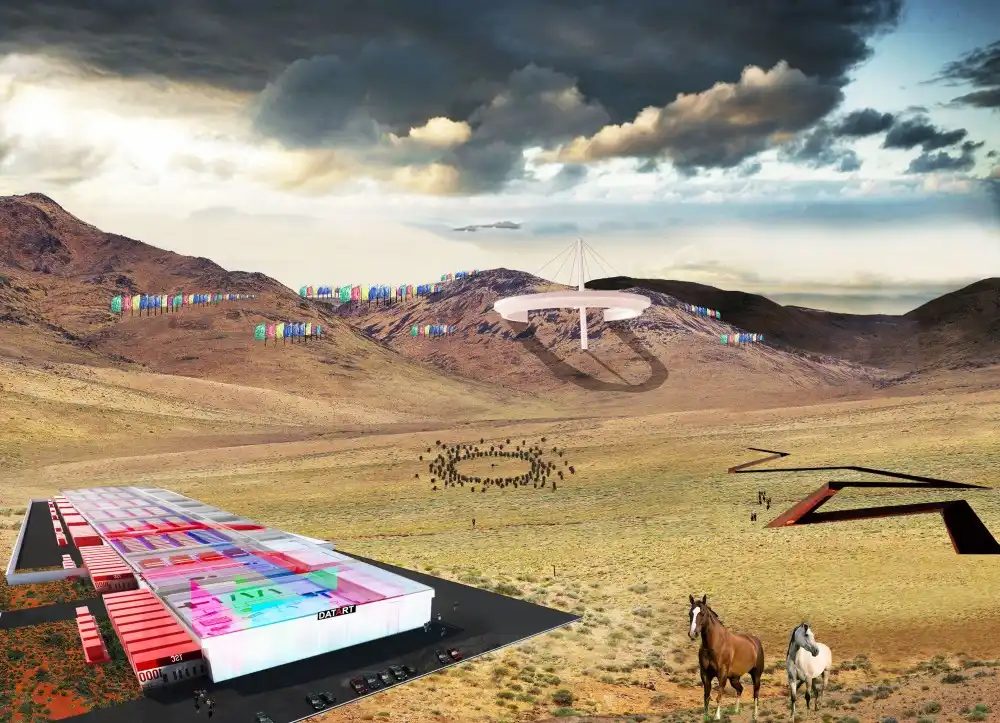
That line of thought leads straight to architecture. The most important buildings of the period, the article argues, are data centers, logistics warehouses, automated greenhouses, and what Koolhaas studied at Nevada’s Tahoe Reno Industrial Center as “box clusters” — Walmart next to Amazon next to Tesla next to Google. These structures are not shaped by celebrated academic discourse. They are designed by anonymous industrial companies outside that discourse, and they operate at a scale that makes human proportion irrelevant.
This is why the author rejects a common idea circulating in tech circles: that the problem would ease if data centers simply looked better. He does not consider that a solution, and he adds that the companies building these vast facilities do not appear to have the political will to pursue such a strategy anyway.
There is also a deeper objection. Better-looking for whom, and for what purpose? These are buildings far beyond human scale. They are not public places meant to be occupied, enjoyed, or even casually used. You cannot rest in their shade. In the article’s view, the dream of the architecturally beautiful data center is just another top-down fantasy applied from a distance to soothe experts who do not really want to engage with the culture of the communities being transformed.
Why data centers now read as AI itself
In the section titled “Understanding the narrative,” the author says creating any new story around data centers will be difficult. His summary of the Koolhaas material is that the industry has to stop treating data centers as the static endpoint of AI development while offloading the physical weight of an urban knowledge project onto the countryside and pointing back to elite centers such as San Francisco.
In the public mind, he writes, data centers have become almost fully synonymous with AI. They are no longer perceived as part of the ordinary infrastructure that lets people send email or upload photos to Instagram. Those older functions fade into the background. New data centers, especially, are perceived as AI, full stop.
Once that equation sets in, the narrative burden follows. Data centers inherit the same political meaning as AI: job loss imposed by elites who insist that the sacrifice is necessary for progress.
The author pauses over that last word. “Progress” carries immense weight in Silicon Valley, which often treats it as the reason for its own existence. But he says Silicon Valley’s idea of progress often does not line up with what ordinary Americans need. For him, this is a familiar pattern: a narrative built around capital and talent escapes restraint and becomes the only narrative in circulation.
If technology is as consequential as insiders believe, he argues, then its story will inevitably be transmitted to everyone else. The problem is that the dominant story now has been built for capital momentum and talent competition, not for winning over the people expected to welcome metropolitan-scale infrastructure into their own backyards.
The rules for a new narrative
The article does not present this section as a policy blueprint. It presents a set of rules instead.
Infrastructure cannot remain anonymous
The author says he sincerely believes anonymous infrastructure defeats its own purpose. If someone burns down a data center, the thing being attacked is the idea of AI, not a specific company with a name and identifiable people behind it. Turning a data center into abstract conceptual space instead of a named corporate presence is, in his view, a mistake.
He contrasts this with Amazon delivery centers. Those facilities have obvious flaws, but they still present a clearer employment and service relationship than data centers do today. Delivery centers are labor-heavy hubs. Data centers are much lighter in human footprint. That makes it more radical, not less, for them to “show themselves” as part of a broader relationship of interdependence.
Reciprocity means treating rural communities as hosts, not sites
The article says a data center should come with explicit reciprocal arrangements for the local community, whether that means allocations for schools and hospitals or even equity for the town itself. The point is that the host community should not be reduced to a parcel of land selected for technical convenience.
Host communities need a new sense of purpose
Those accepting this kind of infrastructure must gain a new civic purpose, the author writes, and perhaps a new kind of pride as well. He ties that directly to reciprocity. “Your children will own part of this,” in his formulation, creates shared interest and a future-facing reason to support the project.
Electricity pricing has to be addressed directly
The author says he does not see how any narrative around data centers can move forward without a serious discussion of energy. Important partnerships are needed between data-center builders and energy providers in order to add real capacity that responds to community concerns.
Architecture still matters, but not in the simple way people say
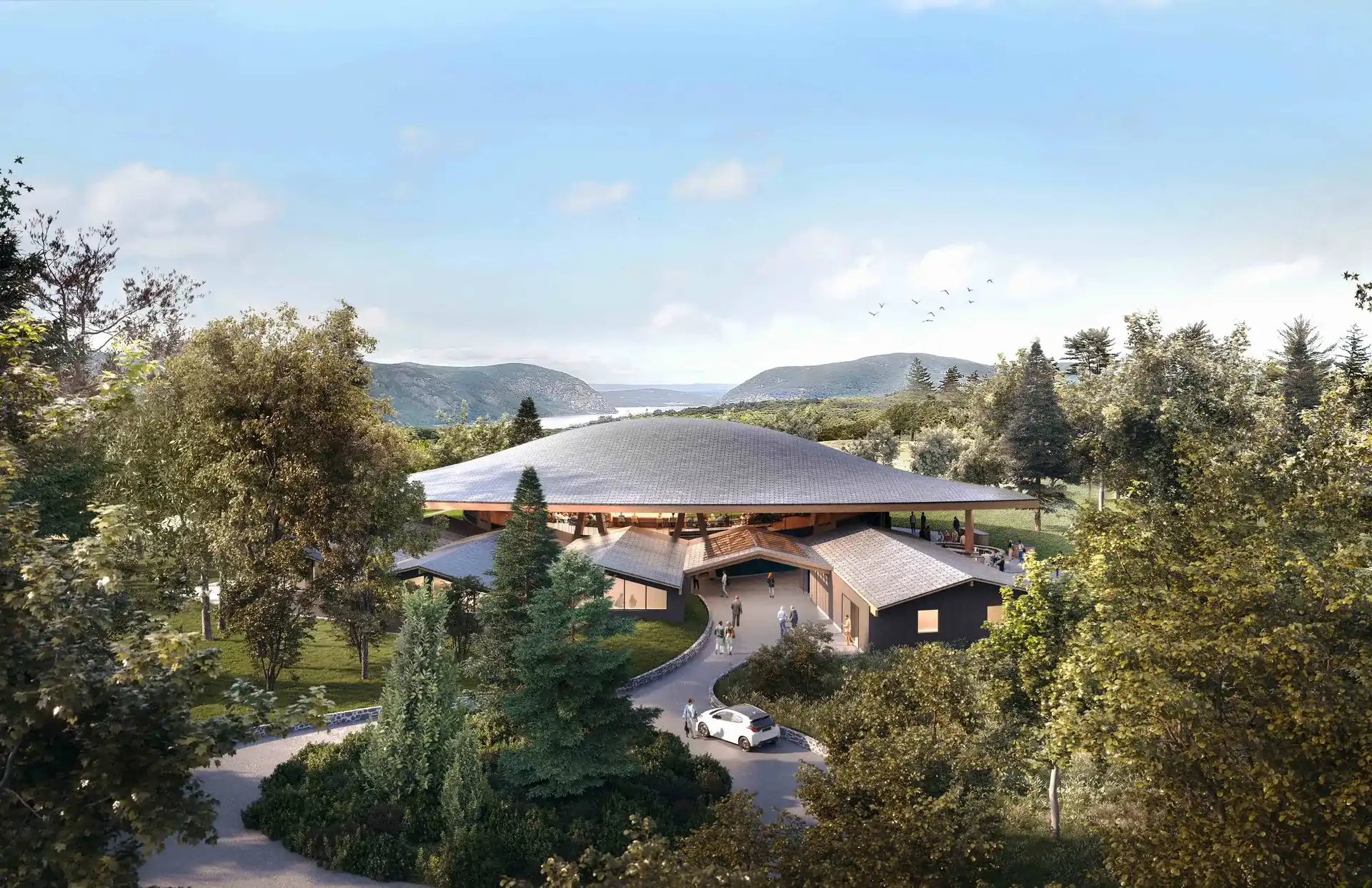
He repeats that making them “beautiful” is not enough. But he also says it cannot be ignored that these facilities are often ugly brown boxes. The first team that truly treats a data center as a thing with presence will create a moment worth studying.
Then he makes a distinction. Presence is not the same as beauty. Presence is authorship. It is the first rule — no anonymous infrastructure — translated into architectural form. The standard brown box, by contrast, is anonymity made visible.
A real narrative must be able to withstand refusal
This is where the article sharpens most. People will say no, the author writes, and the expert response cannot be a reflexive “these hicks are stupid.” Respecting personal and community dignity means respecting refusal.
He is careful not to call these points policy and does not pretend they solve every problem facing an industry that believes deeply in the technology it is building. Still, he says he holds one conviction firmly: a narrative that cannot bear the word “no” is not a narrative at all. Some projects should not be built. Not because AI is inherently bad, and not because every opponent is right, but because a country in which every proposal is approved regardless of what hosts say is operating by force.
If force is the only tool left, the article warns, that would alter how people think progress should happen in the coming decades. Remove the mechanisms of community consent and the belief that only radicalism can answer that force will grow stronger. That is a downward spiral.
A warning for Silicon Valley
The commentary closes by returning to Koolhaas’s central insight: the countryside was never background scenery. The author believes Silicon Valley is entering another decisive moment in which rural America will shape its momentum in ways many in the industry do not expect.
The article says the sector is building the biggest structures of the century thousands of miles from corporate headquarters while refusing to put its own name on them. Quoting his mentor Freddy Anzures, the author writes, “We are chefs afraid to taste our own food.” He adds a second line of his own: the industry is not even willing to sign the menu.
His final point is that the window for setting a new narrative around what he calls the most important technological moment of our lifetimes is open now. It should not be allowed to close simply because the builders believe they know better.
The piece ends with a brief note from the author saying he does not do much editing, apologizing for typos or rough phrasing, and thanking readers for their attention.