

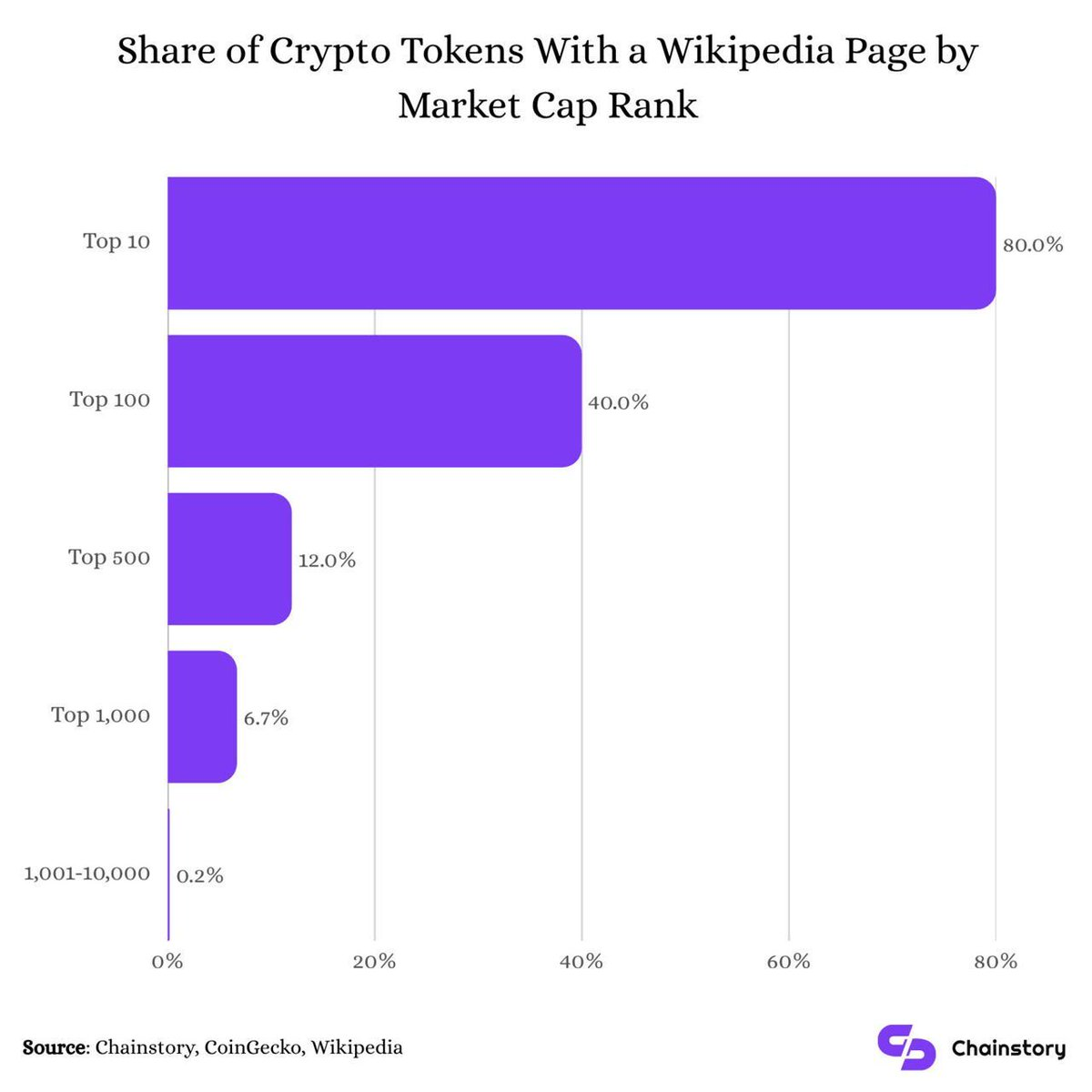
Only 67 of the top 1,000 crypto projects by market capitalization have Wikipedia pages, according to a study from crypto communications firm Chainstory. CoinDesk reported on July 14 that the gap may be shaping how AI tools such as ChatGPT understand and describe the industry as those tools become a larger part of how users gather information.

Just 84 of the top 10,000 tokens were found on Wikipedia
Chainstory said it audited the top 10,000 tokens by CoinGecko market capitalization from June 1 to June 4, 2026, checking each one through the Wikipedia API to see whether an entry existed.
The results showed a steep drop in coverage as market-cap rankings moved lower. Coverage stood at 80% for the top 10 tokens, 40% for the top 100, 12% for the top 500, and 6.7% for the top 1,000. For tokens ranked from 1,001 to 10,000, coverage was just 0.2%. Across the full top 10,000, only 84 tokens had Wikipedia pages.
The smallest project with a page was Firo, which had a market capitalization of $15 million and ranked No. 959.
Even Hyperliquid and Sui are missing
The list of projects without entries includes several large names. Hyperliquid, a perpetual futures platform with a market capitalization of about $15 billion, does not have a Wikipedia page. Sui, a Layer-1 network worth about $5 billion and ranked No. 22, is also absent.
Chainstory also pointed to Monad Labs, valued at $3 billion and led by Paradigm; Berachain, valued at $1.5 billion and co-led by Brevan Howard Digital; and EigenLayer, which received a $100 million investment from a16z. None of them had a Wikipedia entry.
For comparison, Wikipedia includes about 640 fintech companies and more than 7,000 software companies, while the number of companies listed under crypto and bitcoin categories is only about 80.
Wikipedia is ChatGPT’s most-cited single source
Chainstory cited audit data from AI tracking platform Profound showing that around 7.8% of all ChatGPT citation links point to Wikipedia. Reddit ranked next at 1.8%, followed by Forbes at 1.1%. Among the top 10 most-cited domains in ChatGPT responses, Wikipedia accounted for about 47.9%.
Separate analysis from research firm Trakkr, based on 3.29 million citation links, found that as of May 2026, Wikipedia held a 36.1% share among ChatGPT’s top 10 cited sources and a 25.3% share among its top 100 cited sources.
Muck Rack said in research published in May 2026 that Wikipedia was not only the top citation source for ChatGPT, but also the second-largest citation source for Claude, behind PubMed Central, and the fourth-largest for Gemini.
Missing entries can lead to basic factual errors
The report said Wikipedia mainly supplies AI models with concept-level information, but when users ask about specific projects, the presence of a Wikipedia page becomes central to the model’s reasoning process.
Projects with entries tend to receive clearer definitions and descriptions in AI-generated responses. For projects without entries, AI systems have to assemble information from scattered secondary mentions, making mistakes more likely in basic facts such as founders, launch dates, and headquarters locations.
Wikipedia applies a separate notability filter to crypto
Chainstory said the low level of Wikipedia coverage can be traced to the encyclopedia’s review standards for crypto-related topics.
Wikipedia maintains a dedicated notability guideline for cryptocurrencies that requires projects to establish notability through mainstream news sources. The guideline says outlets that mainly cover the crypto industry are not enough to demonstrate notability. It specifically names CoinDesk and Bitcoin Magazine as usually unreliable crypto media. The same logic applies to crypto-native outlets such as Cointelegraph, Decrypt, and The Block.
Sources regarded as reliable by Wikipedia include Reuters, Bloomberg, CNBC, and the Financial Times. Chainstory said those outlets pay little attention to crypto subsectors such as liquid staking and perpetual futures DEXs.
The report described that as a contradiction: the media that actually follows crypto industry developments is not treated as sufficiently reliable within Wikipedia’s system, while the mainstream outlets recognized by Wikipedia do not cover most crypto projects.
Creating a new page is also difficult. New articles must pass volunteer review on standards including notability, verifiability, and source reliability. Even after approval, administrators can still delete a page unilaterally or send it to a seven-day community vote, and the subject of the entry has no right to participate or appeal.