
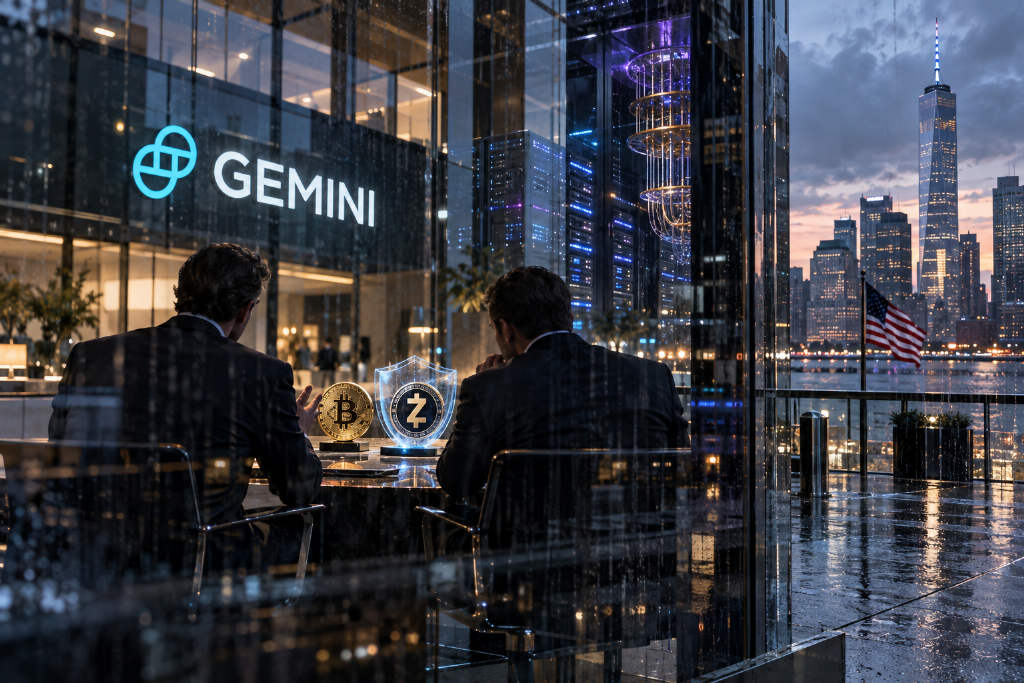
Gemini co-founders Cameron Winklevoss and Tyler Winklevoss said in an interview with Maxime Desalle that their investment thesis has remained consistent from their first Bitcoin purchases in 2012 to their backing of Zcash in 2016: Bitcoin solved decentralized money, but it did not solve financial privacy.
In the interview, the twins described Zcash as 「encrypted Bitcoin」 and 「private Bitcoin」, arguing that it fills the privacy gap left by Bitcoin’s public ledger. They said the rise of artificial intelligence and quantum computing is making that gap more important, not less, and framed Zcash as a crypto-native hedge against both AI-driven surveillance and quantum-related cryptographic risk.
From the 2012 “digital gold” thesis to the privacy gap
Desalle asked the brothers to revisit why they bought Bitcoin as early as 2012. Cameron and Tyler said the original thesis was simple: Bitcoin was digital gold.
They said they compared Bitcoin and gold across nine characteristics and concluded that Bitcoin outperformed on scarcity, portability and divisibility. Gold is scarce, they said, but its total supply is not fixed because more can still be mined each year. Bitcoin, by contrast, has a hard cap of 21 million coins and cannot be inflated even if demand rises.
Portability was another point in Bitcoin’s favor. Gold is physically heavy and difficult to move in size, while Bitcoin is native to the internet. Divisibility also worked in Bitcoin’s favor, according to the twins.
Still, they said Bitcoin did not beat gold on every dimension. The category where it lost was privacy. If someone holds a gold bar, they said, nobody necessarily knows. Bitcoin is different because transactions are recorded on a public ledger. The brothers said they did not give that issue enough weight at the time, and that it later became the starting point for their Zcash thesis.
They also pushed back on the long-running claim that Bitcoin is a tool for crime. Because the ledger is public, auditable and permanent, they said, Bitcoin is actually one of the least suitable places to do bad things.
From a technical standpoint, they described Bitcoin as the first money built for the internet. In their telling, Bitcoin is both a protocol and an asset, unlike bank wires or ACH, and that was the moment they realized it was “the internet of money.” They also called money “the largest social network in history.”
Why they led the Zcash seed round in 2016
When the discussion turned to the 2016 Zcash seed round, the twins said the thesis then was the same as it is now: financial privacy matters.
They made a point that they said runs against common assumptions. In their view, Bitcoin offers less privacy than traditional finance. A bank wire, they said, is generally visible only to the bank and the parties involved, while cash is even more private. Bitcoin transactions, by contrast, are visible on-chain. That, they said, is the core problem Zcash is trying to solve.
The brothers argued that privacy is a requirement for a free and open society. They said that if zero-knowledge proofs had been mature enough at the time, Satoshi Nakamoto would have included them in Bitcoin’s original protocol. According to them, Satoshi did discuss zero-knowledge proofs, but the technology was too new and too large to fit into blocks at the time.
They also drew a distinction between Bitcoin and cash. Bitcoin’s white paper describes “electronic cash,” they noted, but they argued that Bitcoin is not really cash in the strict sense because cash does not leave a trail. Cash is centralized but private; Bitcoin is decentralized but public. Zcash, in their view, completes that arc by combining decentralization with privacy. That, they said, is closer to true electronic cash and to the cypherpunk tradition.
Separating money from the state, in their view, requires privacy
The twins said they often talk about separating money from the state because governments have long used money as a tool to influence people, including through capital controls and hyperinflation.
But they said decentralization alone is not enough. If money is decentralized while governments can still monitor every transaction through broad surveillance, then the separation is only half complete. In the interview, they compared that outcome to moving into a glass house.
They defined privacy as the boundary where the state stops and the individual begins. Personal freedom and self-sovereignty, they said, depend on that line. They linked the idea to property rights and to the Fourth Amendment, which protects against unreasonable searches and seizures.
One of their clearest lines in the interview was: 「Privacy is where the state stops and you begin. Your individual freedom, your self-sovereignty, those boundaries matter.」
They also said: 「Encryption is the peaceful, non-violent version of the Second Amendment.」 In their view, privacy, self-sovereignty, property rights and the boundary around a person’s money are all central values, while government power tends to expand in only one direction.
AI and quantum computing as accelerants for Zcash
Asked whether AI and quantum computing changed their conviction in Zcash, the brothers said they see both as accelerants.
AI, they said, will expose the openness of non-private public blockchains even more clearly by making chain analysis tools more powerful. As models improve, transaction links, fund flows and behavioral patterns on public ledgers become easier to identify and connect.
On quantum computing, they said progress in the field would make Bitcoin less secure because Bitcoin does not resist Shor’s algorithm. They described Shor’s algorithm as a quantum method that can speed up attacks on RSA and elliptic-curve ECDSA signatures, which are part of the cryptographic foundation used by Bitcoin.
Zcash, they argued, is different. In their words, it is resistant to Shor because “you can’t crack what you can’t see.” They specifically referred to shielded pools and said that if users are in shielded pools, including the pools after the Ironwood upgrade, stronger AI still cannot monitor that data.
Their conclusion was blunt: 「If you’re bullish on AI, you have to be bullish on Zcash, even if you don’t realize it yet. Because the faster AI accelerates, the faster your financial privacy deteriorates, and that is exactly the problem Zcash solves.」
They added that they do not view Zcash as a trade. Instead, they see it as the other side of the AI coin. The steeper AI rises, they said, the scarcer privacy becomes. If investors want an AI hedge or a quantum hedge inside crypto, they said, that hedge is Zcash.
Bitcoin still has a role, but not the same one
Even while making the case for Zcash, the twins did not argue that Bitcoin becomes irrelevant. They said public verifiability and auditability can be a feature rather than a flaw in some settings.
They gave the example of institutions that may want to publish a Bitcoin address and let others verify balances directly on-chain instead of relying on self-reporting. Central banks or other institutions, they said, may prefer that kind of transparency.
They also said Bitcoin is unlikely to disappear. It started the broader crypto revolution and now has a track record approaching two decades. For many people, they said, access to a fixed-supply store of value is already enough.
As for how the two assets might be used, the brothers said that if someone truly wants to transact and use crypto as cash, the likely path would be to swap Bitcoin into Zcash, complete the transaction, and then swap back. Bitcoin’s story, they said, is still just beginning for many people, while Zcash remains “very, very early.”
A valuation framework anchored to Bitcoin
On valuation, the twins proposed a direct benchmark: use Bitcoin’s market capitalization as the anchor.
They said ZEC’s market capitalization is about $25 billion, roughly 2% of Bitcoin’s. From there, the question becomes what percentage of Bitcoin’s market cap privacy should be worth.
The brothers said they remain strongly positive on Bitcoin and do not think it is going away. But they argued that privacy should be worth more than 2%. If privacy were worth 10% of Bitcoin’s market cap, they said, ZEC would have 5x upside, its price would move above $5,000, and there would be a clear path to $10,000.
They said this framework makes sense because many people do not realize that Zcash is a fork of Bitcoin. In their words, it is “private Bitcoin” and “encrypted Bitcoin,” not a system built from scratch. It stands on Bitcoin’s shoulders.
They pointed out that both Bitcoin and Zcash have a 21 million hard cap and both follow a four-year halving cycle. Anyone who understands Bitcoin, they said, is already part of the way toward understanding Zcash. They added that the project did not always emphasize the fork relationship strongly enough, even though it is useful for valuation.
The gold comparison also remained part of their framework. Gold may be scarce on Earth, they said, but not in the universe, where asteroids could contain trillions of dollars worth of it. Bitcoin and ZEC, by contrast, remain capped at 21 million on any planet. They said they made this argument years ago and were told it sounded too science-fiction-like, but that the idea now sounds less far-fetched as people discuss things like space data centers.
Why they think Zcash cycles may track AI, not halvings
Looking ahead five or ten years, the twins said Zcash may not follow the same kind of four-year cycle that shaped Bitcoin’s history.
They pointed to the Cyprus banking crisis as one of Bitcoin’s first major moments. Depositors with more than €100,000 were “bailed in,” they said, and money was taken directly. Even people who did not own Bitcoin at the time could see why a decentralized currency outside government control mattered.
Zcash, they said, will likely have a similar moment, one event that makes the importance of financial privacy unmistakable. But they are not sure that moment will line up with halvings. In their view, Zcash is more likely to be tightly linked to progress in AI than to block reward reductions every four years.
They said breakthroughs in AI models may matter more than halvings. In 2012, 2013 and 2014, they noted, transformers had not yet been invented, and the AI and quantum catalysts they are talking about today did not exist. For that reason, they said, it is hard to map Bitcoin’s old chart directly onto Zcash.
The brothers also said the market is in “uncharted territory.” Over the next five years, they said, frontier labs are set to spend on the order of $1 trillion on data centers, more than commercial internet fiber buildouts, more than railroads, and more than the telecom revolution. If that spending becomes a catalyst for Zcash, they said, it would be a very large one.
Cypherpunk: from buying ZEC to backing privacy technology
The interview also covered Cypherpunk, the company the twins said they launched more than a year ago. They said the goal was to give people a way to gain exposure to Zcash.
Gemini listed ZEC in 2018, they said, and they believe it was the first regulated exchange to do so. They said they have long been proud of that decision and have continued to support the asset. At the same time, they noted that many investors prefer access through stock-like wrappers, which is why they first bought large amounts of ZEC and then expanded into mining.
They stressed that Cypherpunk is not simply a vehicle that holds ZEC. The company’s mission, they said, is to support the cypherpunk ethos and invest in privacy technology. That starts with spot ZEC and ZEC mining, but in their words, any technology that advances privacy is within scope.
They tied that mission to the First, Second and Fourth Amendments, saying those protections are part of the American values they want to defend.
Why they expect a privacy war
Asked whether a new conflict could emerge around privacy, including in the context of Flock cameras, the twins said yes. The question, they said, is not whether such a fight will happen, but when.
Even so, they described Zcash as an unstoppable private currency. They said they made a similar argument about Bitcoin years ago: decentralized money is very hard to stop unless the internet itself is shut down. In their view, Zcash is even harder to suppress than Bitcoin.
They said there is already a “quiet war” under way. In their telling, many people misunderstand what Flock cameras do and confuse them with speed cameras. The difference, they said, is that speed cameras have a trigger condition, while Flock-style systems operate continuously, collecting information not only on license plates but also on vehicles, people and the daily movements of law-abiding citizens. That data then flows into centralized databases and can be stitched together with AI tools.
Centralized data, they argued, is a natural attack target, and governments stockpiling movement data on entire populations will not end well.
For a historical parallel, they pointed to the early internet, when the U.S. government treated encryption as munitions. In their account, that approach eventually reversed once policymakers recognized that a thriving internet required encryption, leading to a world where government websites were required to use HTTPS.
That is the analogy they apply to money. 「Bitcoin is HTTP. It’s Web 1.0,」 they said. 「Zcash is HTTPS. It’s encrypted SSL and TLS.」 Their expectation is that governments may resist first, then realize they cannot shut Zcash down without shutting down the internet, and eventually accept it, perhaps even encouraging citizens to use encryption for protection.
They also said France saw about 40 wrench attacks this year, and argued that a public ledger can turn every coin holder into a walking target. Publicly visible wealth and centralized surveillance databases, they said, are both bad outcomes for citizens.
On whether private decentralized money can be banned at the technical level, they said it would be very difficult. They cited the old example of people printing PGP keys on paper and arguing that the keys were protected speech, using that episode to illustrate how hard it is to stop decentralized privacy tools.
Their answer to “I have nothing to hide”
Near the end of the interview, the twins addressed one of the most common objections to privacy: “I have nothing to hide.”
They responded first with Satoshi Nakamoto. If privacy does not matter, they asked, why did Satoshi not sign the Bitcoin white paper with a real name? In their view, an idea like Bitcoin was inherently dangerous, and Satoshi understood what public identification could mean for personal safety. They also noted that the Bitcoin mined by Satoshi in the early days has still not moved, and said moving it could itself create danger.
They then reached further back in history. Copernicus, they said, advanced a dangerous idea for his time when he argued that the Earth revolved around the sun. More recently, they said, many of Albert Einstein’s most challenging ideas were written while he worked at the Bern patent office rather than inside a university system. Because he was outside that structure, they argued, he had more room to think freely and less exposure to political retaliation.
Privacy, in their view, does not only benefit the person who has it. Even if someone feels they do not need privacy, they may still want a person like Satoshi to have it, because that person could be building something that benefits everyone else. The brothers said privacy nourishes intellectual curiosity, frontier discovery and ideas that challenge the status quo.
They also pointed to self-censorship in academia, saying many professors and intellectuals now have to suppress their real beliefs because saying the wrong thing can get them canceled. That is why, they argued, privacy should at least be the default, while disclosure should be a choice.
They closed that line of thought by saying privacy changes the quality of debate itself. If all anyone has is the code, as in the case of Satoshi, then they cannot attack the person behind the idea and must deal with the idea on its own terms. In their view, privacy forces discussion back toward facts, arguments and value.
Across the full interview, the brothers returned to one central claim: Bitcoin delivered decentralization, Zcash is trying to deliver privacy, and advances in AI and quantum computing will make that second layer more valuable over time.



