


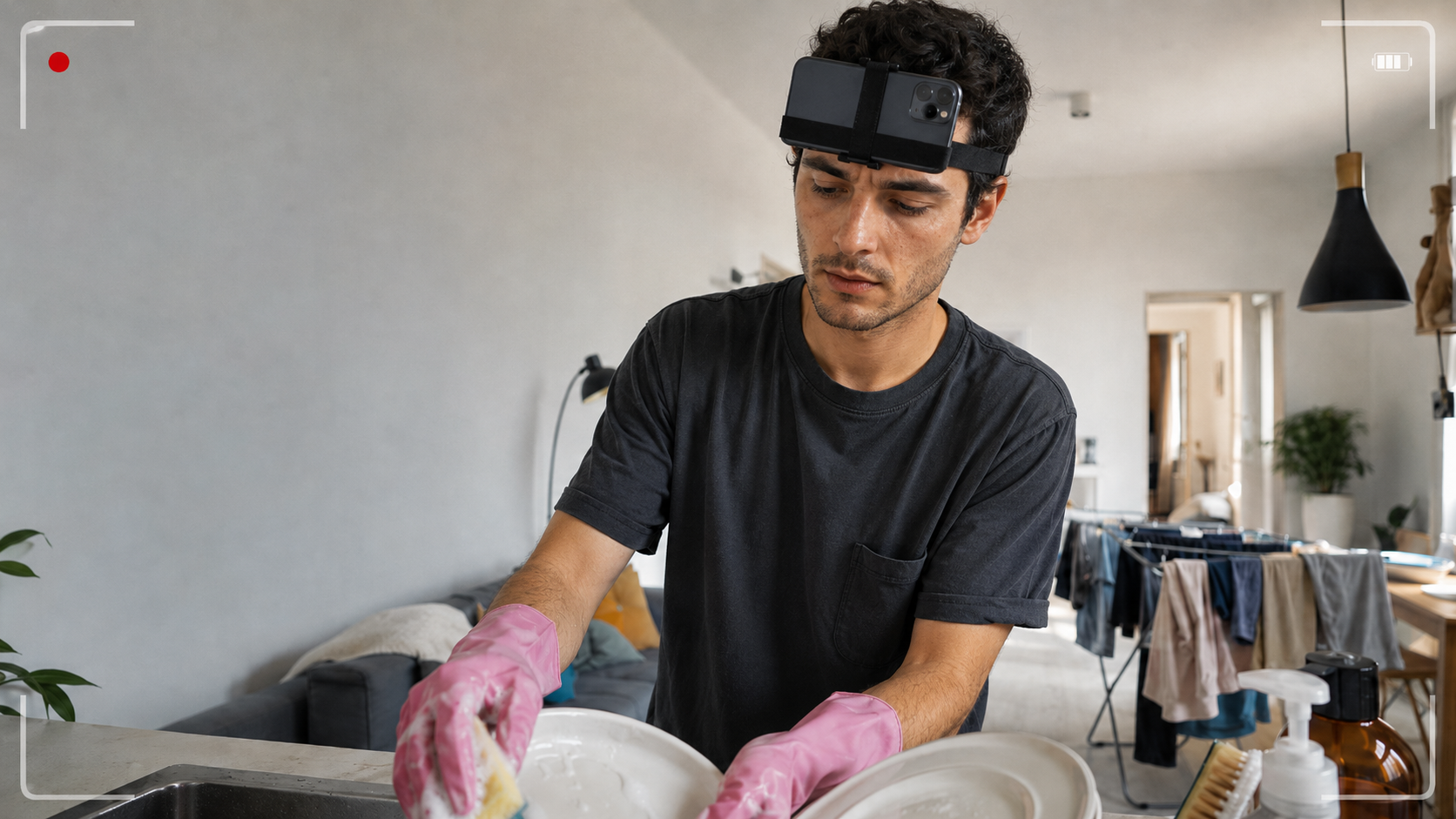
Wired reporter Reece Rogers spent a week with an iPhone strapped to his forehead, filming household chores from a first-person perspective and uploading the clips to Luel, a data collection platform that supplies footage for humanoid robot training. The pay worked out to about $6.6 per hour, below the U.S. federal minimum wage of $7.25.
The tasks were ordinary: slicing cucumbers, pouring drinks, loading dishes into a dishwasher. On Luel, those motions become training material for AI companies building humanoid robots. Rogers wrote that he understood the contradiction. The data he was producing could help train systems that may one day replace some forms of human labor.
Strict recording rules shaped every movement
According to Rogers, Luel set detailed technical requirements for submissions. The camera had to be worn on the head, not handheld. The footage needed a level wide-angle view and at least 1080p resolution. One rule mattered most: both hands had to remain visible for more than 95% of the video.
His first five-minute clip was rejected because his hands were not prominent enough in frame. After that, the process turned repetitive. He adjusted his setup and repeated the same actions again and again, including tying shoelaces 20 times. Salad prep, dishwashing, cucumber slicing — every task had to keep the hands centered and clearly visible.
In the industry, this kind of footage is treated as first-person data. With the camera placed at eye level, robot models can learn how hands approach objects, how fingers apply force, and where visual attention moves after one action ends and the next begins. Text descriptions cannot capture that sequence. Continuous video can.
Cheap labor at the bottom of a growing data market
Luel paid about $1 to $2 per clip, which translated to roughly $6.6 per hour. Rogers noted that similar footage can command better rates elsewhere. He cited DoorDash as paying around $20 per hour for comparable videos, more than three times Luel’s rate.
The gap points to differences in how urgently buyers want the data. Luel is not collecting the footage for its own direct use. It operates as an intermediary, gathering and packaging clips before reselling them to robotics and AI companies. The people recording the videos receive the lowest layer of compensation, while end buyers may pay licensing fees on a very different scale.
This kind of work is scattered across multiple platforms, with no common pricing standard and no labor protection framework attached to it. Rogers’ payment fell below the federal minimum wage, but the arrangement was not illegal because the money was classified as income from selling videos, not wages.