

The 2026 World Cup gave prediction markets a major stress test, and the numbers compiled by Odaily show a sharp pattern: trading volume and fee income surged during the tournament, then cooled once the matches ended.
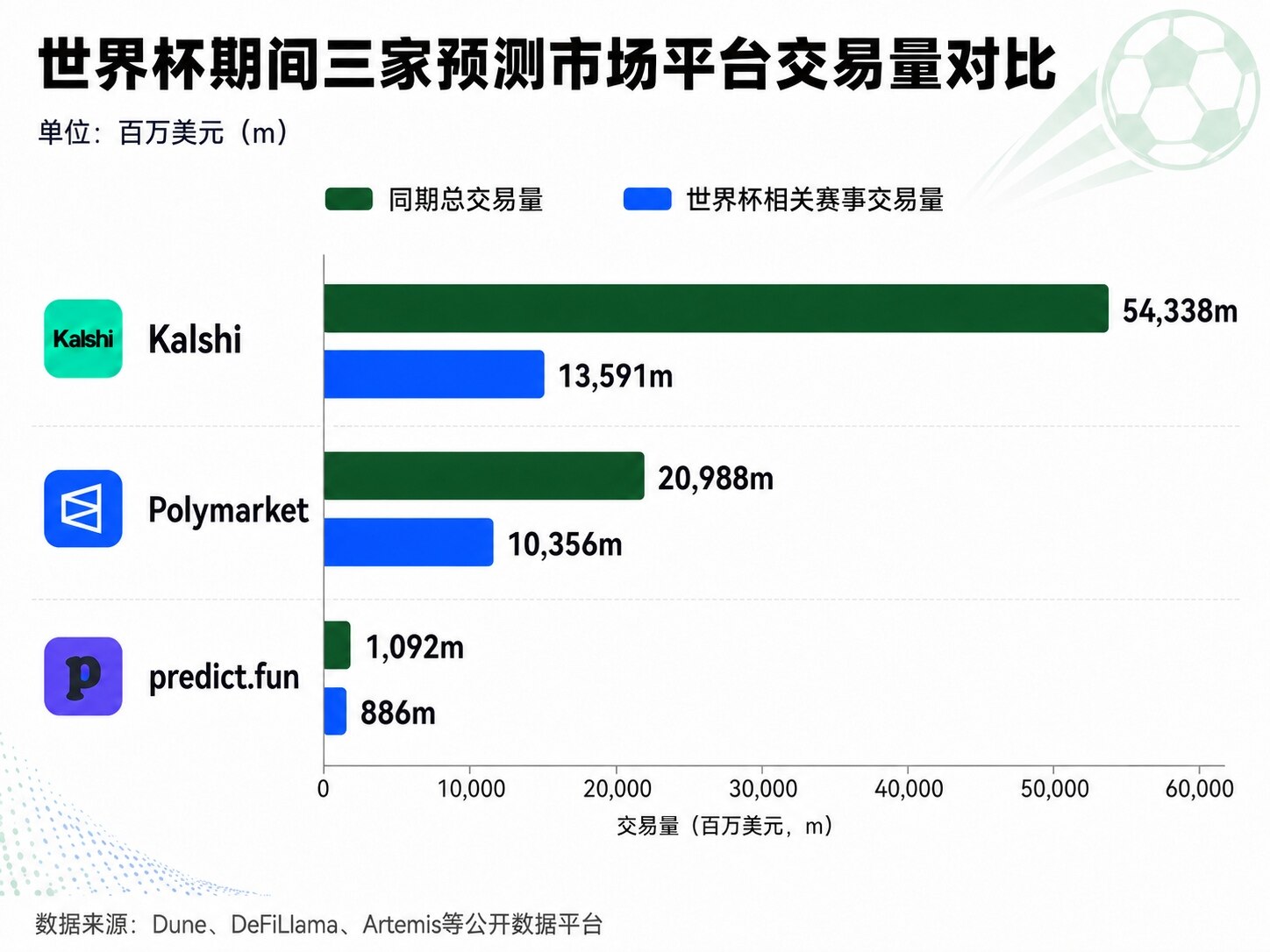
Odaily reviewed three platforms — Kalshi, Polymarket and predict.fun — across three measures: trading volume, fee revenue and total value locked, or TVL.
World Cup volume pushed the sector higher, with Kalshi still in front
Across the tournament period, Kalshi remained the largest platform by total volume. Its total trading volume reached $54.338 billion, while Polymarket posted $20.988 billion, leaving Kalshi at roughly 2.6 times Polymarket’s level. Looking only at World Cup-related markets, the gap narrowed quickly: Kalshi recorded $13.591 billion and Polymarket reached $10.356 billion, which put Kalshi at only about 1.3 times Polymarket. Odaily noted that all volume figures in the report are nominal trading volume.
Odaily said Polymarket’s signature markets had previously been concentrated in the U.S. election, crypto and geopolitical events. The World Cup raised the weight of sports markets on the platform and moved that category from a supplementary offering into a core trading segment. Kalshi, by contrast, benefited from a more diversified trading structure. Beyond the World Cup, other sports events, politics and macro markets continued to contribute volume, giving the platform more areas to absorb activity after the tournament ended.
Predict.fun posted $1.092 billion in total platform trading volume during the World Cup, including $886 million from World Cup-related markets. Its scale still trailed both Kalshi and Polymarket by a wide margin, but for a platform that has been live for just over half a year, nearly $900 million in World Cup-driven volume made it one of the more prominent new beneficiaries of this tournament cycle.
Average daily volume jumped during the tournament, then dropped back
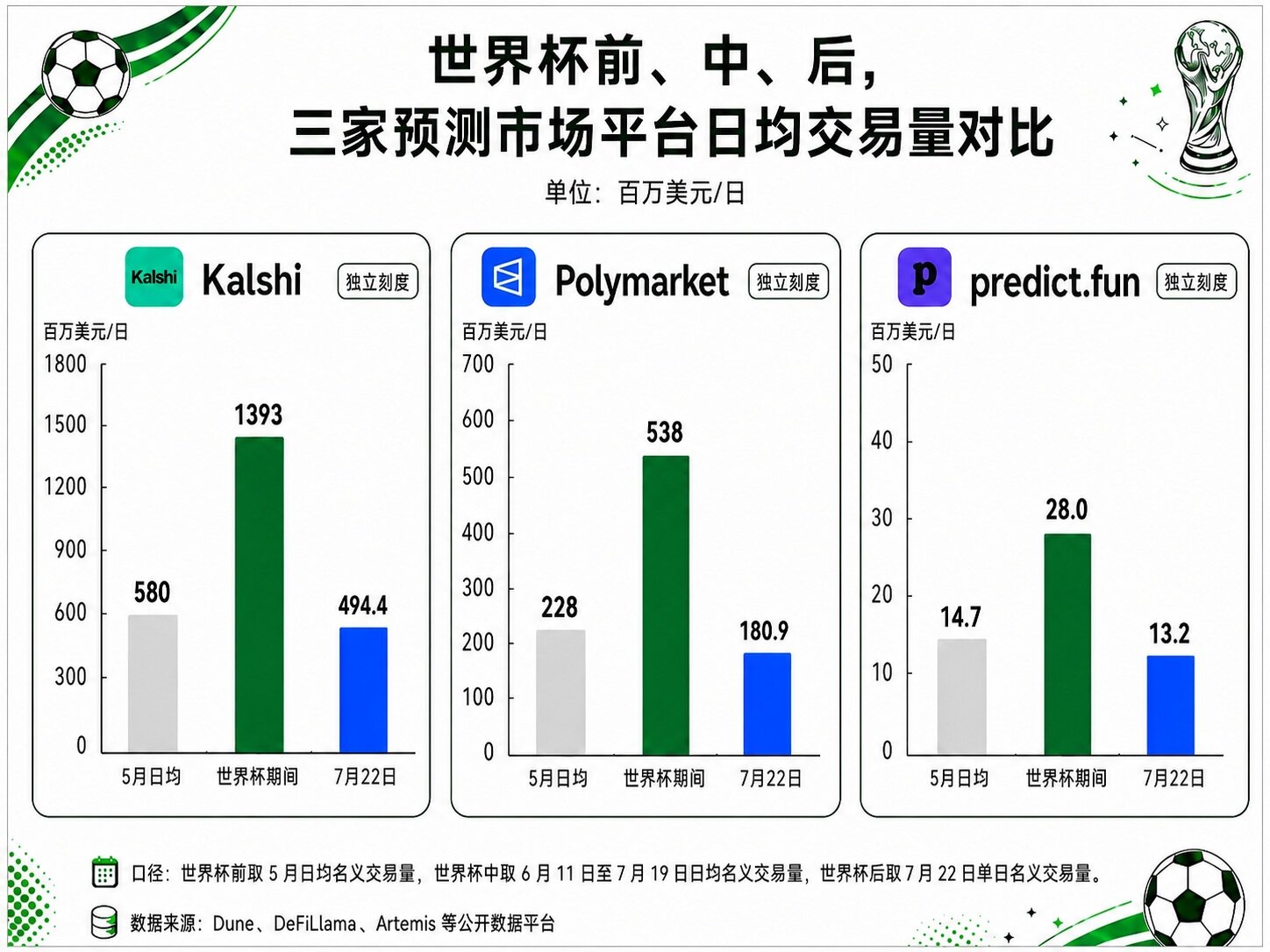
Kalshi showed the strongest lift in average daily volume. In May, its average daily nominal trading volume stood at $580 million. During the World Cup, that figure rose to $1.393 billion, an increase of about 140%. By July 22, volume had fallen back to $494.4 million, below its May average.
Polymarket saw a similar move. Its average daily nominal trading volume was $228 million in May, then climbed to $538 million during the tournament, up about 136%. On July 22, its volume dropped to $180.9 million, also below the pre-tournament level.
Predict.fun started from a smaller base, but the World Cup effect was still clear. Its average daily nominal trading volume was $14.7 million in May and rose to $28 million during the tournament, close to doubling. By July 22, volume had slipped to $13.2 million, roughly back to where it was before the tournament.
Using only the post-World Cup single-day comparison, Odaily said the increase looked more like a concentrated release of event-driven traffic than a lasting step-up in routine platform activity. Whether volumes can rise again will depend on whether other sports events and non-sports markets can capture the trading demand left behind after the World Cup.
Fee revenue climbed with the schedule, and Kalshi topped $100 million in a week
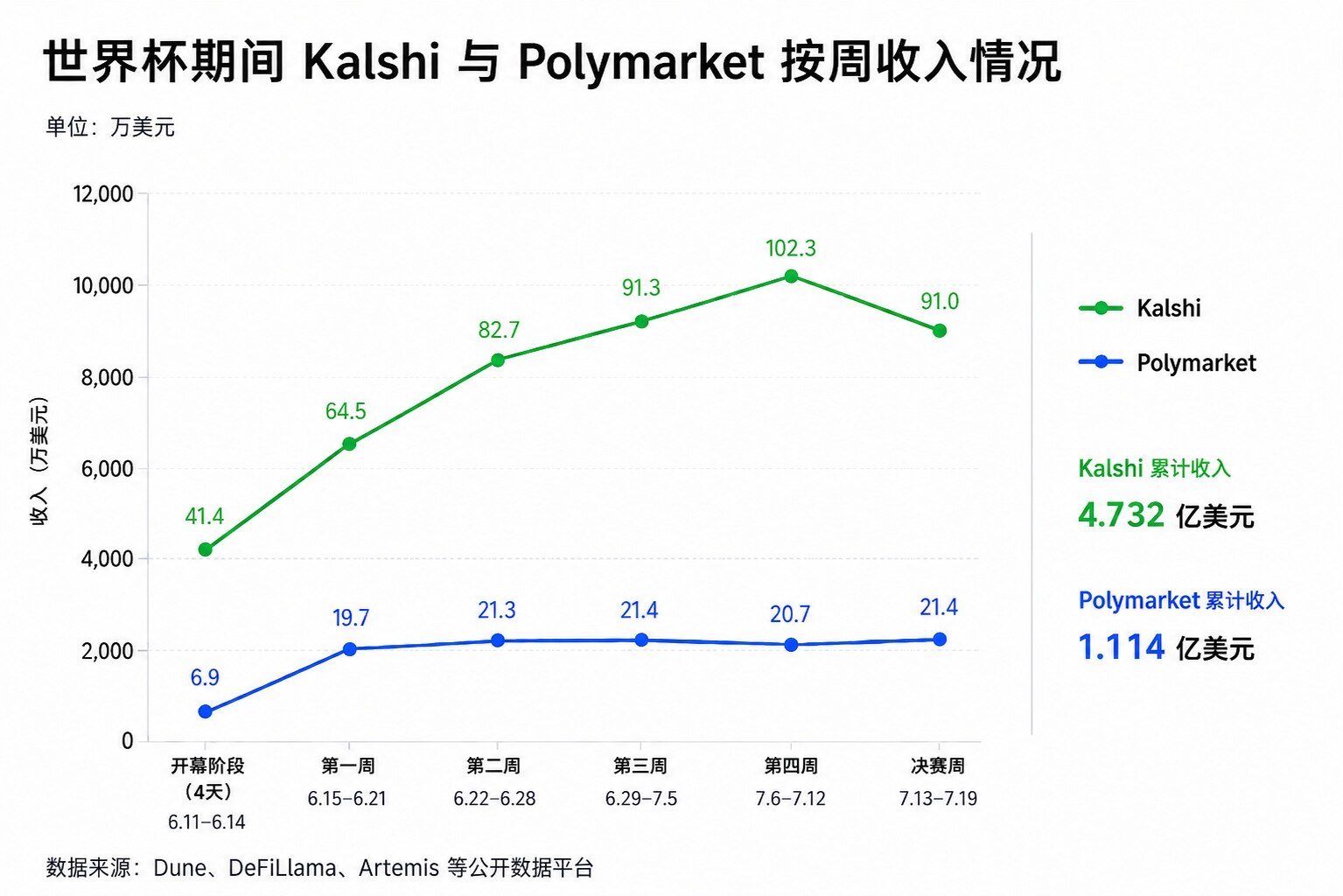
Kalshi’s fee revenue showed a strong upward slope through most of the tournament. It generated $41.40 million during the four-day opening phase, then $64.50 million in the first week, $82.70 million in the second week, $91.30 million in the third week and $102.3 million in the fourth week, the highest weekly figure of the World Cup period. In finals week, that number edged down to $91.00 million. Kalshi’s cumulative fee revenue for the full tournament reached $473.2 million.
Odaily’s reading was that the World Cup did more than bring early attention to Kalshi. It kept trading interest elevated into the back half of the tournament. A weekly fee figure above $100 million also shows that Kalshi converted the surge in traffic into platform revenue, not just headline volume.
Polymarket’s fee pattern was steadier. It generated $6.90 million during the opening four days, then $19.70 million in the first week. In the second, third, fourth and finals weeks, the platform brought in $21.30 million, $21.40 million, $20.70 million and $21.40 million, respectively. Its cumulative fee revenue for the tournament reached $111.4 million.
From the first week onward, Polymarket’s weekly fee income stayed around $20 million. The World Cup lifted its fee base to a higher level, but the platform did not show the kind of late-stage acceleration that Kalshi did as the tournament progressed.
Predict.fun generated $3.4813 million in fees across six settlement weeks
Predict.fun reports fee income by settlement week, with each cycle switching at 10 p.m. every Tuesday. Because of that, its accounting does not fully line up with the World Cup’s natural schedule from June 11 to July 19. The first settlement week ran from June 9 to June 16 and included two days of pre-tournament data. The last settlement week ran from July 14 to July 21 and also included two days after the tournament.
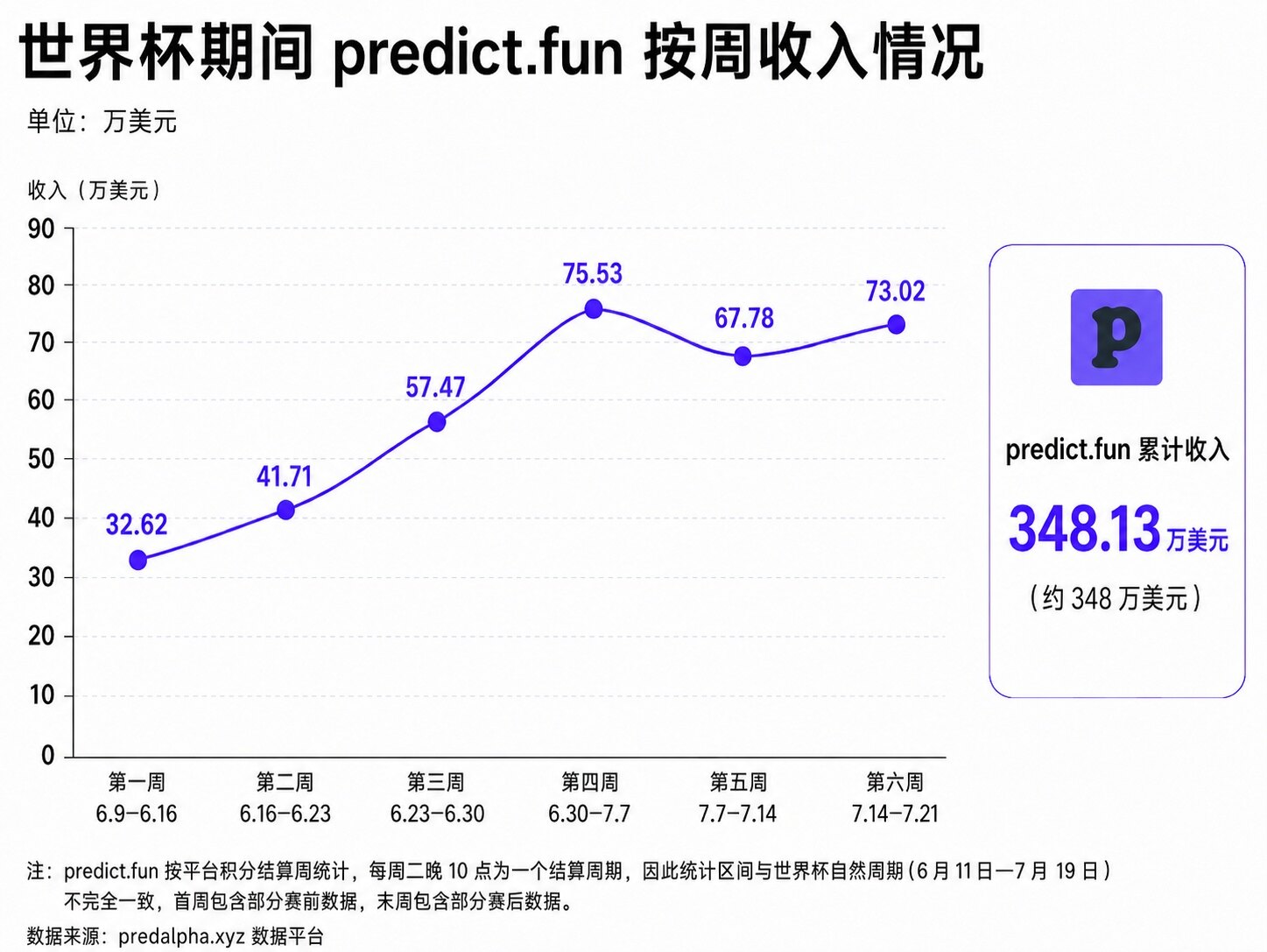
Its first settlement week produced $326,200 in fee revenue. That number then rose for three straight weeks and reached $755,300 during June 30 to July 7, the highest weekly reading in the World Cup cycle. The following two weeks came in at $677,800 and $730,200. Neither set a new high, but both were still well above the early-tournament level. Across the six settlement weeks tied to the World Cup period, predict.fun generated $3.4813 million in cumulative fee revenue.
In the settlement week before the World Cup, from June 2 to June 9, predict.fun’s fee revenue was only $159,400. Once the tournament cycle began, first-week revenue rose to $326,200, an increase of about 105%, and most subsequent settlement weeks moved above $500,000. Even with the first and last periods each containing some pre- or post-tournament data, Odaily said the World Cup’s effect on predict.fun’s fee income was still significant.
After the tournament, fee income fell across all three platforms
Kalshi’s average daily fee revenue during the World Cup stood at $12.13 million. On July 22, that fell to $11.00 million, a decline of 9.3%. Among the three platforms, Kalshi saw the smallest post-tournament drop. Its fee income retreated from the event-period highs, but it remained close to the tournament daily average.
Polymarket’s decline was steeper. Its average daily fee revenue during the World Cup was $2.86 million, but by July 22 that had dropped to $1.70 million, a decline of 40.5%. Odaily said the revenue gain brought by the World Cup was relatively concentrated and faded quickly after the event ended.
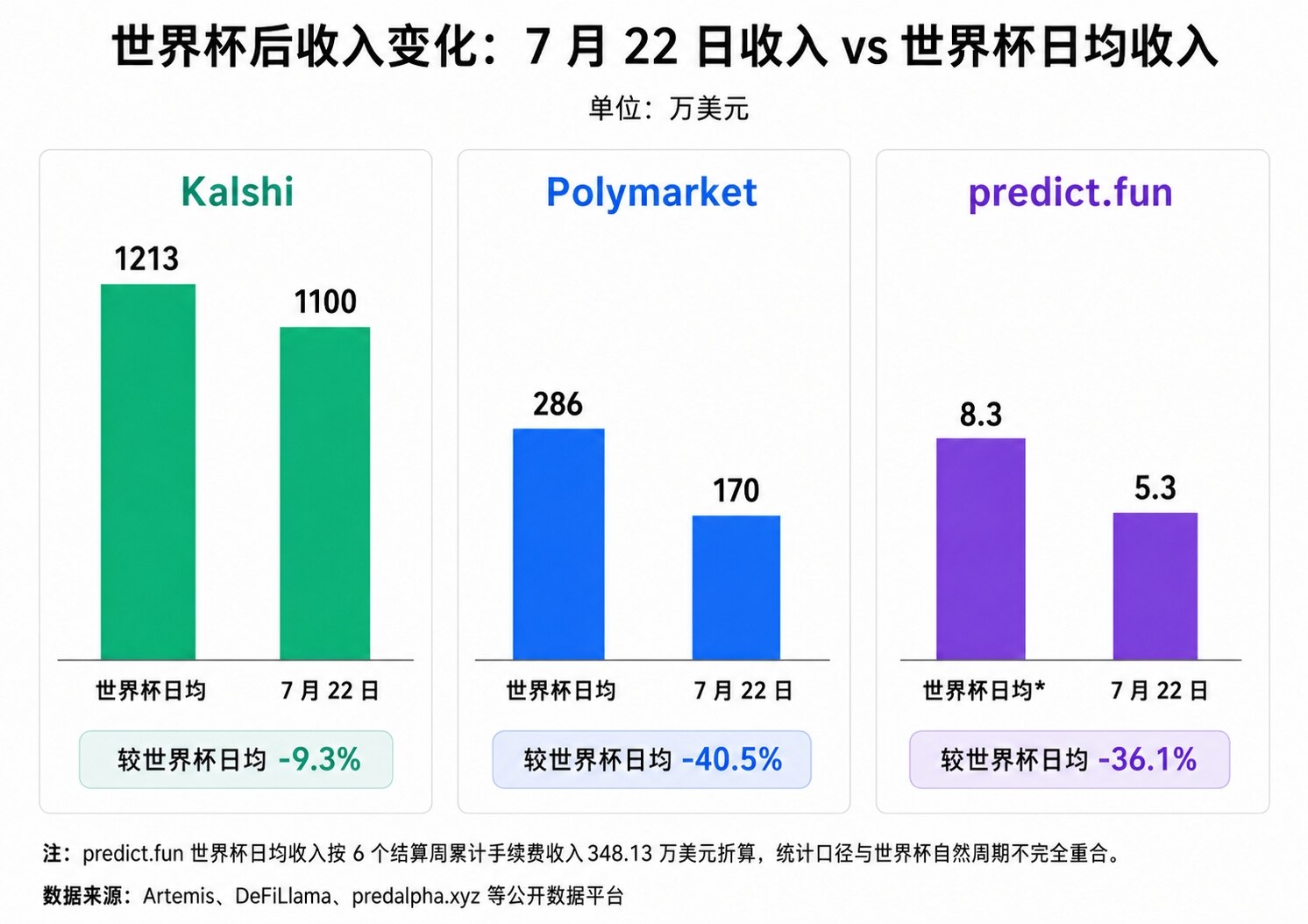
Predict.fun posted about $83,000 in average daily fee revenue during the World Cup, then fell to $53,000 on July 22, down 36.1%. Its accounting method differs somewhat from the other two platforms, but the post-tournament direction was still clear: the World Cup had materially lifted predict.fun’s fee income, and that effect also weakened quickly once the tournament was over.
TVL diverged: Polymarket stayed flat during the event, predict.fun drew funds later
Odaily did not include Kalshi in the TVL comparison because on-chain TVL data for Kalshi is not available.
Polymarket’s TVL did not rise in tandem with trading volume during the World Cup. At the beginning of May, the platform’s TVL was about $410 million. For most of the following period, it stayed in a range of $440 million to $480 million. After the World Cup began, TVL continued to fluctuate around that zone. There were brief spikes in late June and early July, but no sustained upward trend formed.
After mid-July, Polymarket’s TVL began to decline more clearly. By the end of the World Cup, it had fallen to around $400 million, and it has since moved down further to about $340 million. In other words, trading activity expanded sharply during the tournament, but the capital retained on the platform kept shrinking after the event, which suggests the World Cup created more high-frequency trading demand than long-term retained liquidity.
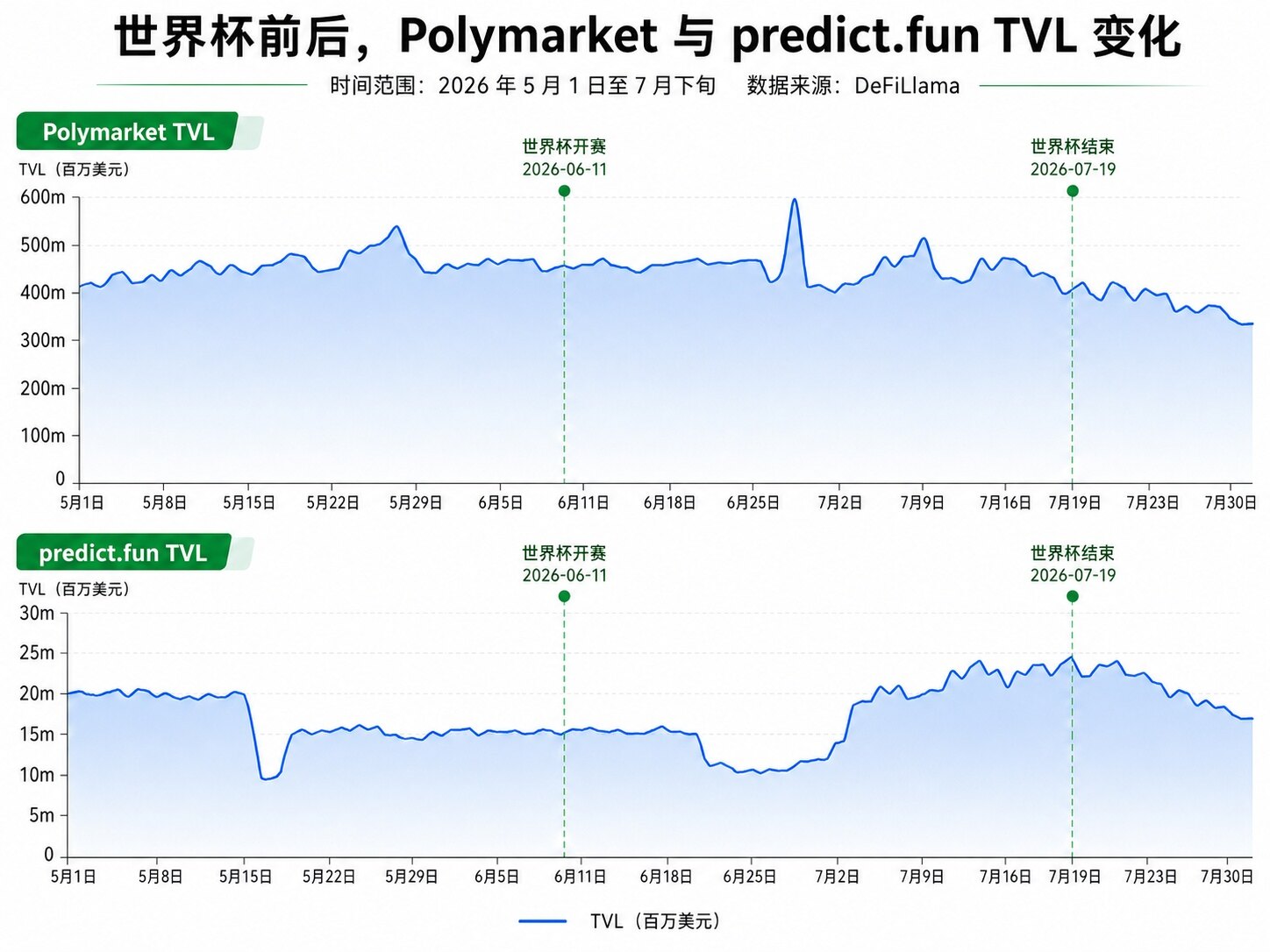
Predict.fun showed a more staged pattern. Its TVL was about $20 million at the beginning of May, then fell to around $10 million in mid-May. It later stayed near $15 million until mid-June. When the World Cup opened, TVL did not rise right away. The rebound started only in early July, then accelerated, pushing the platform into the $20 million to $25 million range during the second half of the tournament and up to a local high around the end of the event.
After the tournament, predict.fun’s TVL gradually pulled back and now stands at about $17 million, still above the low seen in late June. Compared with Polymarket, its capital flows were tied more closely to the World Cup timeline, especially during the knockout stage, when the platform saw a clearer influx of funds.
What the World Cup showed
The report’s conclusion is straightforward. The World Cup delivered meaningful gains in trading volume and fee income for prediction markets, but those gains did not naturally carry over once the tournament was over. Average daily volume and average daily fee income fell across all three platforms after the event, and Polymarket’s TVL continued to slide. A mega-event can sharply amplify trading demand in the short run, but that does not automatically raise a platform’s long-term activity level.
Odaily also argued that the upside was not limited to short-term metrics. The World Cup at least showed that sports events can provide prediction markets with a sustained source of high-frequency, short-cycle trading scenarios, while also helping users build repeat trading habits across a sequence of matches. The tournament is over, but the competition around retention, market supply and normalized day-to-day trading is still ahead.