
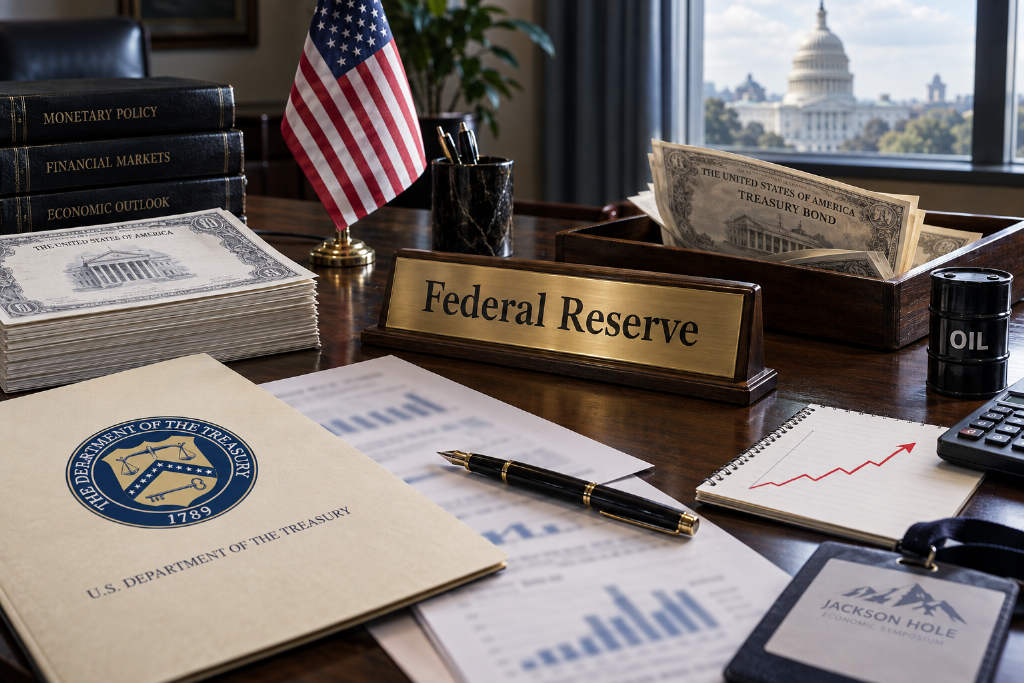
Markets now put next week’s Fed hike odds near 90%
WuBlockchain has republished an NDV Research note that says the market now sees roughly a 90% chance the Federal Reserve will raise rates next Wednesday, after more than three years without a hike.
The article, written by NDV founding partner Jason Huang and adapted from the podcast 20 Minutes of Non-Consensus Episode 50, says the last U.S. rate hike came in July 2023. Since then, there had been no increase for three years and two months. The note says markets are now betting that streak is about to end.
The original piece also includes a disclaimer that the content is for information sharing and discussion of analytical frameworks only, not investment advice.
Where rates stand now
According to the article, the federal funds rate is currently in a 3.5% to 3.75% range. It says the Fed cut rates three times last year, in September, October, and December, and has made no move this year.
The note adds that rates had fallen from 5.33%, with six cuts totaling 175 basis points across 2024 and 2025. If the Fed raises by 25 basis points next week, the target range would move from 3.5%-3.75% to 3.75%-4%.
That would mark the first move back toward tightening in more than three years.
What changed over the past three weeks
Warsh’s Jackson Hole remarks shifted the market
The article points to an Aug. 28 speech by Fed Chair Warsh at Jackson Hole as the turning point. It describes the speech as Warsh’s first major address since taking office and notes that he was selected this year by Trump.
The piece quotes three lines from that speech. First, over the past 12 months, 54% of items in the personal consumption expenditure basket had risen by more than 3%. Second, the Fed’s primary focus should now be prices. Third, the central bank must be sure inflation is returning to target “clearly, and at a sufficiently rapid pace.”
Before the speech, the market had priced the probability of a September hike at a little above 30%, the article says. Afterward, that moved to 60%.
Fed officials were not aligned
On Sept. 3, Fed Governor Christopher Waller said he was willing to wait one more meeting and would support holding rates steady if inflation kept moving lower. But he also said he would consider a hike if the data came in hot, and that the August CPI report would matter.
The article quotes him as saying, “I’m willing to sit and wait, but if inflation turns back up, then it’s time to pull the trigger.”
New York Fed President John Williams also said he wanted to wait longer. The article presents that as evidence that the Fed was not speaking with one voice.
Payrolls and CPI pushed hike pricing higher
The note says nonfarm payrolls released on Sept. 4 showed job growth of 162,000, versus an expectation of 55,000. That lifted the implied chance of a hike to 70%.
Then came the August CPI report on Sept. 11. Headline inflation was 3.4%, with monthly inflation at 0.4%, both in line with expectations. After the release, rate futures pushed the probability of a hike next Wednesday to 90%.
Prediction markets were less aggressive. The article says they moved from a little above 60% to 82% on the day, still pointing in the same direction but not to the same extent. It also says rate futures have already priced in two hikes this year.
Risk assets did not fall as hike odds climbed
The article notes that on Sept. 11, all three major U.S. stock indexes opened higher and held those gains through the session, closing up by about 1% and ending a four-day losing streak. For the full week, though, the S&P 500 was still down 0.8%.
Gold was trading a little above $4,400, while Bitcoin moved around $77,000 to $78,000 and at one point touched $79,800 intraday.
The piece treats that as an important fact: even with hike odds at 90%, risk assets did not sell off that day.
It also mentions a comment from a U.S. crypto podcast host, who said the market had “seen through” the Treasury, which was why gold and Bitcoin were getting buying support. The author explicitly says that was the host’s interpretation, not his own.
Breaking down CPI: energy drove the headline number
The article says the CPI picture looks split once the data are unpacked.
Headline inflation came in at 3.4%. Strip out food and energy, and core inflation was 2.4%, which the note describes as the lowest level since 2021.
What rose most was energy. Energy prices were up 16.3% year over year. Gasoline climbed 27.4% year over year and rose 3.9% in August alone, accounting for more than one-third of that month’s total increase in prices. Airfares were up 23.4%.
On the other side, used car prices fell 2.3%, auto insurance fell 0.8% in August, and rents rose 3%, which the article describes as relatively stable.
The conclusion in the piece is straightforward: rent, used cars, and medical-related items were cooling, while the parts still pushing inflation higher were closely tied to oil.
The article ties higher oil prices to war and delayed pass-through effects
The note argues that oil prices are rising because of war. It says the U.S. and Israel entered into conflict with Iran at the end of February this year.
Brent crude first moved above $100 on March 9, then reached $113 on March 23. By mid-July it had fallen back to $86, before rising again in September.
The article says the U.S. military struck five Iranian oil tankers on Sept. 8, while Iran said it had hit two U.S. destroyers with missiles. By Sept. 11, Brent was at $104.6, up 8% for the week.
From there, the article says, the next leg of inflation transmission runs through fertilizer and food. Fertilizer is made from natural gas. It gives several numbers: urea, the most widely used nitrogen fertilizer, rose 45% from the start of the war through early July; wheat rose 12%; soybean oil rose 50%.
Those costs usually take three to six months to move from farms to supermarket shelves, the piece says, and that process is only halfway complete.
The article then lays out two competing arguments. One side says 3.4% inflation is still too far from target and the breadth of price increases means the Fed has to hike. The other side says this round of inflation comes from a supply shock, so raising rates cannot address the key problem because rate hikes suppress demand, not shipping through the Strait of Hormuz. The piece does not try to settle that debate.
Long yields keep rising while Treasury interventions fail
Long-dated Treasury yields are already elevated
The article says that at the Sept. 11 close, the U.S. 2-year Treasury yield stood at 4.65%, a two-year high. The 10-year yield was 4.96%, the highest since October 2023. The 30-year yield reached 5.38%.
According to the article, the last time the 30-year yield was at that level was June 2007, on the eve of the global financial crisis.
Aug. 19: Treasury doubles long-bond buyback size
On Aug. 19, Treasury Secretary Bessent announced that the buyback size for long-dated Treasuries would rise from $2 billion each time to at least $4 billion.
The article explains that in plain terms as the government stepping in to buy back its own long-term debt in an effort to push long-term yields lower.
Bessent called it a “Treasury version of Operation Twist,” the note says. In the 1960s, the Fed used Operation Twist to buy long-term bonds and sell short-term debt in order to pressure long rates lower. This time, the Treasury is buying back long bonds and filling the funding gap by issuing short-term bills, which is why some critics say the Treasury is doing the Fed’s job.
On the day of that announcement, the 30-year yield fell from 5.28% to 5.17%. By the next day, the move had reversed.
Sept. 9: A $6 billion buyback still failed to move the market
The expanded buyback window runs from Sept. 9 to Nov. 4, according to the article, and covers bonds with maturities from 10 to 30 years. The piece says reports indicated the Treasury had about $950 billion in cash available to use.
On Sept. 9, Bessent returned with a $6 billion purchase, triple the usual amount. It did not help. The article says the 10-year yield rose instead, reaching 4.845%, the highest since November 2023, while the 30-year yield broke above 5.3%.
The market had expected a $7 billion to $8 billion purchase, the note says. Seeing only $6 billion, traders concluded the Treasury was running short on effective tools.
Sept. 8 remarks fed a broader market narrative
The article also highlights comments Bessent made on Sept. 8 at an event at a university in Texas: “I have information asymmetry. I am the house right now. If you want to bet I lose, you can.”
The note stresses that he was talking about the yen, not Treasuries. At the end of July, the U.S. and Japan jointly bought yen, the first time the U.S. had done so since 1998. Japan itself spent JPY 15.4 trillion from late July to late August, and USD/JPY moved from 164 to 153.
Still, the market treated the quote as a statement about every asset class. On Sept. 10, DoubleLine’s Jeffrey Gundlach reposted the line on X and wrote, “They are betting the house loses.” On the same day, he also said the Treasury curve had made new highs for the year across all maturities, including the 30-year bond.
The article points out that just eight days earlier, on Sept. 2, Gundlach had said the 30-year yield had not yet made a new high. In eight days, that changed.
It also notes a separate Aug. 29 Gundlach comment that a Fed chair who claimed not to provide forward guidance might instead be remembered for giving “gauzy” forward guidance in his first major speech.
Why $6 billion was not enough
The article says some economists counted three attempts by Bessent to make the long end “behave,” and concluded that all three failed. Paul Krugman’s Sept. 11 assessment was harsher: those efforts to push rates lower had “failed with distinction.” The piece makes clear those are outside views, not the author’s own words.
It then runs through the arithmetic.
There is more than $5 trillion of outstanding U.S. Treasury debt in the 20- to 30-year sector, the article says. A single $6 billion buyback represents roughly one-thousandth of that stock.
Another estimate cited in the piece says the U.S. has close to $10 trillion of Treasury debt maturing over the next 12 months that must be rolled over. With about $950 billion in available cash, even using all of it would still amount to roughly $1 trillion against $10 trillion.
That mismatch is where the article’s title comes from.
Criticism from Druckenmiller, response from Bessent
The note brings in Stanley Druckenmiller, who was once Bessent’s boss at Soros Fund Management. On Aug. 24, Druckenmiller wrote a Wall Street Journal opinion piece titled Let the Bond Market Speak.
According to the article, he made two central arguments: long-term interest rates are the last remaining enforcer of fiscal discipline in the U.S., and every basis point of artificial suppression is a subsidy for delay.
A week later, Bessent responded by saying Stan is a great investor, but the U.S. bond market has been the best-performing market since the president took office.
Warsh is caught between the White House and the bond market
The article says the bond market is not the only source of pressure.
Trump said on Aug. 31 that Warsh “will do what he has to do,” but in the same sentence said rates were “too high.” CNBC reported on Sept. 5 that people throughout the White House were urging the Fed not to raise rates.
The article’s framing is that Warsh is being squeezed from both sides: the White House on one side, the bond market on the other.
Two warnings on U.S. debt risk
The piece quotes Ray Dalio and Chamath Palihapitiya to show what is at stake if long rates keep moving higher.
Dalio said on Aug. 22 that a U.S. debt crisis could arrive in about three years and suggested holding 10% to 15% of a portfolio in gold.
In the All-In podcast at the end of August, Chamath said that if the 30-year Treasury yield reaches 6%, that would mark the start of a “death spiral.” Not immediately, he said, but one that could hurt for years. At the time of writing, the 30-year yield was 5.38%, leaving a gap of a little more than 60 basis points.
The timeline ahead
The article then lays out the upcoming calendar.
At 2:00 a.m. Beijing time on Thursday, Sept. 17, the Fed will release its decision. Because this is a quarterly meeting, it will also publish the dot plot, where 19 officials place their own markers for where they think rates will be by year-end. At 2:30 a.m., Warsh will hold a press conference.
Immediately after that, the Bank of Japan will meet on Sept. 17 and Sept. 18. Then, on Nov. 4, the U.S. Treasury will conduct its quarterly refunding, which will determine the next step for buybacks. The article also notes that the Fed still has two meetings left before year-end.
What prediction markets and banks are pricing
As of Sept. 11, the article says the dominant market view was a 25-basis-point hike next week, with odds near 90%.
The probability of no move was below 20%. The chance of a 50-basis-point hike was below 1%.
On the sell-side, Deutsche Bank was forecasting two hikes this year, one in September and one in December. Bloomberg’s Sept. 11 headline, according to the article, said bond traders had already fully priced in both of those moves.
Three unanswered questions
Will a rate hike actually lower long yields?
The first open question is whether a Fed hike would bring long-term yields down.
The article says many investors assume that if the Fed hikes, the long end will fall. But academically, it argues, the relationship is not that tight. As an example, it points to 2022, when the Fed raised rates by 525 basis points over 16 months while the 30-year Treasury yield rose from the 2% range to above 4% instead of declining.
The author says this is the number he most wants to watch next Wednesday: if the Fed hikes, does the 30-year yield fall or keep climbing?
When will oil peak?
The second question is oil. The article says the Strait of Hormuz is the main issue, with little disagreement on that point. But it also notes that the Russia-Ukraine war has not stopped and that grain exports from Black Sea ports have recently been affected.
Both channels can keep feeding inflation, the note says, though Hormuz matters more. The author says neither he nor the Fed has an answer to when oil prices will top out.
Could the Bank of Japan matter more than the Fed?
The third question is Japan.
According to the article, Japan’s 10-year government bond yield has reached 3%, a level not seen in 30 years. Japanese banks and insurers still hold large amounts of bonds bought during the low-rate era, and outside observers cannot clearly see what those balance sheets now look like after yields rose from near zero to 3%.
The note also says the U.S.-Japan joint yen-buying operation at the end of July happened because USD/JPY had reached 164 and Japan could no longer stabilize the market on its own.
The Bank of Japan is also meeting on Sept. 17 and 18. Markets are waiting to see whether it raises rates. The article says that if something breaks in Japan, whether the Fed hikes may stop being the main issue.
What to watch when the Fed decision lands
The article closes with three things to monitor when the outcome arrives.
- First, how much the Fed hikes, if at all.
- Second, where the median dot sits for year-end rates, since that reflects whether the 19 officials see more tightening ahead.
- Third, what Warsh says at the press conference: whether he uses language that suggests a one-off move, or whether he sticks to a data-dependent line.
The piece ends by saying the cards are now on the table. After three years and two months without a hike, the market is betting the Fed moves next week.
The original article closes with another disclaimer saying the content is for informational and academic discussion purposes only, does not constitute any form of investment advice, and that all investment decisions should be made independently and at the investor’s own risk.