
A new semiconductor unicorn has surfaced in Wuhan.
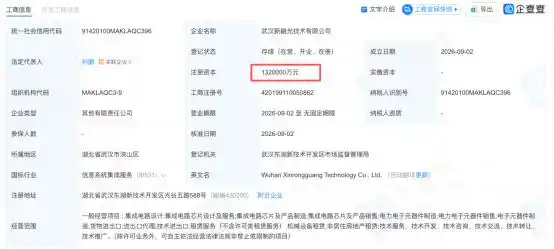
Wuhan Xinrongguang Technology Co., Ltd. was recently registered in Optics Valley with registered capital of RMB 13.2 billion, according to a report republished by MarsBit from the WeChat account Investment Community (投资界). The company appeared with a shareholder base that already spans a wide range of semiconductor-focused industrial and financial investors.
Corporate registration information shows that Xinrongguang is based on Guanggu 5th Road in Wuhan East Lake High-tech Development Zone. Its business scope includes integrated circuit design, chip manufacturing, power electronic component manufacturing, and technology import and export. Its legal representative is Sun Peng, who also serves as director and general manager of Wuhan Xinxin Semiconductor Manufacturing Co., Ltd.
A 38-shareholder cap table led by Wuhan Xinxin
The report says Xinrongguang has 38 shareholders, bringing together many of the best-known names in China’s semiconductor investment ecosystem.
Wuhan Xinxin is the largest shareholder with a 30.30% stake. Wuhan Optics Valley Semiconductor Industry Investment Co., Ltd. is the second-largest shareholder with about 15.15%. The article describes that investor as a specialized industrial investment platform under Wuhan East Lake High-tech Development Zone.
Among industrial investors, Juyuan Guanggu Xinxin (Wuhan) Electronic Information Technology Partnership holds 12.1212%. The report identifies it as CFT Capital, an investment institution launched by Semiconductor Manufacturing International Corporation (SMIC) together with a professional team.
Market-oriented investment firms are also heavily represented. Shenzhen Hongtu Baichuan No. 6, under Shenzhen Capital Group, holds 7.5758%. Other names listed include Oriza Puhua, GF Xinde, New Margin Capital, Sequoia China, Cowin Capital, Cornerstone Capital, China Merchants Capital, Xeno Investment, Hongyi Asset Management, Zhongqing Henghui, Youshan Investment, Gaoyu Fund, Hengxu Capital, Zhaorong Capital, Rongchuang Investment, and CE Health Fund.
State-backed and provincial-level funds also joined the round, including Yangtze River Industry Fund, China Internet Investment Fund, Chengtong Sci-Tech Innovation Fund, Chuchang Investment, Wuhan Sci-Tech Investment, and Yangtze Capital.
The report separately notes that Chengtong Sci-Tech Innovation Fund was established under the guidance of the State-owned Assets Supervision and Administration Commission and led by China Chengtong as one of the first venture capital mother funds for central state-owned enterprises. Yangtze River Industry Fund is described as a provincial-level mother fund in Hubei.
Two other investors highlighted in the article are Shanghai SAIC Xinju Venture Capital Partnership, managed by Shangqi Capital under the SAIC Group system, and Hubei Changfei Angel Venture Capital Fund Partnership from the Yangtze Optical Fibre and Cable system.
Registration came one day before a key IPO review update for Changcun Holding
The timing stands out. One day after Xinrongguang completed registration, Changcun Holding’s STAR Market IPO review status was updated to “inquiry received.” The company is seeking to raise RMB 33 billion.
The report frames the sequence from Yangtze Memory to Xinrongguang as part of Wuhan’s broader semiconductor rise.
How Xinrongguang connects to Wuhan Xinxin and Yangtze Memory
The article traces Xinrongguang’s roots through the history of Wuhan Xinxin and its relationship with Yangtze Memory.
In 2006, Wuhan Xinxin was established with capital from state-owned entities in Hubei and the East Lake High-tech Development Zone. The plan was to build China’s first 12-inch wafer fab, initially focused on DRAM chips.
In 2016, the national memory base was launched in Optics Valley and Yangtze Memory Technologies Co., Ltd. was formally established. According to the report, Yangtze Memory started from Wuhan Xinxin’s existing production lines, equipment, and process team. Wuhan Xinxin was then brought under the Yangtze Memory system. At the capital structure level, Changcun Holding, as the group’s top holding platform, held 100% of Yangtze Memory Technologies and also maintained long-term control of Wuhan Xinxin.
In May 2023, Changcun Holding completed an internal equity transfer. Yangtze Memory transferred all of its Wuhan Xinxin shares to its parent company, Changcun Holding, making the two companies sibling entities under the same group.
The 2026 restructuring created room for a new platform
The report identifies 2026 as the turning point.
On May 19, Changcun Holding formally began IPO tutoring and filing. On the same day, Wuhan Xinxin voluntarily withdrew its own STAR Market IPO application materials. The article says that under A-share IPO review rules, if Changcun Holding had continued to tightly control Wuhan Xinxin, related-party transactions, business boundaries, and potential horizontal competition between the two entities would have remained unavoidable issues in the listing review.
In June, a major equity transaction was disclosed: Optics Valley Semiconductor Industry Investment and its concerted parties agreed to acquire the 39% stake in Wuhan Xinxin held by Changcun Holding. In July, the deal received unconditional antitrust approval.
After the transaction, Optics Valley state-owned capital obtained sole control of Wuhan Xinxin. Changcun Holding’s stake was diluted to 29.19%, and Wuhan Xinxin was no longer included in Changcun Holding’s consolidated financial statements.
The report says Wuhan Xinxin thereby formally exited the Changcun Holding system and became an independent specialty-process wafer manufacturer led by Optics Valley state-owned capital. Xinrongguang then emerged as a new platform established by Wuhan Xinxin after the equity handover was completed.
Process know-how is seen as the base for a silicon photonics push
The article argues that while the ownership structure changed, the technical and industrial lineage did not disappear.
Over the years, Wuhan Xinxin supported Yangtze Memory’s work on 3D memory and accumulated process capabilities in through-silicon via (TSV), hybrid bonding, and multi-wafer stacking. It also built what the report calls China’s first domestically controllable 3D heterogeneous integration production line. That technical base, the article says, has remained with Wuhan Xinxin and now underpins Xinrongguang’s move into silicon photonics and optoelectronic integration.
In the report’s description, Yangtze Memory focuses on how data is stored at scale, while Xinrongguang is targeting how data is transmitted at high speed. Both remain in Optics Valley, where talent, supply chains, and equipment resources can still circulate.
The article also notes that on Aug. 28, Wuhan Xinxin officially unveiled its “Xinguang Plan” at a company conference. Xinrongguang’s appearance a few days later has been widely viewed by the market, according to the report, as the platform that will carry the industrial implementation of that 10-year strategy.
Wuhan’s semiconductor cluster is gaining momentum in the AI computing cycle
The report places Xinrongguang’s debut within the broader rise of Wuhan’s semiconductor and optoelectronics industry.
It says many people have long associated Wuhan semiconductors mainly with Yangtze Memory, but the city’s chip industry was already taking shape when Wuhan Xinxin was founded. The original 12-inch wafer fab was backed by patient capital from provincial, municipal, and district-level state-owned investors in Wuhan.
As AI computing demand has surged, optical modules, optical chips, optical fiber, and memory chips have become core parts of computing infrastructure. The article argues that these are exactly the areas where Wuhan has spent decades building capabilities.
It cites several local companies whose market values have climbed sharply: HGTECH, which grew out of Huazhong University of Science and Technology, became Hubei’s first listed company with a market value above RMB 100 billion; Accelink Technologies also entered the RMB 100 billion range; and Yangtze Optical Fibre and Cable saw its market value exceed RMB 360 billion. All are based in Wuhan Optics Valley.
The report also highlights the rise of what it calls the “Optics Valley Seven Stars”: Yangtze Memory, Yangtze Optical Fibre and Cable, HGTECH, Accelink Technologies, FiberHome Telecommunication Technologies, Guide Infrared, and CICT Mobile Communication Technology. Together they cover storage, optical communications, infrared, and mobile communications. If Changcun completes its STAR Market IPO, the article says the combined market value of this group would move into the trillion-yuan range.
From one optical fiber to storage chips and silicon photonics
The article looks further back to 1976, when Academician Zhao Zisen drew China’s first practical optical fiber at the Wuhan Research Institute of Posts and Telecommunications, laying the foundation for Wuhan’s optoelectronics industry.
For a long period after that, the city did not stand out in China’s industrial map. The report says Wuhan had abundant university resources but faced persistent talent outflows. During the internet boom, many entrepreneurs from Hubei built their reputations elsewhere, while the local market did not produce heavyweight internet giants and was at one point described as a city lacking unicorns.
That changed with the arrival of the AI era, according to the article. Explosive growth in computing demand has lifted demand for optical modules, optical chips, optical fiber, and memory chips, bringing Wuhan’s long-built industrial strengths into sharper view.
The report cites data showing that Optics Valley is now home to 16,000 optoelectronic information companies and hosts globally leading industrial bases in optical fiber and cable, optoelectronic devices, and advanced memory. Wuhan’s total optoelectronic information industry has exceeded RMB 850 billion in scale, leaving it one step away from becoming a trillion-yuan pillar industry.
The article closes by saying Wuhan has moved from a starting point of one optical fiber, to breakthroughs in memory chips, and now toward new ground in silicon photonics and optoelectronic integration. For Xinrongguang, capital is only the beginning. Yield improvement in wafer manufacturing, process iteration, and customer development still lie ahead.
The original article was published by the WeChat account Investment Community (ID: pedaily2012) and written by Yang Jiyun.