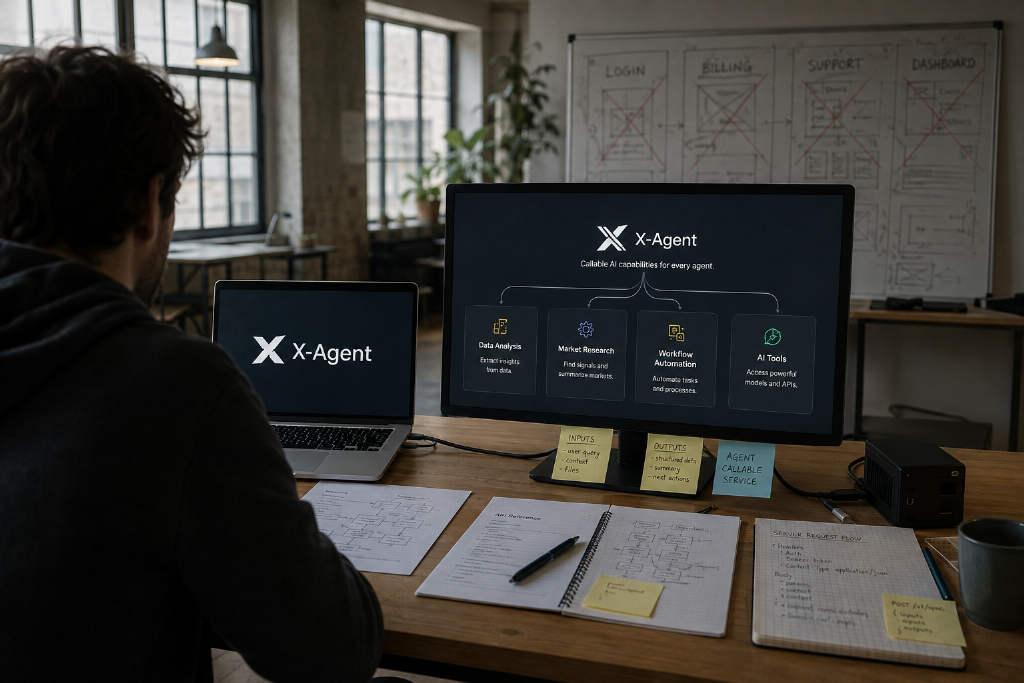
X-Agent says the next step for OPCs is not building more products, but making capabilities callable by agents

X-Agent says the next step for OPCs is not building more products, but making capabilities callable by agents

N
News Editor
2026-09-04 02:39:20
X-Agent argues that AI coding tools and the rise of "Vibe Coding" are rapidly lowering the barrier to software development, allowing a single developer to deliver work that once required a small product and engineering team. In its latest article, however, the firm says that for one-person companies, or OPCs, productivity is no longer the main constraint. The scarcer resources are demand, trust and distribution. The article says a fast-built demo does not automatically enter real workflows used by customers or other agents. Instead of starting with a full SaaS stack that includes a website, login system, backend, subscriptions and customer support, developers can begin with one clear, practical and callable capability. X-Agent suggests packaging data analysis, market research, automation processes or AI tools as MCP services so that agents can understand what the service does, when to call it, what inputs it needs and what results it will return. That idea also sits at the center of the X-Agent AI MCP Hackathon. According to X-Agent, the goal is not to reward the most complex MCP Server, but to help developers turn real APIs, tools or services into agent-native services with clear capability boundaries, stable interfaces, verifiable deployment and long-term product potential.

BlockBeats reported on Sept. 4 that "Vibe Coding" is sharply reducing the barrier to software development. With AI coding tools, a single developer can complete in a short period work that previously required a small product and engineering team.

In its latest article, X-Agent said that for one-person companies, or OPCs, the real scarcity is no longer productivity. It said demand, trust and distribution have become the harder problems. Building a demo quickly does not mean it will enter the real workflows of users or other agents.

What X-Agent sees as the next step for OPCs

X-Agent said developers may be better off starting with one clear, useful and callable capability instead of building a full SaaS product from scratch with a website, login, backend, subscription system and customer support.

Its proposed approach is to package data analysis, market research, automation processes or AI tools into MCP services, allowing agents to understand what the service can do, when it should be called, what inputs are required and what results it will return.

Focus of the X-Agent AI MCP Hackathon

X-Agent said that is also the core focus of the X-Agent AI MCP Hackathon. The event is not designed to compare who can build the most complex MCP Server. Instead, it aims to help developers upgrade real and usable APIs, tools or services into agent-native services with clear capability boundaries, stable interfaces, verifiable deployment and the potential for continued productization.

X-Agent said the most important thing in the agent economy is not simply getting a service online. The key is making the service reliable enough to be discovered, trusted and repeatedly called by other agents.

For OPCs, X-Agent said the real advantage is not stacking more features, but spotting market signals faster than large companies and turning specialized capabilities into digital services that can keep generating value. It ended with a question for developers: could there be another agent that truly needs to call your capability?

This article was originally published by Bit.Fan. For more cryptocurrency news and market insights, visit www.bit.fan.
2200

Disclaimer:

The market information, project data, and third-party content displayed on this platform are for industry information sharing only and do not constitute any form of investment advice or return commitment.

Cryptocurrency trading carries high risks. Users should fully assess their risk tolerance and make independent decisions. All profits, losses, and legal responsibilities are borne by the users themselves.