
xAI released Grok 4.7 on Monday afternoon and called it its best model so far, describing it as 「a notable improvement over Grok 4.6 at the same price and speed」.
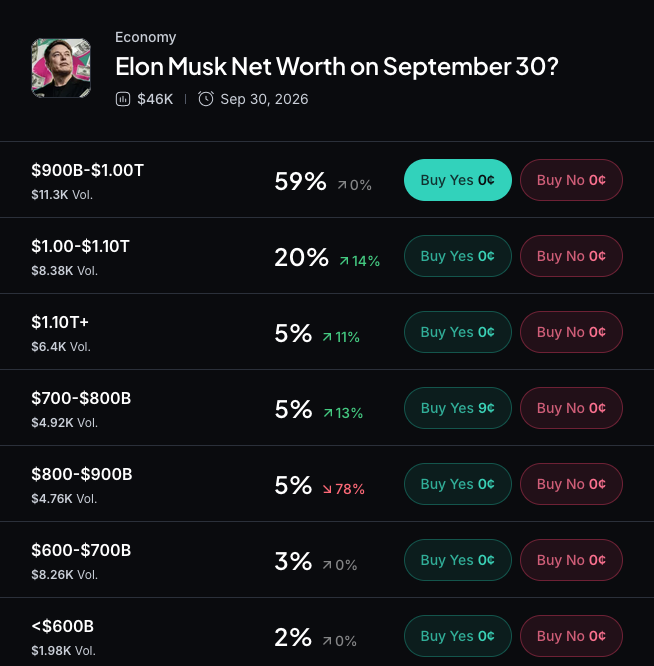
The launch came after several apparent delays. Since late July, Elon Musk had pushed back the timeline at least five times: 「four weeks out,」 then 「a few weeks,」 then 「3 to 4 weeks,」 then 「10 days」 on September 1, followed by 「needs a few more days to cook」 on September 11.
Model size grows and rollout starts immediately
xAI said Grok 4.7 spends longer working through difficult problems and checks its own answers more often than Grok 4.6, while adding what the company described as its strongest safety guardrails yet.
Musk later wrote on X that Grok 4.7 is 「a strong combination of intelligence, speed & low cost.」 Unlike some earlier releases, this one has no waitlist. It is already live in the Grok app, Cursor, Grok Build, and the xAI API.
According to xAI, Grok 4.7 has 2.1 trillion parameters, up 40% from the 1.5 trillion in Grok 4.6. That earlier model was itself a refinement of Grok 4.5. Pricing is set at $2 per million input tokens and $6 per million output tokens.
The article notes that parameters are the internal values a model adjusts during training, and that a larger parameter count usually gives it more capacity to learn patterns. Tokens are the basic units of information an AI model can process or generate.
SpaceX data was added to training
xAI also incorporated supplemental training data from SpaceX, Musk’s rocket company. That data includes Starlink satellite telemetry, manufacturing records, and engineering failure logs. The company’s pitch is that Grok 4.7 should reason better about hardware and physical systems than models trained only on internet text.
Benchmarks still place it behind Claude Fable 5.1
Even so, the benchmark results followed a familiar pattern.
GDPval measures performance on real-world, economically valuable knowledge work, including legal memos, spreadsheets, and slide decks. The tasks are vetted by working professionals in each field, and the results are scored using an Elo rating system, the same head-to-head ranking method used in chess.
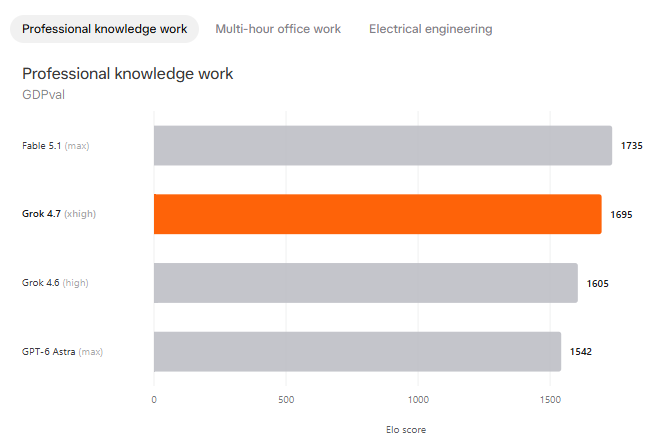
Grok 4.7 scored 1695 on GDPval. Claude Fable 5.1 led the chart at 1735.
AA-Briefcase, built by Artificial Analysis, tests multi-hour office work that combines research, analysis, and document production into one extended task. It also uses Elo scoring. Grok 4.7 posted 1657, while Fable 5.1 came in at 1678. The outcome was the same as in GDPval.
On CursorBench 4.0, Cursor’s benchmark for real coding tasks inside its editor, the chart compares accuracy against the cost and token count consumed by each task. Grok 4.7 sits in the middle. Its per-task cost is higher than GPT-6 Astra, the successor to GPT-5.6 Sol, and higher than Claude Sonnet 5, yet it still trails Fable 5.1, which leads across every price point shown on the chart.
xAI’s pattern remains the same: lower price, not top-tier capability
The article says this is not new for xAI. Grok 4.5 launched in July with what was described as the biggest training cluster in the industry, but it ranked third behind Claude and OpenAI models. Before that, Grok 4.20 traded reliability for speed and personality. Grok 4.6 also lagged the frontier group on coding autonomy.
That does not make Grok 4.7 a bad product for the millions of people using it through X, the standalone app, or a Tesla dashboard. It means the model most likely to answer user questions or run a car’s voice assistant is built on a system that, by its maker’s own benchmarks, sits one rung below the top tier.
That is also why price matters more than leaderboard position for most users. The report says xAI has consistently undercut Anthropic and OpenAI on token pricing even while trailing them on raw capability. Its bet is that 「good enough, cheap, and everywhere」 will beat 「best, but pricier」 for much of everyday use.
Musk lowered expectations before launch and outlined what comes next
Days before the release, Musk had already tempered expectations. He wrote that Grok 4.7 should land 「roughly on par with」 Anthropic’s Claude Opus 5.0, not the newer Opus 5.1, and said multimodal performance still needed work.
In the same post, he outlined the next three models: Grok 4.8 as a meaningful step up, Grok 4.9 in 「Astra/Fable class,」 and Grok 5 as a possible frontier leader. None of those upgrades has a release date yet. As Musk put it, 「We shall see.」