
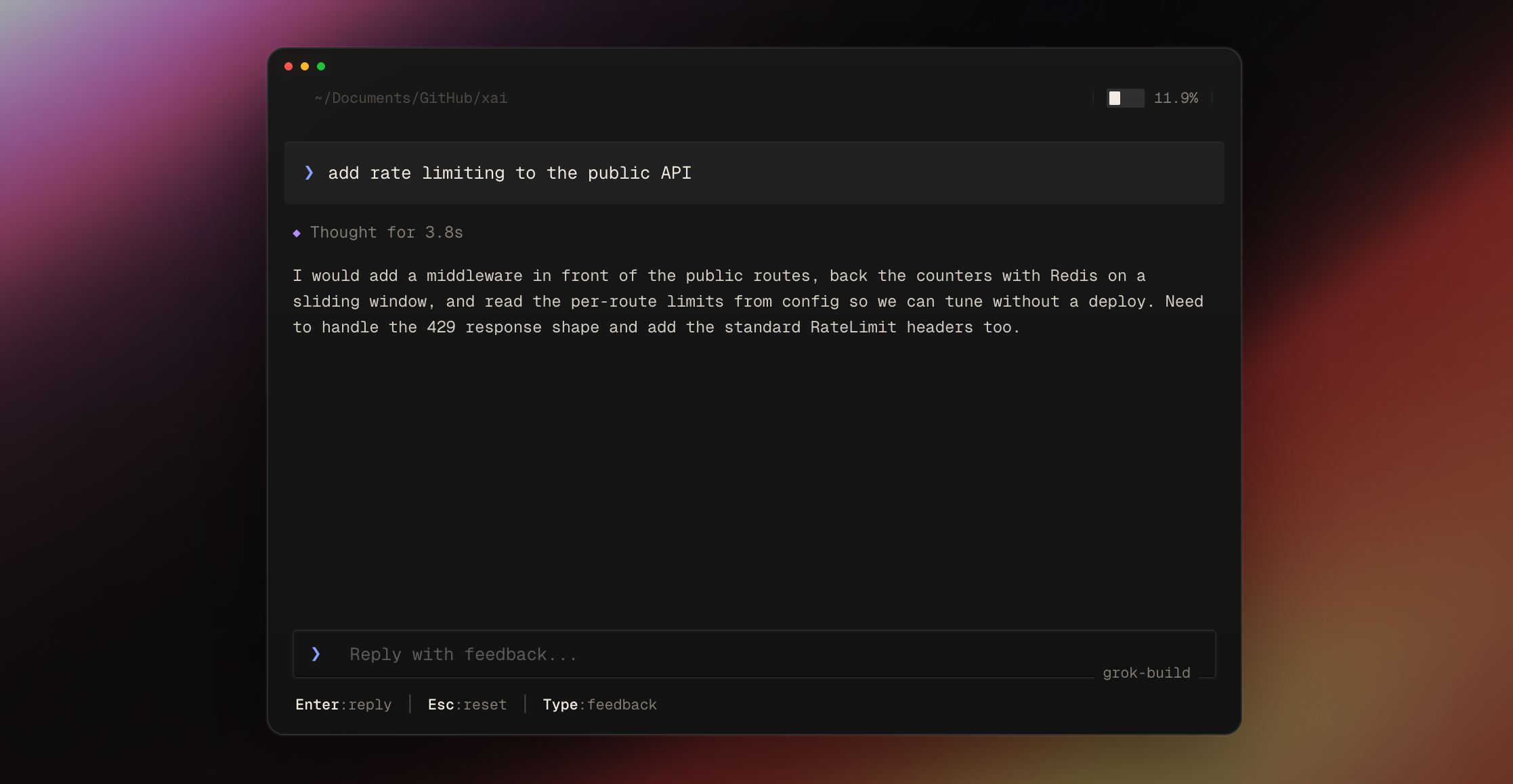
xAI, Elon Musk’s AI company, has released Grok Build, its first AI coding agent product, taking direct aim at Anthropic’s Claude in one of the most commercially important segments of the AI market. The tool is now in an early beta phase and is available only to paying subscribers. It runs on Grok 4.3 beta, uses a 16-agent Heavy architecture, and offers a 2 million-token context window.
Parallel agents and plan review sit at the center of the product
Grok Build is built around two main layers of functionality. First, it supports up to eight parallel AI agents that can work on planning tasks, searching files, and writing code at the same time. Second, its Plan Mode produces an execution plan before any action is taken, and the user must approve that plan before the system proceeds. Each change is shown as a clean diff, a structure meant to reduce the risk of accidental edits.
xAI also says the product follows a local-first design, meaning source code is not sent to xAI servers. For enterprise users, that point matters. Compliance requirements often decide whether an AI coding tool can move from testing into real development workflows.
Pricing targets paid users as xAI names Claude as the benchmark
Grok Build is included in the SuperGrok Heavy subscription tier, which is priced at $299 per month, with a $99 monthly promotional rate for the first six months. Michael Nicolls, president of xAI and also a senior executive at Starlink, said the company’s near-term goal is to “match Claude’s performance across tasks.” That statement leaves little ambiguity about how xAI is positioning the product.
Cursor partnership highlights the distribution side of the strategy
Shortly before the Grok Build release, SpaceX, xAI’s parent company, announced a partnership with coding editor Cursor. The terms include either a future $60 billion acquisition or a $10 billion licensing payment. Cursor co-founders Andrew Milich and Jason Ginsberg have already joined xAI and SpaceX and now report directly to Musk.
The deal is not only about product integration. SpaceX said its Colossus supercomputing cluster delivers compute equivalent to 1 million H100 GPUs, placing it among the largest known AI infrastructure systems. Cursor, on the other side, has millions of active developer users and is one of the most widely adopted AI-assisted coding tools in the market. According to the source material, xAI has compute but lacks end-user reach, while Cursor brings a distribution channel xAI does not yet have on its own.
Grok Build’s multi-agent design and large context window, Cursor’s developer base, and Colossus compute together form xAI’s current push into AI coding. Whether those technical advantages turn into routine adoption by engineers remains the question the company is now facing.