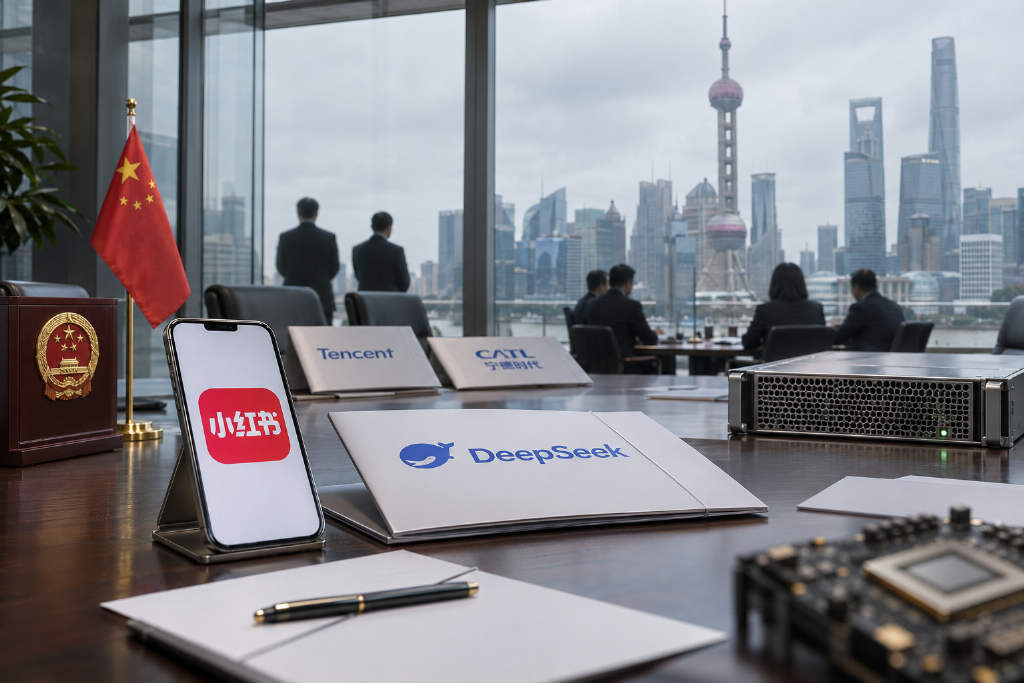
The Information reported that DeepSeek raised RMB 105.5 billion in its second financing round at a valuation of RMB 615.5 billion, with nearly 30 investors taking part. Xiaohongshu was among the names on the list.
Xiaohongshu joins DeepSeek’s investor roster
According to the report, Xiaohongshu invested in DeepSeek in the latest round. The article noted that there has not been much direct connection between Xiaohongshu’s founding team and Liang Wenfeng. Mao Wenchao and Qu Fang built their careers in consumer business, consulting, and commercial storytelling, while Liang has been rooted in mathematics, computing power, and quantitative systems. The only coincidence mentioned in the report is that they were all born in 1985.
Over the past decade, the two sides moved along very different tracks. One built traffic and community, the other built foundation models. With this investment, those once-parallel entrepreneurial paths have now met in the AI era.
AI has moved higher on Xiaohongshu’s agenda
The report said AI has taken on a much heavier weight inside Xiaohongshu over the past two years. For a long period before that, the company’s AI strategy appeared conflicted. It had been developing models in-house, but at the same time it was trying to prevent AI-generated content from eroding the platform’s community built around what the article described as “authentic recommendation” behavior.
That stance shifted in April, when Xiaohongshu created Dots as a first-level department centered on AI. Dots was upgraded from Hi Lab, a humanities-oriented intelligence lab established in early 2025. The new unit includes model research and development, infrastructure, engineering, and product teams, and reports to newly appointed president Conan. In the view cited by the article, that move showed Xiaohongshu was embracing AI on a broader scale.
In October, Xiaohongshu followed up with a company-wide letter saying it would connect Dots with Infra, the company’s core infrastructure team, and clarify internal responsibilities. Under that arrangement, Dots is responsible for model deployment and product-facing services, while Hi Lab continues to focus on frontier and long-cycle research.
This was the second major AI organizational adjustment at Xiaohongshu within six months. The company-wide letter repeatedly said that, rather than chasing model capability or computing scale for their own sake, what mattered more was deep integration between models and applications. The article said that may also help explain Xiaohongshu’s decision to invest in DeepSeek.
It had already backed Kimi and MiniMax
Xiaohongshu has also been active externally. The report said its name appears on the shareholder lists of Moonshot AI’s Kimi and MiniMax. In 2024, it participated in Kimi’s financing of more than $1 billion. Before MiniMax went public, Xiaohongshu also appeared among its strategic investors.
With DeepSeek now added to that list, the article argued that Xiaohongshu appears to have secured seats across China’s top tier of large-model companies.
DeepSeek’s second round doubles from the first
According to The Information, DeepSeek’s second round reached RMB 105.5 billion, roughly double the size of the first round. The share of state-backed capital rose from just 2% in the first round to 27% in the second. The National AI Industry Investment Fund added another RMB 1 billion, while China Mobile, China Telecom, CICC, CITIC, and China Life joined the round with individual commitments ranging from RMB 2 billion to RMB 8 billion.
Industrial capital was also lining up for allocations. The Information said Tencent and Contemporary Amperex Technology Co. Limited, or CATL, remained the two largest investors in the round. Tencent invested RMB 10 billion this time, unchanged from the first round, bringing its total across the two rounds to RMB 20 billion. CATL and its chairman Zeng Yuqun together invested RMB 10 billion in the second round, double the RMB 5 billion committed in the first.
New investors included Semiconductor Manufacturing International Corporation, or SMIC, and ChangXin Memory Technologies on the chip side; Luxshare Precision and Midea on the manufacturing side; Geely from the auto sector; and Meituan, vivo, Trip.com, and Xiaohongshu from the internet and consumer technology side. The article added that market talk put the commitments from major platform companies in a range of RMB 1 billion to RMB 3 billion each.
Among market-oriented funds, Monolith Lisi Capital invested RMB 3 billion in the first round and RMB 7.5 billion in the second. IDG Capital invested a combined RMB 6.5 billion across the two rounds. Boyu Capital invested RMB 3.5 billion in the second round.
Liang Wenfeng invested again and kept control terms tight
In June this year, DeepSeek’s first round was about RMB 50 billion. Founder Liang Wenfeng invested RMB 20 billion at that time, making him the largest single investor in the round. In the second round, he invested another RMB 2 billion.
The report also said DeepSeek set a special threshold in the first round to preserve research independence and purity in decision-making. Except for the National AI Industry Investment Fund, outside investors did not inject capital directly into the DeepSeek operating entity. Instead, their money entered through a limited partnership managed by Liang. Those investors gave up voting rights and agreed to a five-year lock-up.
The original article said the rush from different types of capital also reflected anxiety over where the next super entrance may emerge. In that framing, investing in DeepSeek was not only a way to secure exposure to the future of AI, but also a way to open a path for business reinvention.
The piece was originally published by the WeChat public account Investment Community, with Zhou Jiali listed as the author, and was republished by MarsBit.