
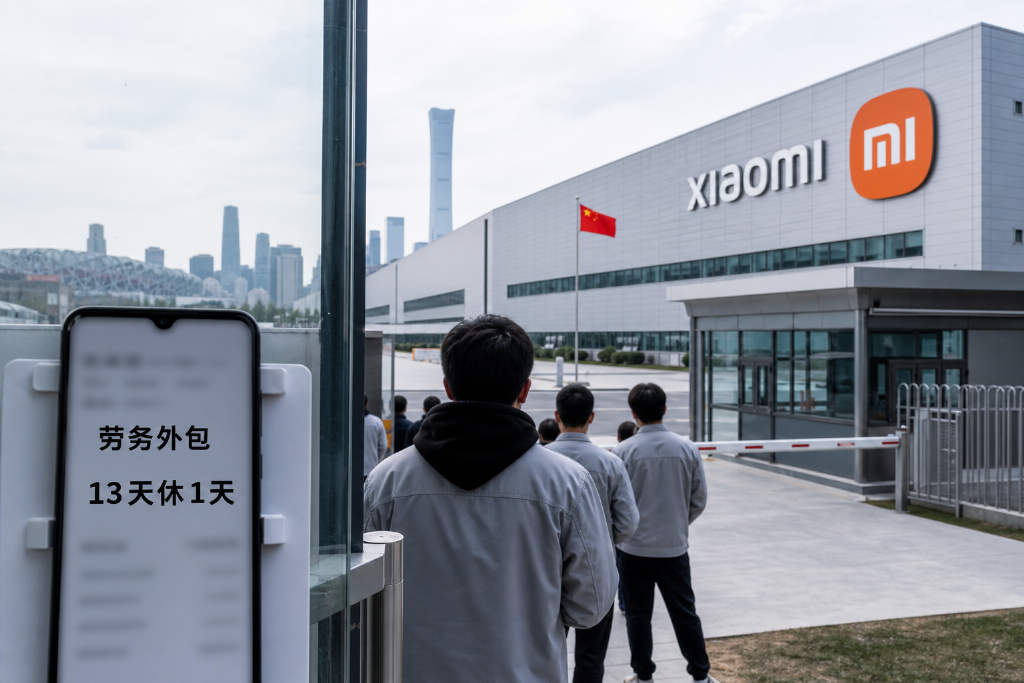
A hiring screenshot said to be linked to Xiaomi EV’s Beijing super factory has been circulating on Chinese social platforms, triggering debate over the workload it describes. The image lists a two-shift system, 11 actual working hours per day, and a schedule of 13 working days followed by one day off, with pay set at RMB 25 an hour. The report argues that the bigger issue may not be the schedule alone, but the employment classification shown on the form: labor outsourcing.
The circulated image lays out the job terms
According to the report, the screenshot says Xiaomi EV’s Beijing super factory was recruiting general workers. Applicants were required to have a high school education or above, be between 18 and 32 years old, be in good health, have no criminal record, and be able to adapt to shift work. Prior front-line experience in auto manufacturing was listed as a preference.
The role was described as a rotating two-shift position. Day shift would run from 9 a.m. to 9 p.m., and night shift from 9 p.m. to 9 a.m., with actual working time set at 11 hours a day and shifts rotating every two weeks. Pay was listed at RMB 25 per hour, with a night-shift subsidy of RMB 25 per day. The package also included free four-person dormitory housing, private bathrooms, shared utility costs, a full-attendance meal subsidy of RMB 695 per month, social insurance, heat subsidies, and free commuter shuttle service.
Using that schedule, the article calculates monthly working time at about 306 hours. It says that figure is roughly 1.76 times China’s statutory standard of 174 monthly hours.
The debate centers on outsourced labor as much as on long hours
The article says most people first fixate on the “13 days on, 1 day off” arrangement because it appears extreme. But it identifies the second line of the image as the key detail: the form labels the employment type as labor outsourcing. In the report’s reading of Chinese labor practice, that means the legal employer would not be Xiaomi itself, but an outside contractor.
It then compares the alleged outsourced terms with those of regular employees. Chinese media reported in 2025 on blue-collar compensation at Xiaomi’s Beijing plant, where workers described 12-hour days in the welding shop, a mandatory six-days-on, one-day-off schedule, and a night-shift subsidy of RMB 25 per day, with base pay at around RMB 4,000. Overtime on weekdays was paid at 1.5x, weekend overtime at 2x, and with full-attendance bonuses, monthly pay could exceed RMB 10,000. Technical maintenance roles, the report says, could reach RMB 15,000, with monthly hours at around 290.
Set against that benchmark, the terms in the screenshot look different. The article says regular workers were paid through a base-salary-plus-overtime-multiplier model, while the outsourced position in the image was based on a flat hourly wage of RMB 25 with no distinction between weekdays and holidays and no overtime multiplier shown. At 306 hours a month, rough pay would come to about RMB 7,660. Adding the night-shift subsidy and full-attendance meal subsidy would bring the total to roughly RMB 8,700.
Wage legality and hour limits are treated separately
On whether RMB 25 an hour violates wage rules, the report points to Beijing’s standards. Starting in September 2025, Beijing’s monthly minimum wage was adjusted to RMB 2,540. For full-time workers, that works out to an hourly rate of about RMB 14.6, so RMB 25 is above that threshold.
Beijing also has a separate minimum hourly rate of RMB 27.7 for part-time work, which the article says is the highest in China. But that standard applies to part-time employees working no more than four hours a day, so it does not directly fit the position described in the screenshot.
Based on that distinction, the article says the hourly rate itself would not be illegal. The problem would lie in the hours and in how overtime is calculated. Chinese rules require at least one rest day per week, and a “13 days on, 1 day off” pattern would exceed that limit.
How labor dispatch differs from labor outsourcing
The report then shifts to the legal structure behind the hiring form. Under China’s Interim Provisions on Labor Dispatch, the number of dispatched workers used by a company may not exceed 10% of its total workforce. The article adds that a 2025 rule further reduced the ratio for state-owned enterprises to 7% and required compliance by the end of 2026, while private companies remained at 10% but had to disclose job lists.
If a factory needs flexible labor far above that cap, the article says one practical workaround is to replace “labor dispatch” with “labor outsourcing.” In legal terms, labor dispatch means the worker belongs to the dispatch agency while the work is managed by the company using that labor. Under labor outsourcing, an entire line of work is contracted out, and both the employees and the work are treated as part of the contractor’s operation. The first model is subject to the 10% cap. The second is not.
The article says that in practice, the line between the two often exists only in contract language. Chinese lawyers have a blunt term for such arrangements: “fake outsourcing, real dispatch.”
The timing comes as Xiaomi EV pushes production and delivery
The report places the screenshot in the context of Xiaomi EV’s current production ramp. It says the first-phase Beijing plant has been running at full load on a two-shift basis since June 2024, with capacity utilization at one point nearing 200%. A second-phase plant is already in production. A third-phase plant is expected to start operating after the 2026 Lunar New Year. The first-phase Wuhan plant is scheduled in May, with a target of reaching monthly output of 35,000 vehicles by October.
Pressure on the order and delivery side is also heavy, according to the article. Xiaomi delivered 104,199 new vehicles in the second quarter of 2026, up 28.2% year over year, and set a full-year target of 550,000 vehicles.
The financial picture in the same report points in another direction. Xiaomi’s smart EV segment posted revenue of RMB 23.9 billion in the second quarter, up 15.9% from a year earlier, while gross margin fell from 26.4% in the same period of 2025 to 19.2%. Operating loss widened to RMB 2.6 billion. Deliveries rose, but margins moved lower.
The screenshot has not been fully verified
The article says the hiring image cannot be verified with complete certainty because it does not show a company letterhead or publication date, and the identity of the original poster is unclear. Xiaomi has not commented on hiring at the Beijing auto plant, and the contractor that may have posted the information has not been identified.