
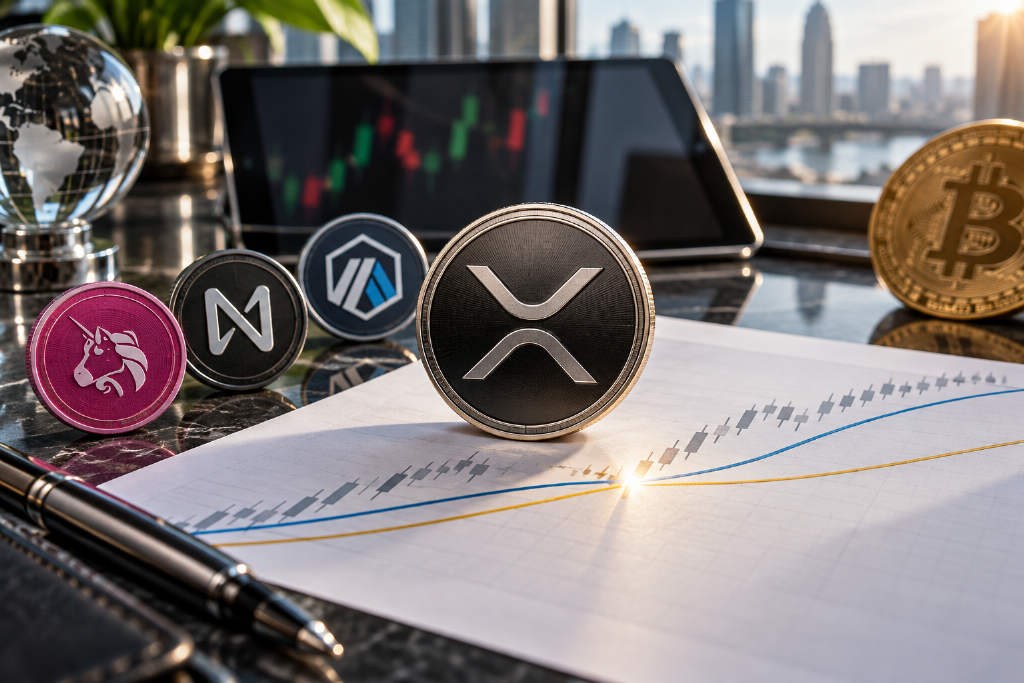
XRP is close to flashing a major bullish chart signal as traders increasingly turn their attention to altcoins and bitcoin’s market share slips, according to a Sept. 18 excerpt from CoinDesk’s Daybook newsletter.
XRP moves closer to a golden cross
The signal in focus is the golden cross, which appears when an asset’s 50-day moving average rises above its 200-day moving average. Chart analysts generally treat that formation as a long-term bullish sign. CoinDesk noted that the pattern has often worked across a range of markets, including bitcoin, which recently confirmed its own golden cross.
On paper, that gives XRP a constructive technical setup. The historical record for XRP itself is more mixed.
CoinDesk said none of XRP’s previous 16 golden crosses lasted as long as 12 months. Every one of them was later cut off by a death cross, the bearish opposite in moving-average structure.
Even so, the short-term picture has sometimes been strong. Many of those earlier golden crosses led to sizable gains over a three-month period. Of the 10 signals that lasted long enough to reach the three-month mark, five delivered gains ranging from 85% to more than 1,000%. The report highlighted a 1,009.6% rally after the April 2017 cross and a 135% gain after the February 2021 cross.
XRP’s 50-day average is now about 2% below its 200-day average, the narrowest gap since the token’s last golden cross in August 2024.
Bitcoin holds steady while altcoins gain traction
CoinDesk said analysts remain constructive on bitcoin’s price outlook after the asset weathered what it described as this week’s storm, including the Clarity Act setback and a Federal Reserve rate increase. Bitcoin was trading near $78,000, roughly unchanged from a week earlier. The report also displayed a BTC price reference of $80,734.35.
At the same time, bitcoin dominance, or bitcoin’s share of total crypto market capitalization, has dropped to a one-month low below 59%. CoinDesk said that points to rotation into altcoins. Tokens including UNI, NEAR and ARB have surged by nearly 30% in 24 hours.
Alex Kuptsikevich, chief market analyst at The FxPro, said in an email, 「Altcoins have accelerated sharply while the majors lag. Markets hope for SEC and CFTC crypto adoption, plus passage of the Bitcoin Reserve Bill.」
He added, 「It appears that traders are cautiously shifting their focus towards altcoins, although neither the altcoin season index nor market sentiment has yet reached high levels.」
Past data shows the signal is not reliable on its own
The table referenced in the report tracks XRP’s price performance three months and 12 months after each of its 16 previous golden crosses. Cases interrupted by a death cross were marked as terminated.
All 16 were terminated within 12 months. Six did not survive even three months. Of the 10 that did last that long, five posted gains between 85% and more than 1,000%, while five fell by as much as 32%.
CoinDesk said the data suggests that the golden cross, like most technical indicators, is not fully reliable when used in isolation.
Other items listed as trending
- Reuters reported that stocks and bonds fell as central banks raised rates to fight inflation, while the yen headed for its biggest daily slide since mid-February after the Bank of Japan lifted rates to a 31-year high.
- CoinDesk reported that Iran has charged tankers between $1 million and $2 million this year to pass through the Strait of Hormuz, and the U.S. Treasury said that since June, part of that money moved through Tehran-based crypto exchange BitBank.
- CoinDesk also reported that U.S. spot ether ETFs saw roughly $39 million in net outflows on Thursday, the third straight day of withdrawals. XRP funds lost about $5 million, reversing a small inflow from the day before, while bitcoin ETFs took in roughly $159 million.
- According to the Associated Press, Asian shares mostly ended higher on Friday on the back of a Wall Street rally and easing oil prices, while European benchmarks slipped in early trading. U.S. shares appeared set for modest gains.
Other headlines listed in the newsletter
- 1DHS’s predictive policing is unconstitutional, un-American and should be stopped
- ECB President Christine Lagarde intervened to block Binance’s EU MiCA license: WSJ
- Zcash targets November upgrade to make private payments up to three times faster
- Layer-2 and DeFi tokens lead broad crypto advance as post-Fed hike nerves fade
- Bitcoin weathers September storm as rate hikes and Clarity act setback test bulls
- Live updates: Bitcoin climbs over $80,000 as rally accelerates at U.S. market open
- SBI Group backs payments firm dtcpay in $25 million funding round
- Iran’s Strait of Hormuz toll booth ran through a bitcoin exchange, U.S. says
- Solana speeds up blocks by 17%, but transaction capacity stays the same
- Corporate treasuries bought just 5,900 bitcoin in 3 months. Other demand signals look weak, too.
Stablecoin series mention
The newsletter also mentioned 「The Definitive Stablecoin Landscape Series: Asia Pacific.」 CoinDesk said the report examines the region’s rules, use cases and RLUSD’s role as stablecoins move into regulated finance and APAC becomes a key proving ground.
The item ended with the line 「Why it matters:」 but no further details were included in the provided text.