
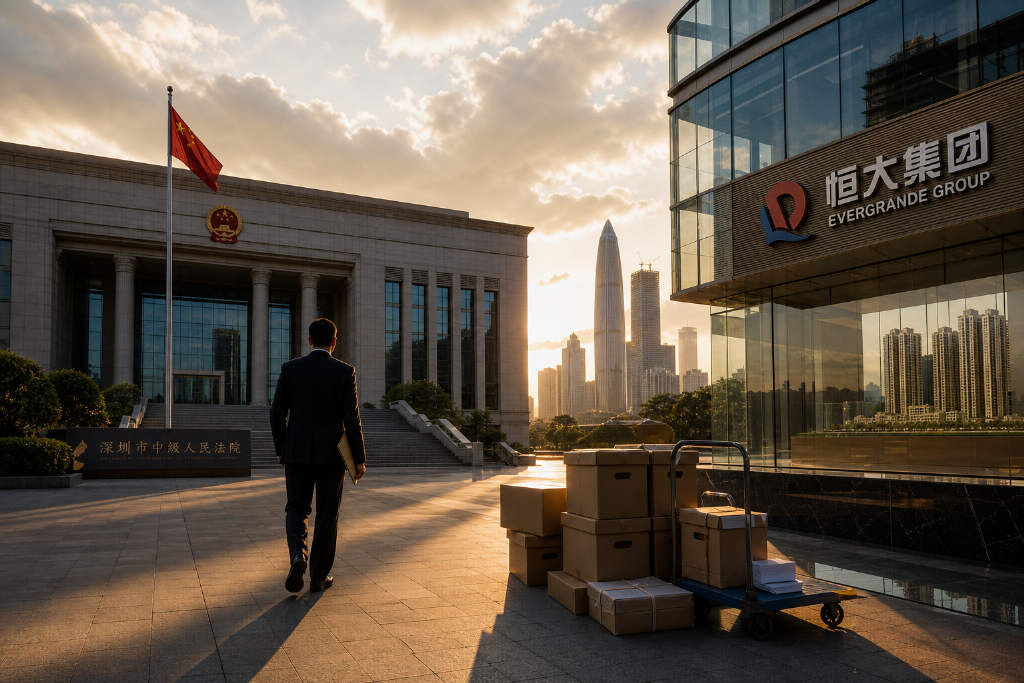
China Evergrande Group founder Xu Jiayin has been sentenced to life imprisonment in a first-instance ruling after years of fallout from the developer’s debt crisis. According to China Central Television, the Shenzhen Intermediate People’s Court in Guangdong publicly delivered its verdict on the morning of Aug. 20 in cases involving Evergrande Group, Evergrande Real Estate and Xu.
The court said Xu was convicted on multiple charges, including fundraising fraud, fraudulent securities issuance and occupational embezzlement. He received a life sentence, was stripped of political rights for life and had all personal assets confiscated.
Evergrande Group was fined 8.82 billion yuan, while Evergrande Real Estate was fined 7 billion yuan. Illegal gains tied to the case will continue to be recovered, and any uncovered losses must be repaid.
Court says fraud ran from 2016 to 2021
The court found that Xu was the de facto controller of Evergrande Group, fully responsible for the group’s operations, and that he managed and controlled several companies including Evergrande Real Estate, Evergrande Wealth and Evergrande Nanchang. The group’s business footprint spanned property, property services and finance.
According to the ruling, Evergrande Group, Evergrande Real Estate and Xu engaged in sustained, large-scale financial fraud from 2016 through 2021. The court said they inflated assets and concealed liabilities, leading to criminal conduct involving illegal absorption of public deposits, fundraising fraud, fraudulent securities issuance and illegal disclosure of material information.
The case went beyond false financial reporting. The court also found that Evergrande Group and Xu used bribery and other means to gain control over financial institutions, then illegally obtained credit and insurance funds for Evergrande Group’s use. That formed part of the basis for charges including unit bribery, illegal loan issuance and illegal use of funds.
The court also said Xu used his position as chairman of Evergrande Real Estate to organize financial fraud and embezzle company assets in the name of “dividends,” which separately constituted occupational embezzlement.
Eight offenses tied to Xu
Based on the court’s findings, Evergrande Group and Xu were involved in illegal absorption of public deposits, fundraising fraud, illegal loan issuance, fraudulent securities issuance, illegal disclosure of material information and unit bribery.
Xu personally also faced charges related to illegal use of funds and occupational embezzlement, bringing the total to eight offenses. The court ultimately imposed a combined punishment of life imprisonment, lifelong deprivation of political rights and confiscation of all personal assets. Evergrande Real Estate was found guilty of fraudulent securities issuance.
The court described the crimes linked to Evergrande and Xu as involving “especially huge amounts” and “especially vile circumstances,” saying they caused extraordinarily severe economic losses and seriously damaged market economic order, which led to strict punishment under the law.
Xu pleaded guilty at the April hearing
ABMedia said the Evergrande fraud case was heard at the Shenzhen Intermediate People’s Court on April 13 this year. Evergrande Group and Evergrande Real Estate appeared as defendant entities, while Xu stood trial in his personal capacity.
At that hearing, Evergrande Group and Evergrande Real Estate faced accusations including illegal absorption of public deposits, fundraising fraud, illegal loan issuance, fraudulent securities issuance, illegal disclosure of material information and bribery. Xu was also charged with illegal use of funds and occupational embezzlement. After court investigation, arguments and final statements, Xu pleaded guilty in court, and the court said it would announce the judgment at a later date.
Roughly four months later, the ruling has now been delivered, with Xu receiving a life sentence in the first-instance judgment.
From China’s richest man to a life sentence
Xu once worked as a steel worker before founding Evergrande Real Estate in Guangzhou in 1996. Through a model built on rapid development, rapid sales and high leverage, he turned the company into one of China’s largest property developers. Its business later expanded into tourism, health, culture and new energy vehicles.
In 2016, Evergrande entered the Fortune Global 500 for the first time. In 2017, Xu topped the Hurun China Rich List with a fortune of about 290 billion yuan.
But that rapid rise rested on a heavy debt structure. After China introduced the “three red lines” financing policy for property developers in 2020, Evergrande’s high-leverage model became harder to sustain. In the second half of 2021, the company ran into a series of problems including overdue commercial bills and suspended payments on wealth management products. In December that year, it said it could not fulfill part of its debt obligations, and the debt crisis fully broke into view.
By the end of 2022, Evergrande’s total liabilities had reached about 2.4 trillion yuan. In September 2023, Xu was placed under compulsory measures by Chinese authorities on suspicion of criminal offenses. In March 2024, the China Securities Regulatory Commission imposed an administrative penalty over financial fraud at Evergrande Real Estate, fining Xu 47 million yuan and banning him from the securities market for life.
The company’s own endgame unfolded in parallel. In January 2024, Hong Kong’s High Court ordered the liquidation of China Evergrande. Its shares then remained suspended for a long period, and the Hong Kong Stock Exchange ultimately decided to cancel its listing status.
From becoming China’s richest man in 2017 to presiding over a property group hit by trillions of yuan in debt, then seeing the company enter liquidation and lose its listing, Xu’s fall has played out over nearly a decade. With his detention, guilty plea and now a first-instance life sentence plus confiscation of all personal assets, the Evergrande collapse has become one of the clearest cases tied to the end of China’s era of rapid property expansion.