
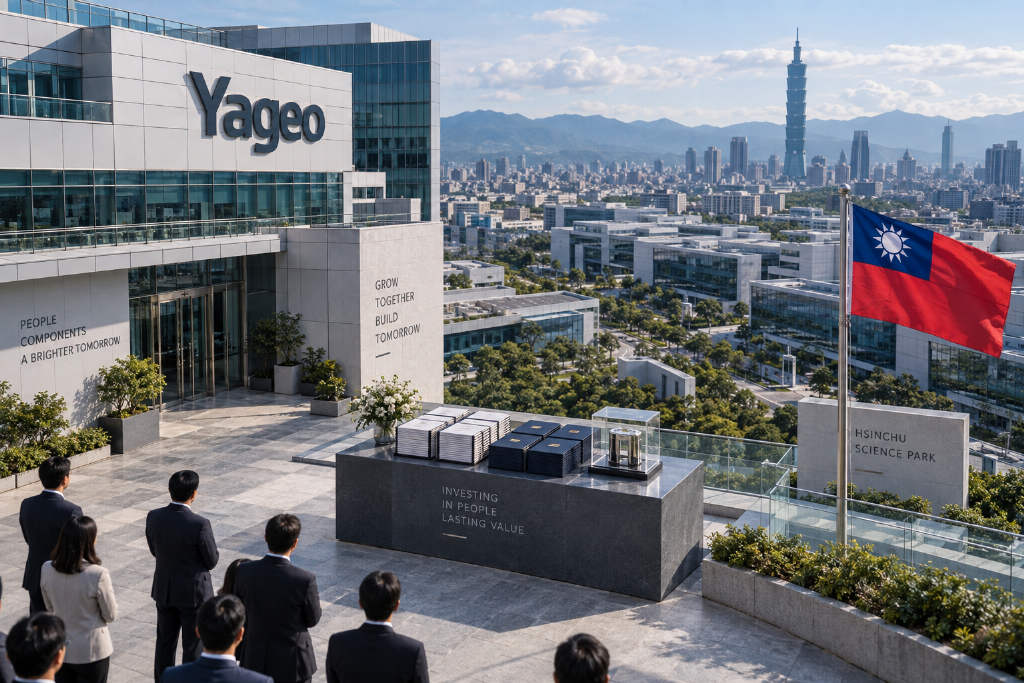
Yageo, a leading passive components maker in Taiwan, has set the capital increase record date for its 2025 and 2026 restricted stock awards for employees, according to a filing cited by ABMedia. The company plans to issue about 4.398 million restricted shares at no cost. At a current market price of about NT$570 per share, the package is worth roughly NT$2.5 billion.
Nearly 4.4 million shares to be issued across two years
The filing said Yageo will issue 3,294,628 shares under its 2025 plan and 1,103,146 shares under its 2026 plan. The par value is NT$2.5 per share, and the capital increase record date is set for Sept. 10, 2026.
Based on Yageo’s current outstanding share capital of about 2.058 billion shares, the dilution rate is around 0.21%, the report said. ABMedia described the effect on earnings per share and voting rights as limited.
The report said the restricted shares come with lock-up periods and performance requirements. Before the conditions are met, the shares will be placed in trust and cannot be sold in the secondary market right away, limiting the chance of near-term sell pressure.
Still, under accounting rules, the roughly NT$2.5 billion in market value will be amortized quarter by quarter as salary expense during the vesting period, making it a defined expense in the company’s financial statements.
Taiwan tech compensation is shifting toward a two-track structure
ABMedia said Yageo’s stock grant structure reflects a broader change in incentive systems across Taiwan’s technology sector. Since Taiwan adopted the expensing of employee profit-sharing in 2008, the old model of broad-based stock distribution has largely faded. In its place, major tech companies have increasingly moved to a two-track approach.
- Cash compensation remains the main tool for rank-and-file staff and engineers, with a focus on stable take-home income.
- Restricted stock awards are used more often for core technical staff and senior executives, tying compensation to long-term company performance.
The report named Taiwan Semiconductor Manufacturing Co. (TSMC), MediaTek and Yageo as examples of companies that have used restricted stock in recent years to bind strategic talent to longer-term operating goals.
For employees who receive RSAs, the structure offers upside if the company grows, but it also comes with lock-up restrictions and tax pressure. Under the tax rules cited in the report, restricted stock must be included in comprehensive income at full market value on the vesting date. If the employee falls into the top 40% tax bracket, the upfront tax burden can be substantial.
Report says Yageo’s base-level pay looks closer to manufacturing
The article also examined compensation for Yageo’s rank-and-file workers. Using Taiwan Stock Exchange data on non-management full-time employee pay in 2025, it said Yageo’s median annual salary stood at a little more than NT$750,000.
ABMedia contrasted that with wafer foundries and IC design companies, where median annual pay often starts above NT$1 million. As a passive components manufacturer, Yageo’s wage structure was described as closer to traditional hardware manufacturing. The report added that when the sector enters an inventory correction cycle, year-end bonuses and profit-sharing for front-line employees often become less generous.
Equity rewards are described as concentrated on core performers
ABMedia also said Chairman Pierre Chen is known for a management style centered on measurable results. The article said employees involved in cross-border acquisitions, integration in high-end automotive and industrial markets, or critical technical architecture are more likely to receive highly competitive bonuses and equity incentives.
In the report’s account, the main logic behind this RSA issuance is to align interests and keep top technical and management talent in place over the next two to three years, with the aim of supporting operating performance and the share price.
The article concluded that Yageo does not follow a universal profit-sharing model, but equity rewards remain a direct retention tool for the company’s top contributors.