
Japanese avant-garde artist Yayoi Kusama died on Aug. 14 at a hospital in Tokyo at the age of 97. Her official website did not announce the news until the morning of Aug. 27. The report said the cause of death was multiple organ failure, and the update sent shockwaves through the global art world.
How hallucinations became her artistic language
Kusama was born on March 22, 1929, in Matsumoto, Nagano, Japan, where her family ran a nursery and seed business. Around the age of 10, she began experiencing hallucinations: flashes of light, halos, dense fields of dots, talking flowers, and patterns on fabric that seemed to reproduce and spread on their own. She later described the white pebbles in the riverbed outside her family home as the starting point of her fascination with dots.
What once caused her deep distress eventually became the visual language that defined her work for the rest of her life.
New York years and international recognition
In 1958, Kusama left Japan for New York. Before departing, she wrote to American painter Georgia O’Keeffe for advice, saying she saw Japan at the time as 「too small, too obedient, too feudal, and too dismissive of women」. During more than a decade in New York, she created her first Infinity Mirror Room in 1963 and staged a series of happenings in the 1960s centered on nudity and polka-dot body painting. Those actions included a controversial event at the Museum of Modern Art in New York in 1969. She also appeared at the Venice Biennale twice, in 1966 and again in 1993.
Return to Japan and decades of work
Kusama returned to Japan in 1973. In 1977, she voluntarily entered a psychiatric hospital in Tokyo, where she continued to live for decades while maintaining an active artistic practice.
Her dot motif expanded far beyond galleries during that period. In 2012, her collaboration with Louis Vuitton brought polka dots to luxury storefronts around the world. In 2017, the Yayoi Kusama Museum opened in Tokyo. According to the official statement cited in the report, she never put down her brush before her death.
The naming thread running into Polkadot and Kusama
Kusama’s influence did not stop at art. The report points to a notable echo in crypto, saying one well-known public blockchain appears to carry her imprint in its naming.
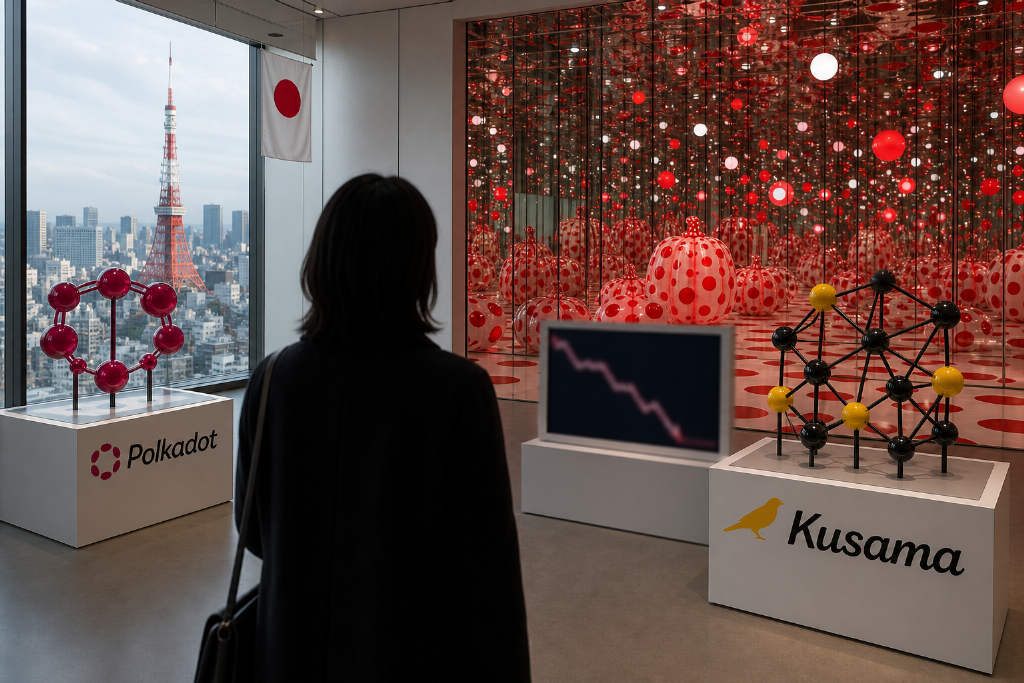
Polkadot’s Chinese name refers directly to dotted circles, the visual element most strongly associated with Kusama. Gavin Wood, Polkadot’s founder, has explained that the dot pattern has no beginning, middle or end, symbolizing the infinity and continuity of decentralized infrastructure. Even so, the report argues that the naming naturally recalls Kusama’s body of work.
The connection becomes more explicit with Kusama, Polkadot’s experimental canary network launched in the summer of 2019. Its name matches the Romanized spelling of the artist’s name, Yayoi Kusama.
The report said two major names in the Polkadot ecosystem — Polkadot and Kusama — both point back to the same artist. It added that while there has been no official public confirmation of that interpretation, the sense of tribute is strong.
Auction strength versus quieter chain activity
Kusama’s art market has followed what the report described as a steadily rising curve. In 2022, her Untitled (Nets) sold for about $10.5 million at a Phillips auction in New York, setting a personal auction high. She has also long ranked as the highest-grossing female artist in global auction sales.
Polkadot, by contrast, has been much quieter in recent years. The report said monthly active users across the Polkadot ecosystem fell from about 230,000 in early 2024 to fewer than 40,000.
From seeing those dots for the first time at age 10 to dying in a hospital room at 97, Kusama spent nearly 90 years making art. Her work and her symbols are now being revisited once more in crypto because of that naming link.