
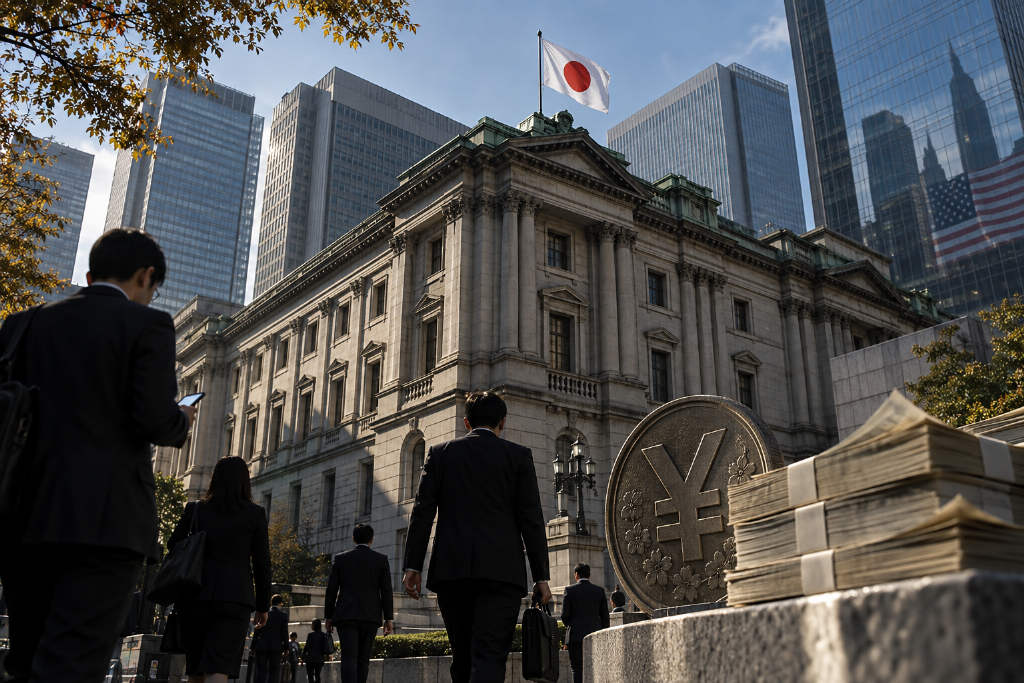
The Bank of Japan lifted rates in September as expected, but the move was less aggressive than markets had priced in. That gave investors brief relief after a stretch of anxiety tied to the yen’s fast appreciation and a run of hawkish signals from BOJ officials, which had revived memories of the 2024 carry-trade reversal that hit global assets.

The report, written by Wu Shuo and Lin Yan and published by Wallstreetcn, says the BOJ did not deliver the kind of hawkish surprise some investors had feared. Although Governor Kazuo Ueda did not rule out consecutive rate increases at the post-meeting press conference, he left the timing of future hikes open. At the same time, the external backdrop was not obviously negative: US August nonfarm payrolls were steady and oil prices were falling. With those factors in place, the impact on global markets remained limited. Asia-Pacific equities rose across the board, and the yen weakened further after the rate decision.
Risk of a near-term disorderly unwind has eased
The market has not dropped the issue entirely. As the BOJ continues with rate hikes, the cost of yen funding is rising, which reduces the appeal of the yen as a global funding currency for carry trades. Even so, the report argues that the risk of a concentrated near-term reversal has fallen. Capital is more likely to return gradually, with spillover effects seen as manageable.

At a basic level, yen carry trades rest on three linked parts. The first is funding: investors borrow low-yielding yen, and the policy rate set by the BOJ determines the financing cost. The second is foreign exchange: borrowed yen is converted into US dollars, and exchange-rate moves directly affect gains or losses on principal. The third is the asset side: those dollars are deployed into higher-yielding assets such as US Treasuries and US equities to earn spread income and capital gains.
For a full-blown, crowded unwind to take hold, the report says three conditions usually need to arrive together: persistent BOJ hikes that push funding costs higher, a fast and sizable appreciation in the yen that creates FX losses, and falling dollar-asset prices that compress returns.
Funding side: the BOJ has started hiking, but remains cautious
On the funding side, the report says the BOJ has begun tightening but still lacks the basis for a rapid and large increase in yen funding rates. Domestic fundamentals and fiscal constraints remain hard limits for Japanese policymakers, making an aggressive hiking cycle difficult.

The core payoff in a carry position comes from the US-Japan rate differential. While the yen’s funding appeal is weakening, that gap is still wide. The report points to a 10-year differential of around 200 basis points, which means the profit cushion for carry trades is unlikely to disappear quickly. Traders still have room to adjust leverage and reduce positions in stages, which lowers the odds of forced, concentrated liquidation in the near term.
FX side: the speed of yen gains matters more than the level alone
On the currency side, the report makes a clear distinction between the level of the yen and the pace of its move. A sharp rise over a short period can generate immediate mark-to-market FX losses and force traders to close positions together. A slower appreciation path gives the market time to adjust, making a stampede less likely.
For now, the pace of yen appreciation has slowed. The report links that partly to the BOJ’s likely gradual approach under domestic economic constraints. It also says this round of BOJ tightening is interacting with the Federal Reserve’s policy cycle in a way that limits how quickly the US-Japan yield gap can narrow, restraining one-way upside momentum in the yen.

Asset side remains the key variable
The asset side is where the report places the most weight. Carry capital ultimately goes into dollar assets such as US Treasuries and US equities, and those returns are what sustain the trade. If US stocks retreat sharply and Treasury yields fall quickly, income from the asset leg can shrink or turn negative. Combine that with rising yen funding costs and FX losses from yen strength, and the setup for large-scale liquidation becomes much more dangerous.
At present, though, higher-yielding dollar assets including US equities are still showing resilience. The macro backdrop and AI end-market demand have not shown signs of systemic deterioration, according to the report. That leaves asset-side returns sufficient, for now, to cover yen funding and FX costs, with no strong catalyst for investors to rush for the exit at once.

Position crowding has already come down
The report also says the crowding in yen-depreciation trades has eased significantly. After joint US-Japan intervention, short yen positions were covered in a visible way. In the week ended Sept. 15, CME non-commercial short yen positions were down about 56% from the late-July peak, while long positions jumped 135%. Net long positioning has also moved out of negative territory since September.
Because part of the short yen trade has already been covered, the risk that another wave of rapid short covering could trigger a concentrated carry unwind is seen as relatively contained.
What to watch next
Looking ahead, the report says markets should follow two things closely: whether the BOJ’s pace and scale of rate hikes accelerate beyond expectations, and whether the yen starts appreciating more sharply over a short window. Even so, it says the asset side remains the most important catalyst.

The 2024 episode offers the template. At that time, the market was also dealing with a rapidly strengthening yen and the start of BOJ hikes. But what finally broke carry positions was the shock from a pullback in global risk assets. The report says the initial rise in yen rates and the stronger yen only led to a gradual adjustment in positions. The decisive turn came in August, when a rise in the US unemployment rate triggered the Sahm Rule and pushed recession expectations higher. That sparked systemic selling in global assets and accelerated both the carry unwind and yen appreciation.
For that reason, the report argues that investors should pay closer attention to tail risk on the US asset side. The main factors to monitor are a sharper-than-expected slowdown in the US economy, escalating geopolitical conflict, wider divergence inside the AI sector, and sharp volatility in the US Treasury market.
