

On July 6, Yield Guild Games (YGG) and co-founder Gabby Dizon announced the closure of YGG Play, the company’s game publishing division. Under the transition plan, the platform and several published games will be gradually wound down by July 31. YGG said 35 employees will receive an additional eight weeks of compensation. Among the affected titles, GIGACHADBAT will be transferred to developer Delabs for continued operations, while games including LOL Land and Waifu Sweeper will be retired.
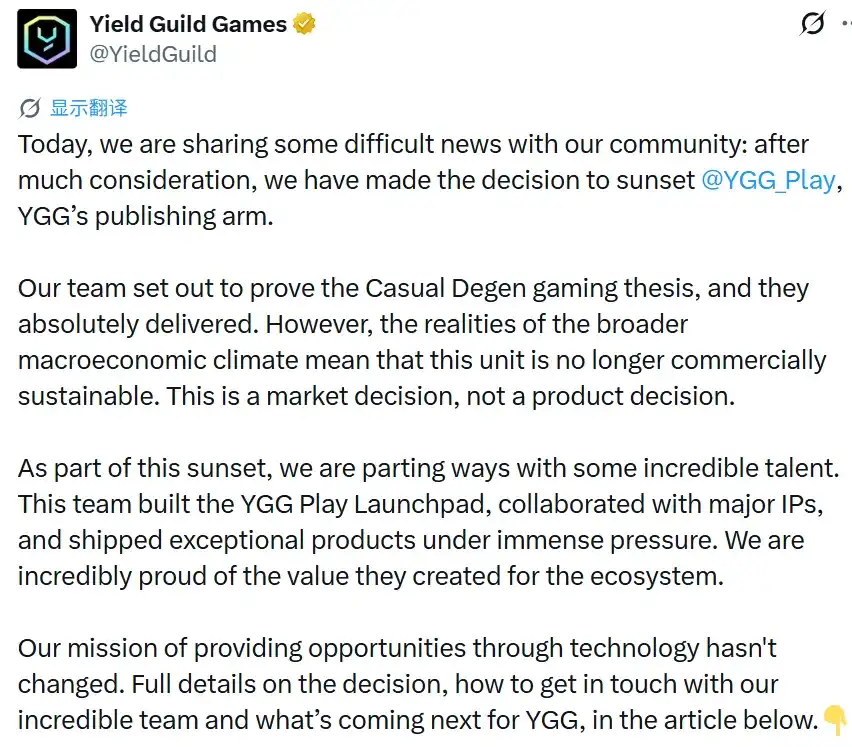
According to the company, games published through YGG Play generated more than $9 million in cumulative revenue, with $876,000 contributed in the first quarter of 2026 alone. In his statement, Dizon described the move as “a market decision, not a product decision.” He said the team had successfully validated the casual crypto gaming segment, especially short-session experiences with high engagement and fast feedback loops for crypto-native users, but weakening liquidity and falling user confidence in the broader macro environment had undermined the business’s commercial sustainability.
YGG exits publishing and redirects resources to AI data infrastructure
Alongside the shutdown, YGG announced a full pivot toward the AI Data Economy. The company said it intends to compete in the market for AI training datasets, which it described as a multibillion-dollar opportunity. Its initial priority will be building B2B pipelines around gaming-related datasets. The shift signals a major reallocation of resources away from YGG’s previous “guild operations plus publishing” model and toward a data-focused business line.
YGG Play was launched in 2025 as YGG’s Web3 game publishing arm, designed primarily for casual crypto users. The platform focused on lightweight mobile experiences with social features and reward feedback, helping independent studios distribute games on-chain while using YGG’s community network for user acquisition and live operations. By the company’s own account, the business generated meaningful revenue through 2025 and 2026, suggesting that selected verticals in Web3 gaming were still capable of producing real consumer spending even in a weaker market cycle.
However, the revenue peak came around October 2025. The original report said the large-scale liquidation event in the crypto market that month further damaged users’ willingness to spend and reduced retention among YGG Play’s target audience. In that sense, the platform did not fail on product execution alone. Instead, it ran into worsening market timing and a deteriorating demand backdrop. The shutdown therefore represents a clear strategic contraction after YGG’s recent expansion into publishing.
From Axie-era guild leader to repeated reinvention
To understand the weight of the decision, it helps to revisit YGG’s trajectory. The company was founded in 2020 by Gabby Dizon, Beryl Li, and pseudonymous co-founder Owl of Moistness. At the height of the pandemic, many service-sector workers in the Philippines had lost jobs, while Axie Infinity was rapidly expanding through its scholarship model, which allowed players to borrow Axie NFTs and share earnings. YGG seized that opening by raising funds to acquire Axie assets, organizing and training players, and quickly becoming one of the largest and most influential guilds in the Axie ecosystem.
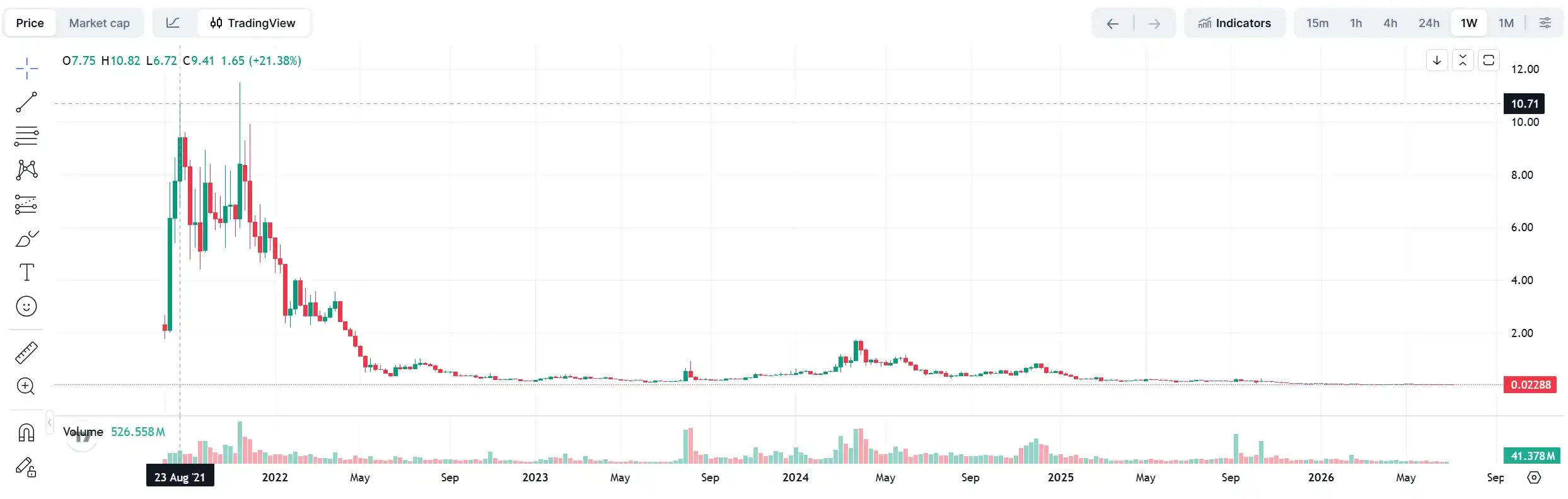
YGG reached its peak in 2021. Supported by both the crypto bull market and the Play-to-Earn narrative, the YGG token climbed to above $10 at its high. The organization expanded from a single Axie-focused guild into a global network spanning dozens of regional guilds, while forming partnerships with more than 80 blockchain gaming and infrastructure projects. During that period, YGG went beyond asset lending and revenue sharing, using quests, campaigns, and community operations to help users maximize returns. In markets such as the Philippines, gaming even became a form of real economic activity, with YGG often cited as a flagship example of the P2E model.
That momentum faltered in 2022 as the bear market exposed the fragility of Axie Infinity’s token economy and, more broadly, the limits of P2E. New user growth slowed, token prices collapsed, and player retention deteriorated. Many guilds and game projects disappeared altogether. YGG survived, but only by entering a prolonged period of adaptation. In 2025, it made another strategic bet by launching YGG Play and moving into game publishing, aiming to replace unsustainable heavy P2E models with lighter, higher-frequency casual experiences for crypto users. Less than a year later, that pivot has also been cut back.
YGG Play’s shutdown mirrors broader structural problems in Web3 gaming
The closure of YGG Play can also be read as a condensed version of the last five years in blockchain gaming. In April 2026, crypto quantitative trading and market-making firm Caladan reviewed the sector’s rise and collapse, arguing that the downturn was not simply a cyclical slump. Instead, it reflected a structural mismatch between speculative financial design and players’ actual entertainment demand. According to that analysis, roughly $15 billion in capital was destroyed as a result.
The original article cited several examples. Pixelmon raised $70 million and still had not reached public beta after four years. Ember Sword burned through $18 million before winding down. Hamster Kombat reportedly lost 96% of its users within six months. As of April 2026, among roughly 3,200 blockchain game projects tracked in the report, 93% had been classified as effectively dead or no longer meaningfully active. Across the gaming segment, crypto token prices were down an average of 95% from their 2022 all-time highs.
The common thread in those failures is the dependence of many blockchain games on a “play-to-earn” incentive loop. In practice, early player returns and token prices relied heavily on a continuous inflow of new users buying tokens or NFTs. Once user growth slowed and external capital weakened, token inflation overwhelmed the system’s economic balance. That in turn triggered falling prices, shrinking rewards, and player exits in a classic death spiral. Against that backdrop, YGG Play’s revenue generation was not enough to offset the sector’s deeper structural headwinds.
For YGG, shutting down YGG Play and shifting toward the AI Data Economy is more than the end of one product line. It marks another clear break from a previous Web3 gaming narrative that once defined the company’s identity. Based on the information disclosed so far, YGG’s next phase will center on gaming datasets and AI training-data infrastructure for business clients, while game publishing will no longer be a strategic priority.