
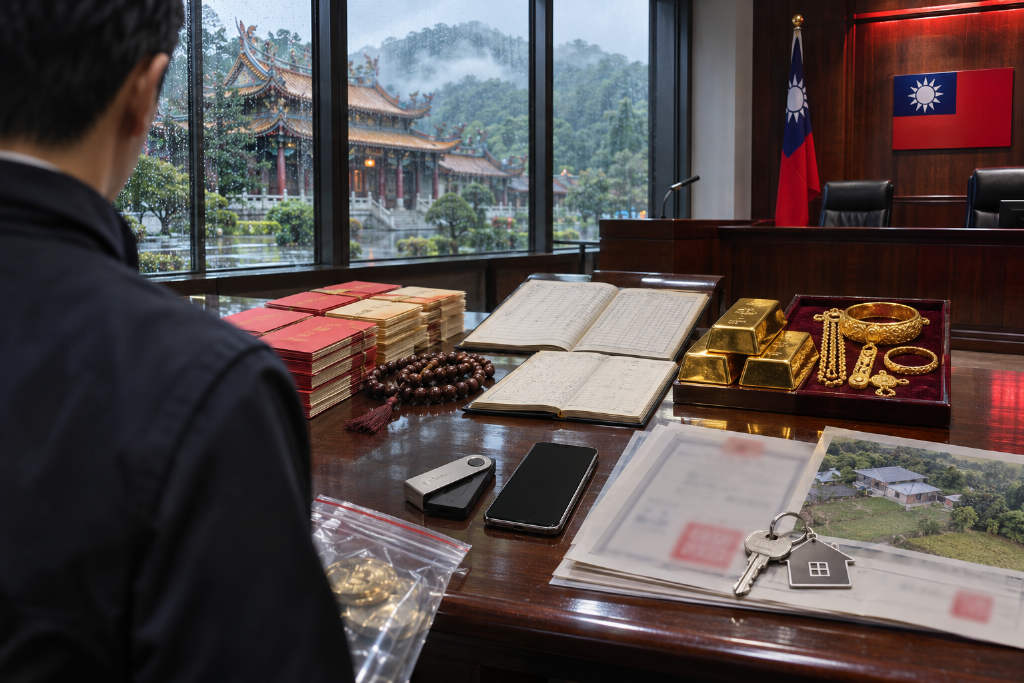
Amitabha Home Donglin Temple, a well-known Buddhist temple in Yilan, is at the center of a major embezzlement and money laundering probe. Citing United Daily News, ABMedia reported that abbot Chang Ching-yu and his son allegedly controlled the temple’s finances over a long period and diverted hundreds of millions in donations and temple assets for personal use. Investigators say the money was used to buy land, a farmhouse, and a luxury camper van, and that part of the funds may have been concealed through nominee accounts, gold, and cryptocurrencies. After tracing the case, the Yilan District Prosecutors Office found the two were suspected of serious offenses including occupational embezzlement and money laundering, and a court approved detention with no visitation.
A family dispute over donations worth nearly NT$300 million
The case first surfaced through a family property dispute involving Jin Cheng Fish Ball, a century-old business on Dihua Street in Taipei. The shop’s second-generation female owner, surnamed Tsai, began practicing at Donglin Temple in 2010 and donated assets worth nearly NT$300 million over several years.
Her family alleged that Tsai was elderly, illiterate, and blind in one eye. They said that even while she was in poor health and hospitalized, she was taken out of the hospital to process bank transfers. After leaving the hospital, more than NT$70 million in time deposits was also withdrawn. The family later found that most of her substantial assets had been depleted, with only about NT$300,000 left in her account, and filed a fraud complaint against people linked to the temple.
Chang had previously denied fraud in court. He argued that the money had been donated voluntarily by followers and was intended for construction of the religious site, and said the family had already known about the donations.
Probe widened from donation dispute to asset diversion and laundering
As investigators dug deeper, the focus moved beyond a dispute over religious donations and expanded into suspected misappropriation of temple assets and money laundering. Prosecutors believe Chang and his son had long controlled the temple’s finances, converted part of the donations and temple property into private assets, and used the money to acquire land near the temple, a farmhouse, and a luxury camper van.
The report said the pair also allegedly converted part of the suspected proceeds into gold and cryptocurrencies to hide the source and destination of the funds. Investigators are also tracing nominee accounts, stocks, silver, and other assets. Their suspicion is that the people involved spread funds across several financial instruments, making the trail harder to reconstruct.
Crypto angle remains unclear
Compared with traditional bank transfers, cryptocurrencies can be moved through self-custody wallets without relying on a bank intermediary for each on-chain transfer. If multiple wallet addresses, different blockchains, or over-the-counter channels were used, that could make it harder for law enforcement to identify the actual controller and rebuild the full flow of funds.
That said, crypto transactions are not fully anonymous. Transfer records on public blockchains can usually be traced, and investigators can cross-check exchange identity verification data with bank deposit and withdrawal records.
In this case, it is still unknown whether the assets involved included Bitcoin, USDT, or some other cryptocurrency, how much money was moved, which trading platforms were used, or whether self-custody wallets or cross-chain tools were involved.
Based on account books, fund flows, and related transaction records, prosecutors concluded that the allegations against Chang and his son were serious enough to justify detention. The court has ordered both men held in custody.



