
Beijing police have opened a criminal investigation into Yixin-related companies after months of repayment turmoil, placing founder Tang Ning and the group’s earlier blockchain and crypto investments under renewed scrutiny.
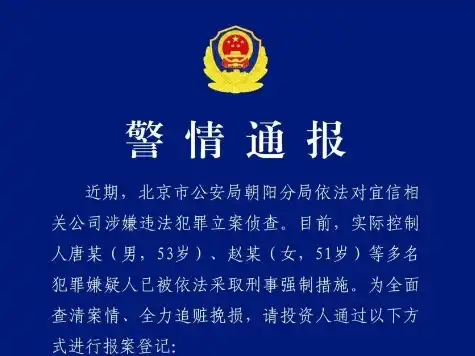
The Chaoyang branch of the Beijing Municipal Public Security Bureau said it had filed a case over suspected illegal and criminal activity involving related Yixin companies. It added that multiple suspects had been placed under criminal coercive measures, including actual controller Tang, a 53-year-old man identified as Tang, and Zhao, a 51-year-old woman identified as Zhao. One day earlier, Yixin had sent an apology letter to clients of its quasi-fixed-income products, acknowledging that the products had effectively defaulted and saying the group might be insolvent and facing a significant repayment gap.
Tang was once one of the best-known figures in China’s internet finance industry. With the case now under formal investigation, the market is revisiting both Yixin’s rise and its later investment reach into blockchain finance and Web3.
From consumer lending to a New York listing
Public information cited in the report shows that Tang studied mathematics at Peking University, later went to the United States to study economics, and then joined Wall Street investment bank DLJ, where he worked on listings, bond issuance and M&A. After returning to China in 2000, he served as director of strategic investment and mergers and acquisitions at AsiaInfo Group. He founded Yixin in 2006, entering the personal and small-business lending market.
Less than a decade later, Yixin had taken one of its platforms to the New York Stock Exchange. In 2012, online P2P platform Yirendai went live. In December 2015, Yirendai was listed on the NYSE, becoming the first Chinese P2P online lending platform to go public in the United States. That gave it the label of China’s first listed P2P company in the U.S. market. At a time when domestic internet finance was expanding quickly, the U.S. listing turned Tang and Yixin into one of the sector’s most watched names.
Yixin later expanded from personal and small-business lending into wealth management and equity investment, with its client base extending to high-net-worth investors. In 2016, Yixin’s new financial industry investment fund reached $1 billion in size and began looking globally for fintech opportunities. Publicly disclosed portfolio companies included card-issuing infrastructure firm Marqeta, bond trading platform Trumid and identity verification company Onfido, showing a business scope far beyond its original online lending match-making model.
Repayment suspension lasted nearly five months before the police case
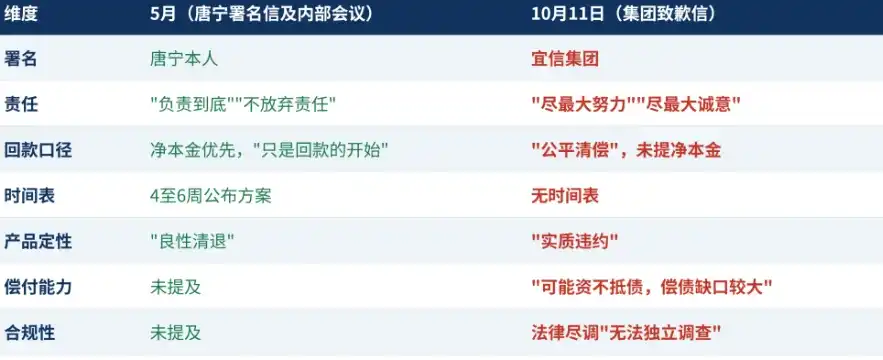
Yixin abruptly halted repayments in May. On May 22, it announced a “benign liquidation” process for its quasi-fixed-income products, suspended repayments across the board, and said it expected to release a winding-down plan within four to six weeks.
According to media reports cited in the source article, the funds involved were about 30 billion yuan. A former employee separately estimated that the outstanding balance of the products was 40 billion to 50 billion yuan, involving nearly 100,000 investors.
The underlying assets of those products mainly included consumer finance loans, vehicle-backed loans, supply chain finance, financial leasing and agriculture-related claims. Some of the products had previously advertised expected annualized returns of 4.6% to 10.5%. Yet after nearly five months, investors still had not received a clear repayment arrangement. As of October, Yixin had not announced a final recovery ratio or a specific repayment timetable.
On Oct. 11, Yixin pushed an apology letter to affected clients through the Ruicheng and Yiren Youxuan apps. According to the group’s explanation, shrinking scale and weak returns in its inclusive finance and wealth management businesses, heavy losses in multiple operations, low prices for asset disposals and a lack of effective funding sources together led to an effective default on the quasi-fixed-income products. A preliminary third-party asset inventory and financial due diligence review found that the group might be insolvent and facing a large repayment gap.
From calling it a “benign liquidation” in May, to acknowledging an effective default on Oct. 11, and then to the police case, Yixin’s repayment crisis has stretched close to five months. Specific charges and the full case details have not yet been disclosed.
Yixin’s crypto link dates back to a 2016 investment in Circle
As Yixin’s troubles escalated, its past overseas investments, especially in Web3, drew fresh attention. Public records show that the company’s connection to the crypto sector can be traced back to 2016.
In June 2016, Circle announced a $60 million strategic financing round. Yixin joined the round alongside IDG, Breyer Capital, Baidu, CICC ALPHA under CICC, Everbright and Wanxiang, among others. Circle’s official announcement also included a statement from Tang saying that Yixin’s fintech industry fund was optimistic about digital mobile payments and blockchain technology.
At that time, Circle was not yet the stablecoin issuer familiar to today’s crypto users. Its main product focus was blockchain-based social and cross-border payments, with the goal of letting users in different countries move money as easily as sending a message. Circle did not launch USDC until September 2018. In other words, when Yixin invested in Circle, it was backing a blockchain payments company, not the later stablecoin business.
That said, Circle’s ownership structure changed materially after later financing rounds and its eventual listing. According to the latest public disclosures from 2026 cited in the source article, Yixin and its affiliated entities no longer appear on the list of Circle’s major shareholders. Current major holders include IDG-related funds, BlackRock, General Catalyst, Chuang Xi Capital and CEO Jeremy Allaire. So while Yixin once invested in Circle, it is no longer a shareholder.
Other crypto and blockchain companies in Yixin’s portfolio
Figure: on-chain lending infrastructure
In April 2019, Yixin’s fintech industry fund published an announcement listing Figure as a portfolio company and noted that it had won awards related to blockchain innovation. Figure appeared again in the fund’s disclosed investment list in 2020.
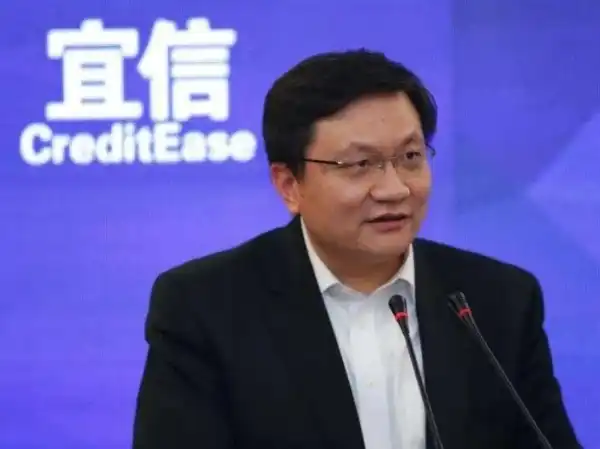
Figure entered the market through businesses such as home equity lending and combined lending operations with blockchain technology. According to information on its website cited in the report, Figure Connect supports whole-loan transactions and securitization execution on-chain.
That model was close to Yixin’s own lending background: the loans still corresponded to real-world borrowers and assets, while blockchain was applied to asset circulation and capital markets transactions. What is often discussed now under the RWA label had already appeared in Yixin’s portfolio.
Matrixport: crypto financial services platform
In August 2021, Matrixport raised $100 million in a Series C round at a valuation of more than $1 billion. The round was co-led by partners of DST Global, C Capital and K3 Ventures, with participation from Yixin’s fintech industry fund, Qiming Venture Partners, Tiger Global and Foresight Ventures.
Headquartered in Singapore, Matrixport provides trading, lending, structured products, asset management and custody services for retail and institutional investors. Based on company data disclosed at the time, client assets under management and custody exceeded $10 billion as of March 2021, and monthly transaction volume across product lines was about $5 billion.
Compared with Circle’s payments business and Figure’s tokenization-style lending infrastructure, Matrixport was more directly involved in crypto asset investment and management, giving it a clearer overlap with Yixin’s wealth management business.
Matrixport remains a privately held company, so its full cap table is not public. In theory, early investors may still hold part of their stakes, or they may have exited through later rounds or the secondary market. At present, though, there is no evidence showing an active equity or business connection between Yixin and Matrixport.
Cashmere Wallet: Solana enterprise multisig wallet
In August 2022, Solana enterprise wallet Cashmere completed a $3 million seed round at a $30 million valuation. Yixin participated alongside Coinbase Ventures, FBG Capital and Y Combinator.
Cashmere Wallet offers multisig wallets for companies and project teams on Solana. Outgoing transfers require approval from multiple authorized wallets. Teams can use that structure to assign treasury management and payment permissions and reduce the risk that assets are controlled by a single person or a single wallet.
The deal extended Yixin’s investment reach into crypto custody and enterprise treasury management.
Poko: Web3 payments provider
In June 2023, Poko announced a $4.5 million seed round. Investors included Y Combinator, NAZCA, Global Founders Capital and Yixin.
Poko provides payment integration tools for wallets, marketplaces, games and other Web3 applications. It supports the transfer of funds into on-chain assets through bank cards and local payment channels. Developers can embed those functions into their apps, reducing user friction in steps such as token purchases and transfers.
From Circle to Poko, Yixin’s crypto-related investments covered payments, lending, wallet tools and platforms that directly offer trading and asset management services.
No public evidence so far ties the repayment gap to crypto investments
Based on currently searchable police notices, Yixin’s apology letter and related public reporting, there is no evidence at this stage that the repayment shortfall was caused by crypto investments. There is also no evidence that investor funds were used to purchase crypto assets or were transferred on-chain.
For portfolio companies such as Circle, Yixin’s participation in a past financing round does not mean the two sides are operationally or financially bound today. Any actual impact would depend on the current holdings of relevant Yixin entities and on whether later share disposals become part of the picture.
For investors still waiting for repayment, the better-known names in Yixin’s portfolio are not the central issue. The key question is how much of those investments can still count as assets available for repayment.