
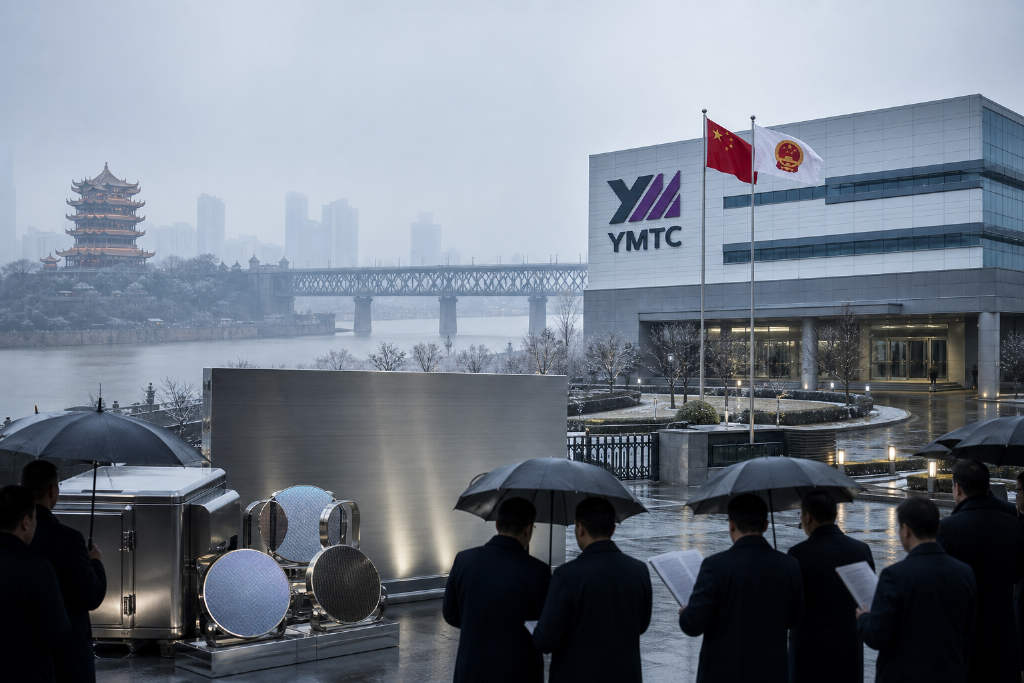
Yangtze Memory Technologies Co., Ltd. Holding, or YMTC Holding as referenced in the report, has had its STAR Market IPO application accepted and has formally submitted its prospectus. The company plans to raise RMB 33 billion, a sum that would top ChangXin Memory Technologies’ RMB 29.5 billion deal and set a new record for the largest IPO on Shanghai’s STAR Market.

The filing has put Hubei’s state-owned capital back in focus. A month ago, ChangXin Memory went public on the STAR Market, and its market value later climbed to RMB 4 trillion at one point. Both ChangXin Memory and YMTC Holding were founded in 2016, one in Hefei and the other in Wuhan, and the two are often grouped together as China’s “memory twins.” After ChangXin Memory’s listing, Hefei’s state capital system booked a massive paper return. The report argues that Wuhan may now be approaching a similar moment.
YMTC Holding moves toward a record STAR Market listing
The story starts well before the current filing. In 2006, Hubei province and the city of Wuhan invested more than RMB 10 billion to establish Wuhan Xinxin and build central China’s first 12-inch integrated circuit production line. That project laid the groundwork for the region’s later semiconductor expansion.
In 2015, memory chip development was elevated to the level of national strategy. Large semiconductor investment funds followed, including the national integrated circuit industry investment fund and local funds worth hundreds of billions of yuan. Against that backdrop, China’s push to localize memory chips accelerated. In the following year, the national memory base was established in Wuhan Optics Valley, and YMTC Holding was formed on the foundation of Wuhan Xinxin.
The company then advanced quickly. The report points to several milestones: a breakthrough with its first 3D NAND flash chip, the launch of the Xtacking architecture, and the successful development of a 128-layer 3D flash chip. Over time, the company grew into one of China’s major storage-chip players. Based on TrendForce data calculations cited in the article, YMTC Holding ranked third globally and first in China among NAND Flash manufacturers by both sales value and shipment volume in January through March 2026.
The timing is notable. The report says the market is in a storage upcycle tied to AI computing demand, and frames the IPO as part of Wuhan’s rising profile in semiconductors. At RMB 33 billion, the planned fundraising would not only refresh the STAR Market record but also overtake the benchmark ChangXin Memory set only recently.
Valuation expectations are also running high. The article says some analysis expects YMTC Holding’s future market capitalization could approach ChangXin Memory’s level. After listing, ChangXin Memory’s value at one point reached RMB 4 trillion. In operating terms, ChangXin Memory posted attributable net profit of RMB 24.762 billion in the first quarter of this year after returning to profitability. YMTC Holding posted revenue of RMB 47.042 billion and attributable net profit of RMB 33.379 billion over the same period.
The report adds a caveat. The two companies operate in different market segments, face different competitive structures, and have different product mixes, so direct comparisons remain an optimistic scenario rather than a settled market consensus. A more common view cited in the piece is that YMTC Holding could clear a RMB 1 trillion valuation after listing.
Prospectus details show the depth of Hubei state backing
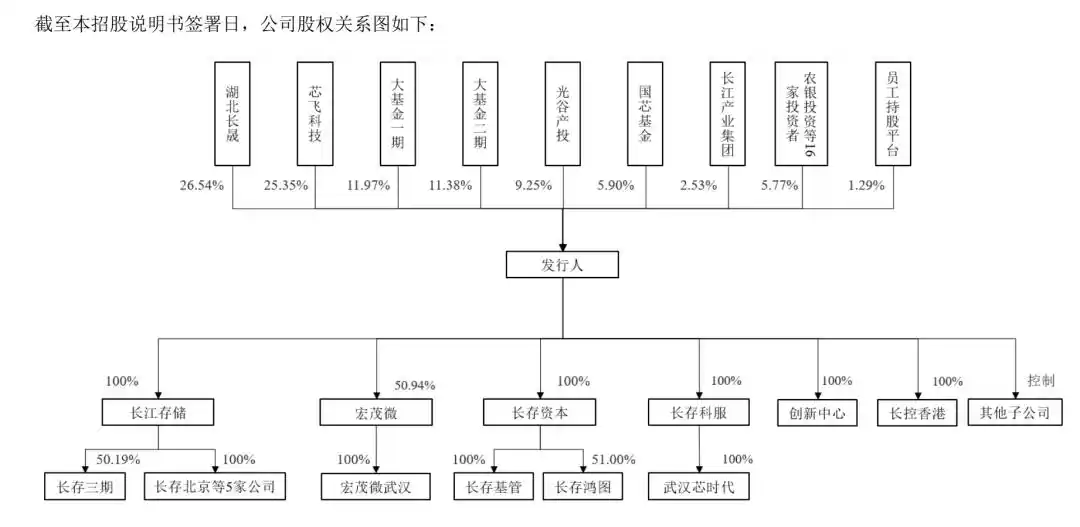
With the prospectus now public, more details about the company’s ownership have emerged. YMTC Holding’s predecessor, Changcun Limited, was jointly established by Xinfly Technology, Big Fund Phase I, Hubei Science Investment, and Guoxin Fund. At that stage, the company’s net asset appraisal value was about RMB 13.4 billion. Xinfly Technology, Hubei Science Investment, and Guoxin Fund are all described in the report as local Hubei state-capital vehicles.
According to the prospectus cited in the article, seven shareholders currently hold more than 1% each in YMTC Holding: Hubei Changsheng, Xinfly Technology, Big Fund Phase I, Big Fund Phase II, Optics Valley Industrial Investment, Guoxin Fund, and Yangtze River Industry Group. Their respective stakes are 26.54%, 25.35%, 11.97%, 11.38%, 9.25%, 5.90%, and 2.53%.
- Hubei Changsheng: 26.54%
- Xinfly Technology: 25.35%
- Big Fund Phase I: 11.97%
- Big Fund Phase II: 11.38%
- Optics Valley Industrial Investment: 9.25%
- Guoxin Fund: 5.90%
- Yangtze River Industry Group: 2.53%
Five of those seven shareholders carry Hubei state-owned capital backgrounds, according to the report. Hubei Changsheng, the largest shareholder, is wholly owned through a three-level state-capital structure spanning Hubei province, Wuhan city, and Wuhan East Lake High-tech Zone. Xinfly Technology is funded by Hubei state capital and the national semiconductor fund. Optics Valley Industrial Investment is described as the professional industrial investment platform of Wuhan East Lake High-tech Zone. Guoxin Fund also traces back to Hubei state investors, while Yangtze River Industry Group is 100% controlled by the Hubei State-owned Assets Supervision and Administration Commission.
If YMTC Holding lists at a valuation above RMB 1 trillion, the market value represented by Hubei state-capital holdings would run into the hundreds of billions of yuan. In the framing of the article, that would amount to a major payoff after roughly a decade of support.
Wuhan’s Optics Valley is seeing a broader hard-tech rerating
If YMTC Holding reaches the trillion-yuan mark, it would become the first listed company from Hubei to do so. The report says investor attention has already shifted toward Wuhan and Hubei this year.
It cites the recently discussed “Optics Valley Seven Stars”: YMTC Holding, Yangtze Optical Fibre and Cable, HGTECH, Accelink Technologies, FiberHome Telecommunication Technologies, Guide Infrared, and Datang Mobile’s listed platform CITIC Telecom Mobile as named in the article. Together, they are presented as a real-world snapshot of Wuhan’s optical communications industry gaining momentum.
HGTECH is one of the clearest examples. Its market capitalization has surpassed RMB 100 billion, and Wuhan state capital also plays a central role there. In 2020, HGTECH launched a reform to separate university-owned enterprise interests and agreed to transfer part of its shares through a public solicitation process. Guoheng Fund was selected, backed by shareholders including Wuhan Guochuang Innovation Investment Co., Ltd. and Wuhan Industrial Development Fund Co., Ltd.
Under the transaction terms cited in the article, Guoheng Fund paid about RMB 4.291 billion for a 19% stake in HGTECH held by Huazhong University of Science and Technology Industry Group. After the deal, Guoheng Fund became HGTECH’s largest shareholder, and the company’s ultimate controller shifted to the Wuhan State-owned Assets Supervision and Administration Commission.
At the time, HGTECH’s market value was only in the RMB 20 billion to RMB 30 billion range and the company’s hard-tech growth potential had not yet been fully recognized. It is now worth more than RMB 100 billion. Based on Guoheng Fund’s 19% holding, that stake is now worth more than RMB 19 billion, implying an unrealized gain of roughly RMB 15 billion, by the article’s estimate.
The report draws a straight line between YMTC Holding and HGTECH. In both cases, local state capital entered during a weaker phase, stayed through long development cycles, and benefited when industrial growth finally translated into earnings and valuation gains. Citing Hubei Daily, the article says provincial, municipal, and district-level state investors have put more than RMB 30 billion into the storage industry over the past decade-plus, continuing to add capital even during years when companies remained loss-making.
That support has also fed a wider cluster effect. The piece says Optics Valley now hosts 16,000 photoelectronic information companies. It is described as home to the world’s largest optical fiber and cable R&D and manufacturing base, China’s largest optoelectronic device R&D and production base, and the country’s advanced storage R&D and manufacturing base.
The article puts the scale of Wuhan’s photoelectronic information industry at more than RMB 850 billion. Under Wuhan’s 15th Five-Year Plan framework, the city aims to build two trillion-yuan industrial clusters in photoelectronic information and life and health, while pushing photoelectronic information toward world-class cluster status.
Hefei’s ChangXin case remains the benchmark comparison
The report then turns to Hefei, where ChangXin Memory’s STAR Market debut has become another landmark example of local industrial investment paying off. Hefei had already drawn attention for earlier moves involving BOE and NIO. ChangXin Memory has now added a new chapter to that story.
Its latest market capitalization is above RMB 3.7 trillion, making it the largest A-share company by market value, according to the article. Based on its prospectus, Qinghui Jidian, ChangXin Integration, and Hefei Jixin held a combined 45.16% stake before the offering, and Hefei’s state-capital system accounted for about 36.79%. At the current valuation, the market value of Hefei state-owned holdings exceeds RMB 1 trillion.
The article argues that the significance goes beyond financial return. Once ChangXin Memory was established in Hefei, semiconductor equipment, materials, and testing companies began building local supporting capacity around it, helping create a fuller chip ecosystem. Hefei now hosts more than 450 integrated circuit companies across design, manufacturing, packaging and testing, materials, and equipment, forming a complete chain.
The report says this industrial shift has also changed the city’s standing in capital markets. As of the July 27 close, excluding ChangXin Memory, the total market value of Hefei’s other A-share listed companies stood at about RMB 1.28 trillion, ranking 19th among Chinese cities. Including ChangXin Memory, that figure rises above RMB 4.56 trillion, pushing Hefei past Suzhou, Hangzhou, Wuxi, Chengdu, Guangzhou, Tianjin, and 15 cities in total to reach fourth nationwide.
What the report says about the next phase of city competition
The article closes by arguing that a single investment can alter a city’s industrial trajectory, but the path is hard to replicate. ChangXin Memory endured years of heavy losses over the past decade, yet Hefei’s state investors did not withdraw. YMTC Holding also remained in the red until 2024, when it finally returned to profitability. Before any payoff, local state capital had to absorb long holding periods and operating volatility.
The report also says that hard-tech tracks such as semiconductors and advanced manufacturing are not built on luck. It cites Zhongji Innolight in Suzhou and Eoptolink in Chengdu as other examples that took time to prove themselves.
Finally, the piece points to newly released GDP data for the first half of 2026. Anhui, with RMB 2.737 trillion, has returned to the national top 10. Zhejiang, Shanghai, Beijing, and Hubei all posted growth rates above the national level. In the article’s telling, those shifts reflect repeated rounds of industrial change and upgrading that are now reshaping the ranking of Chinese cities.
The original article was published by the WeChat public account Investment Circle and attributed to writer Wu Qiong.