
Yangtze Memory Technologies Co. (YMTC) has had its STAR Market IPO application accepted, according to an updated review notice on the Shanghai Stock Exchange website. The company plans to issue 1.98 billion to 2.43 billion shares and raise 33 billion yuan, with 20.8 billion yuan allocated to mass-production line technology upgrades and 12.2 billion yuan set aside for research and development projects.
Based on the proposed fundraising amount, the deal is the largest IPO application ever filed on the STAR Market. The sponsors are CITIC Securities and CSC Financial.
The prospectus shows a sharp improvement in operating performance. From 2023 to 2025, YMTC’s revenue climbed from 18.744 billion yuan to 63.185 billion yuan, representing a compound annual growth rate of 83.60%. Net profit attributable to shareholders moved from a loss of 19.181 billion yuan in 2023 to a profit of 6.771 billion yuan in 2024, then rose to 14.211 billion yuan in 2025.
In the first quarter of 2026, the company reported 47.042 billion yuan in revenue and 33.379 billion yuan in attributable net profit. Profit for that single quarter was already more than double the full-year figure for 2025.
Those results arrived in a specific market window. Since the second half of 2025, the global memory industry has entered an upswing driven by AI computing demand, with NAND flash prices continuing to rise. At the same time, major international memory makers temporarily tilted capacity toward overseas customers, leaving a supply gap that domestic producers were able to fill.
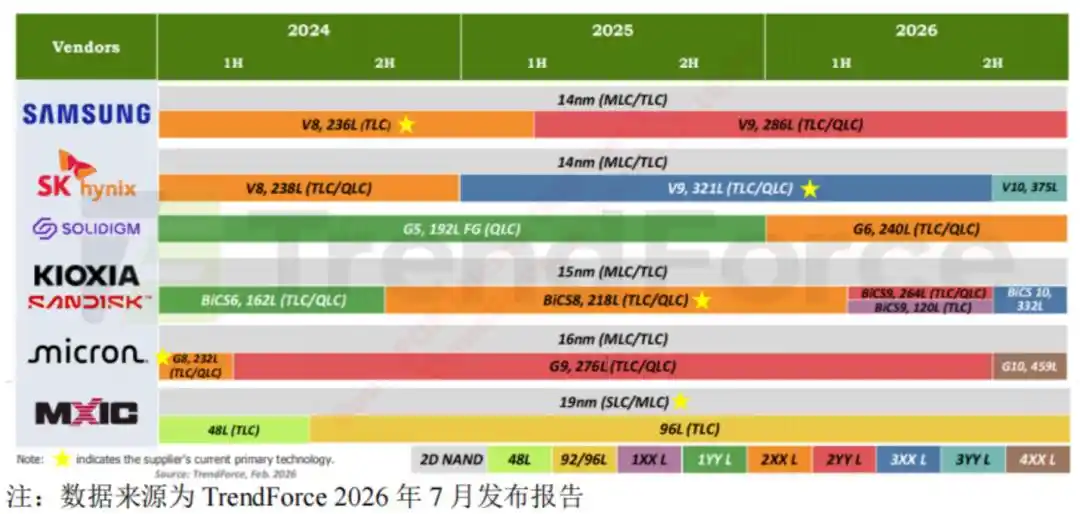
Using TrendForce data, the filing says YMTC ranked third globally and first in China among NAND Flash manufacturers in the first quarter of 2026 by both sales value and shipment volume.
That has also raised a harder question. Was a quarterly gross margin of 76.77% and a net margin of 71% a sustainable operating level for a chip manufacturer, or a snapshot taken near the top of the cycle? Once pricing tailwinds fade, what will support annual capital spending that runs into the tens of billions of yuan? And behind the 33 billion yuan fundraising plan, is the company building for expansion, or filling a financing gap?
The answers sit in the business model and the financial statements.
A capital-heavy memory business tied closely to the cycle
YMTC is an integrated device manufacturer, or IDM, in memory. Its operations cover chip design, wafer fabrication, packaging and testing, and system solutions. Its core product is 3D NAND flash, used in data centers, enterprise servers, smartphones, PCs, and other storage scenarios.
The earnings model is straightforward. In a standardized product market where pricing is set by supply and demand, the company relies on technology upgrades and scale to dilute unit costs and capture the spread between selling prices and production costs. When the market is strong, selling prices move well above relatively rigid costs and profit expands quickly. When the market turns down, the same high-depreciation cost structure can magnify losses.
The revenue mix reflects that pattern. In 2025, NAND Flash products accounted for 90.77% of YMTC’s core business revenue. Memory chips generated 29.444 billion yuan, or 47.17% of the total, with a gross margin of 44.21%. Smart terminal products integrating controller chips and firmware brought in 21.191 billion yuan, or 33.95%, with a gross margin of 29.83%. Solid-state drives contributed 6.025 billion yuan, or 9.65%, with a gross margin of 23.75%.
Other products and services were under pressure. Revenue from wafer foundry services, NOR Flash, chip packaging and testing, and similar businesses shrank from 23.12% of revenue in 2023 to 3.58% in the first quarter of 2026. Gross margin for those segments was below 25% in most reporting periods, showing a clear move to the edge of the business.
The ownership structure is another key part of the story. Before the offering, YMTC had 29 shareholders. The top five were Hubei Changsheng with 26.54%, Xinfei Technology with 25.35% — formerly Hubei Unigroup Guoqi and linked to the Unigroup system — the first phase of the National Integrated Circuit Industry Investment Fund with 11.97%, the second phase of the same fund with 11.38%, and Optics Valley Industrial Investment with 9.25%.
The prospectus states clearly that the company has no controlling shareholder and no actual controller.
Three features stand out. First, state capital plays a dominant role, with Hubei state-owned platforms and the two phases of the national semiconductor fund together holding more than half the company. Second, the shareholder list includes debt-to-equity implementation vehicles tied to five major state-owned banks: ABC Investment, CCB Investment, BOCOM Investment, BOC Asset Investment, and ICBC Financial Asset Investment Fund. That reflects the company’s earlier reliance on large-scale debt financing. Third, employee shareholding platforms such as Zhixin Plans No. 1 through No. 6 are also in the cap table, with limited combined ownership but coverage that points to core technical staff.
This mix of dispersed ownership and strong state backing means YMTC carries an industrial policy role while still needing to fund itself through commercial operations. That makes the quality of earnings central to any reading of the filing.
Profit growth has been driven first and foremost by pricing
In the first quarter of 2026, YMTC reported 33.379 billion yuan in attributable net profit. That result came with an average selling price for NAND products that was 172.72% higher than the full-year 2025 level, while shipment growth lagged far behind the increase in price.
Over a longer period, nearly all of the company’s profit elasticity came from pricing. In 2024, average product prices rose 125.11% and the company returned to profit. In 2025, average prices actually fell 13.76%, and YMTC relied on 64.74% shipment growth to keep profit expanding. In the first quarter of 2026, prices jumped again and profit followed.
That means the current net margin above 70% rests on historically elevated memory pricing.
The prospectus flags the risk directly in its section on special risk factors, warning of volatility and declines in prices and gross margin. The filing’s own history shows why that matters. In 2023, during an industry downturn, YMTC’s gross margin was only 5.45% and it posted a net loss of 19.181 billion yuan. It also recorded 11.353 billion yuan in inventory write-downs and impairment losses related to contract performance costs. By year-end, the inventory write-down ratio had reached 23.85%, nearly 9 percentage points above the 14.93% average for comparable memory companies listed in the prospectus.
According to the filing, one reason the burden was heavier than peers was the large amount invested in long-term assets, which pushed up unit product costs.
The swing from an annual loss of nearly 20 billion yuan to a quarterly profit above 30 billion yuan in just three years says as much about the cycle as it does about execution.
A depreciation-heavy cost base cuts both ways
The second challenge is embedded in the cost structure. Manufacturing expenses and depreciation accounted for 69% to 74% of operating costs, while materials made up only 21% to 26%. Over the reporting period, depreciation and amortization totaled about 50.949 billion yuan, and cash paid for the purchase and construction of long-term assets reached about 96.390 billion yuan.
That kind of fixed-cost base creates two-way operating leverage. When utilization and selling prices rise, gross profit expands quickly. When prices fall, depreciation does not fall with them, and losses can return just as fast. In 2023, while capacity was still ramping, the company’s core business gross margin was only 5.39%, a direct example of how the structure behaves in a downcycle.
The current fundraising plan adds another layer. Of the 33 billion yuan to be raised, 20.8 billion yuan is earmarked for production line upgrades. Once those projects are completed, they will become a new round of depreciation expense. YMTC is raising money for expansion near the top of the cycle, while the peak depreciation burden may arrive later.
Cash flow improved, but capital spending still absorbs it
The third challenge is the continuing strain between operating cash flow and capital expenditure.
In 2025, YMTC generated 32.684 billion yuan in net cash from operating activities. On the surface that looked solid. But cash paid for fixed assets and other long-term asset purchases reached 36.192 billion yuan in the same year, leaving free cash flow negative.
From 2023 to 2025, cash and cash equivalents fell from 56.322 billion yuan to 34.778 billion yuan. Heavy investment was sustained by drawing down existing cash, equity financing, and bank borrowing. In 2023, financial expenses reached 3.226 billion yuan, equal to 17.21% of annual revenue.
Operating cash flow improved sharply to 26.744 billion yuan in the first quarter of 2026, but accounts receivable rose from 9.541 billion yuan at the end of 2025 to 22.845 billion yuan, an increase of about 13.3 billion yuan in a single quarter. That growth far outpaced revenue.
The mismatch suggests that in a rising-price market, revenue recognition and cash collection did not move in step. The top five customers accounted for 54.34% of revenue, which means collection timing depends heavily on the bargaining power and payment terms of a small group of major buyers.
Inventory write-downs and procurement data point to supply-chain pressure
The fourth challenge appears in inventory and procurement.
As of the end of March 2026, YMTC carried 19.941 billion yuan of inventory on its books. The write-down ratio for raw materials was as high as 22.36%. Since 2024, that figure has stayed above 20% in every period, well above the roughly 7% level recorded for finished goods over the same stretch.
Why were raw material write-downs so large and persistent? Procurement data offers one clue. Purchases of spare parts as a share of total raw material procurement rose from 40.99% in 2023 to 58.99% in the first quarter of 2026. In that same quarter, the largest supplier was a trading company, accounting for 23.04% of procurement.
Buying equipment spare parts through trading channels, then seeing those parts lose value quickly as technology changes, gives a clearer picture of the real cost of equipment maintenance and spare-part security under external supply-chain constraints. The prospectus says directly that domestic suppliers are still catching up with international leaders, and that the overall technical level and stability of the supply chain remain barriers to entry in the industry.
Taken together, the chain is clear. Profit rises with the cycle, but the cost base is rigid, so cash accumulated in good times has to be pushed quickly into the next round of capacity competition. That competition requires equipment and spare parts, while supply-chain constraints lift procurement costs and write-down pressure. The funding gap then returns to the capital market. That is the backdrop to this 33 billion yuan IPO.
Two additional details stand out. As of the end of March 2026, YMTC still had about 3.4 billion yuan in accumulated losses that had not yet been fully offset. Its R&D expense ratio fell to 3.75% in the first quarter of 2026, below the 4.95% average for comparable memory companies listed in the prospectus.
In the race toward generations above 300 layers and new memory architectures, the intensity of R&D spending will shape where YMTC sits in the next technology cycle.
How much of the surge came from the market, and how much from YMTC itself
Part of the company’s latest performance came from the cycle. Part came from its own progress.
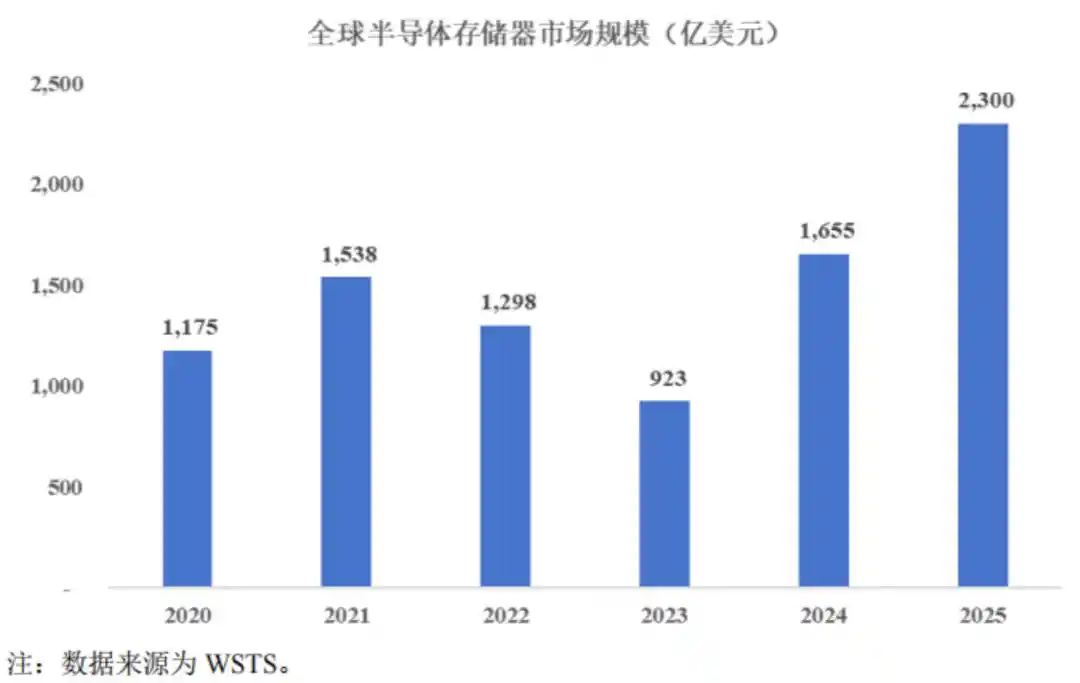
According to WSTS, the global semiconductor memory market expanded from $117.5 billion in 2020 to $230 billion in 2025. TrendForce data shows the global NAND Flash market reached $71.1 billion in 2025.
This upcycle differs from earlier ones because demand has changed in structure. AI has moved from training into scaled inference deployment, cloud service providers continue to add computing infrastructure, and enterprise storage demand has grown rapidly. On the supply side, a mismatch emerged that favored domestic producers. International memory giants temporarily prioritized overseas customers, while domestic memory makers currently cover only about half of local consumer-market demand. The gap turned into orders, giving YMTC an external base for shipment growth.
At the company level, YMTC’s gross margin in the first quarter of 2026 exceeded those of Micron, Kioxia, and SanDisk, and came close to SK hynix. Three years earlier, the figure was still in the single digits.
On products, YMTC was among the first companies globally to break through the 200-plus-layer threshold in 3D NAND. During the reporting period, its main products moved from the third generation to the fourth and fifth generations. Higher storage density and better yield directly reduced unit costs.
On customers, enterprise-grade storage chips have gradually won recognition from leading domestic data center users, a more meaningful threshold than consumer-market penetration. Compared with ChangXin Technology, the DRAM leader that listed on the STAR Market on July 27, YMTC’s first-quarter revenue of 47.042 billion yuan was below ChangXin’s 50.8 billion yuan, but its attributable net profit of 33.379 billion yuan was above ChangXin’s 24.76 billion yuan. On profitability, it did not trail.
Strength in NAND, but no hedge from DRAM or HBM
The gap with global leaders is still clear. Samsung and SK hynix run memory businesses that span DRAM, NAND, and HBM, and they have spent decades building enterprise-market positions and global customer systems.
YMTC is concentrated in NAND. Its revenue mix does not include DRAM or HBM as a counterbalance, and it has no position yet in HBM, the most critical memory segment for AI servers.
When companies such as Samsung can smooth the cycle with a full product portfolio, YMTC has to absorb each move in NAND pricing much more directly.
The prospectus outlines the company’s response.
- On products, it is extending toward system-level solutions and channeling more of its self-produced memory chips into in-house smart terminal and SSD products. Smart terminal revenue as a share of total revenue rose from 19.99% in 2023 to 35.53% in the first quarter of 2026. Increased procurement of materials for system-level products within spare parts also points in the same direction.
- On capacity, the company is pushing ahead with upgrades to the first production line and construction of the second and third phases, aiming to dilute depreciation through scale while concentrating wafer capacity in Wuhan for efficiency. The filing separately lists regional concentration of capacity as a risk.
- On supply chains, YMTC is building a more diversified supplier system, using both original manufacturers and trading channels, and including localization of semiconductor materials and equipment in the R&D direction for the fundraising projects.
- On capital, the IPO itself is part of the answer. The 33 billion yuan fundraising plan, together with a reduction in the asset-liability ratio from 61.30% to 43.65%, gives the company more room for the next investment cycle.
The filing shows both peak prosperity and structural volatility
YMTC’s prospectus presents a company reaching the capital market during a strong part of the cycle. Revenue more than tripled in three years. It returned to profit in 2024. In the first quarter of 2026, it ranked third globally in NAND Flash by both sales value and shipment volume. Its gross margin moved above those of three established international peers. Those facts are all in the filing.
So are the other facts: profit is highly sensitive to pricing, depreciation and amortization totaled 50.949 billion yuan, spare-part costs remain hard to avoid under current supply-chain conditions, and about 3.4 billion yuan of accumulated losses had not yet been fully covered as of the end of March 2026.
For investors, the most important line in the filing may not be the 33.379 billion yuan of quarterly net profit. It may be the company’s own warning that prices and gross margin are subject to volatility and decline.
This article was originally published by the WeChat public account Hension and written by Hension.