
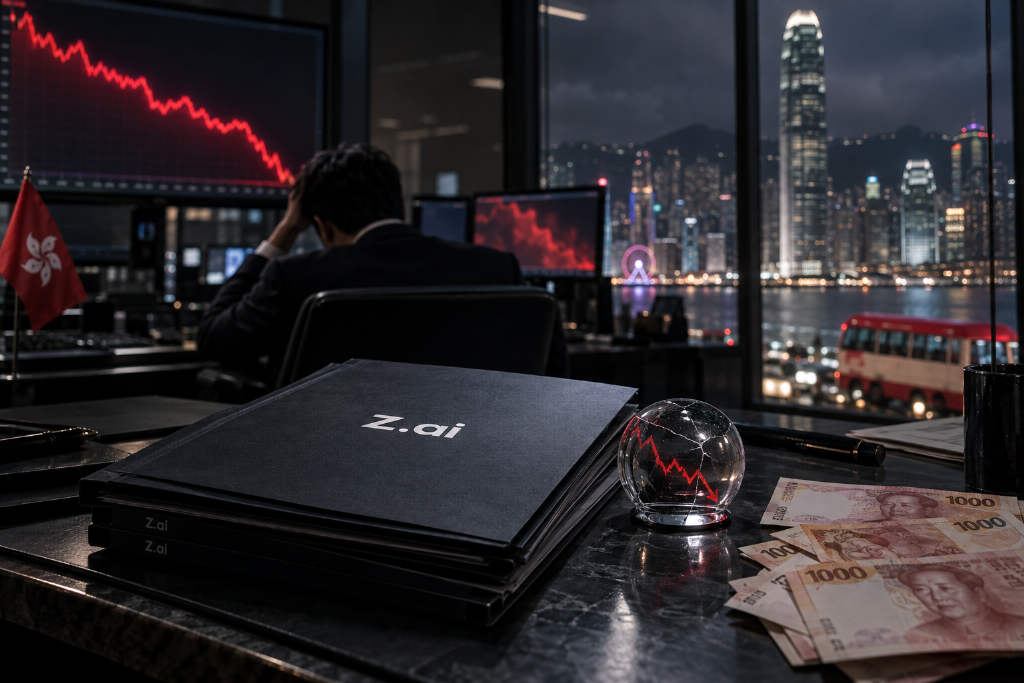
Z.ai, listed in Hong Kong as 2513, closed at HK$677.5 on Sept. 15, down 6.0% on the day and marking its 11th consecutive trading-session decline. From a closing price of HK$1,195 on Aug. 31, the stock has fallen 43.3%. The latest close also put the shares below the HK$714 placement price the company had just announced over the weekend.
On the same day, the Hang Seng Index fell 1%, while another large-model stock, MiniMax, dropped more than 7%.
Shares moved below the latest placement price
Z.ai launched roughly $5 billion in fundraising after the market close on Sept. 11 and said on the evening of Sept. 13 that the deal had been completed. Of the total, $2 billion came from a placement of new shares at HK$714 apiece.
The stock closed at HK$721 on Sept. 14, just HK$7 above the placement price. By Sept. 15, it had fallen to HK$677.5, below that level. Based on the latest close, institutions that subscribed to the new shares were already facing a 5.1% paper loss.
Three near-10% single-day drops in one week
The 11-day slide was not a slow grind lower. On Sept. 8, Z.ai fell 10.0% to HK$916, losing the HK$1,000 level. On Sept. 10, it dropped another 10.3% to HK$819. The report said DeepSeek began cutting API pricing for its V4 Flash model that day, adding pressure across Hong Kong-listed application software names.
On Sept. 14, the stock fell 9.1% to HK$721. Alongside the discount placement, the market was also dealing with a broader sell-off in Asian AI stocks. Over the weekend, Anthropic CEO Dario Amodei called for a slower pace in developing frontier models, and OpenAI CEO Sam Altman later voiced support.
That same day, SoftBank fell 13% intraday, SK Hynix lost about 5%, and MiniMax was down 5.4%. Z.ai fell as much as 10.5% intraday, a steeper drop than MiniMax in Hong Kong trading.
Two equity placements in two months
Z.ai went public on the Hong Kong Stock Exchange on Jan. 8 at HK$116.2, raising about HK$4.3 billion in its IPO. On June 22, the stock hit an intraday record of HK$2,980, briefly pushing its market capitalization above HK$1.33 trillion. That represented a 25-fold increase in five months.
According to East Money Information, Z.ai carried out its first share placement on July 9, selling 19.78 million shares at HK$1,588 each and raising about HK$31.4 billion. The day before the announcement was also the end of the IPO lock-up period, with around 25.68 million restricted shares becoming eligible for sale. Even so, the stock rose 13% that day.
In the September financing, Z.ai placed 21.97 million new shares at HK$714 each, a discount of about 10% to the Sept. 11 close, representing 4.5% of the enlarged share capital. It also issued RMB 20.14 billion in zero-coupon convertible bonds, equivalent to about $3 billion, due in September 2027 with a conversion price of HK$892.5. The company said proceeds would be used for research and development, computing power and infrastructure, as well as business expansion, strategic investment, and potential acquisitions.
Across the two placements in two months, the placement price fell from HK$1,588 to HK$714, a 55% cut. According to calculations cited from Sina Finance, institutions that subscribed at HK$1,588 in July were facing a 57% paper loss based on the Sept. 15 close.
The same report estimated that Z.ai’s average daily cash burn was HK$20.4 million during the IPO stage, then rose to HK$220 million a day after the July placement, nearly 11 times faster. Including the latest $5 billion round, the company has raised more than HK$75 billion in total over eight months since listing.
Revenue grew quickly, but losses and R&D spending stayed high
Fundamentally, the company’s first-half revenue reached RMB 954 million, up nearly fourfold from a year earlier. MaaS, or model-as-a-service, revenue came in at RMB 825 million, up 2,736%. As of the end of August, annual recurring revenue, or ARR, had reached $1.6 billion, up 60% from July.
At the same time, net loss attributable to shareholders was RMB 2.071 billion, while R&D spending totaled RMB 2.131 billion, meaning research spending exceeded total revenue.
Jefferies cut the cloud valuation multiple
Jefferies said in a report that the sharp ARR increase in August did 「not come entirely from recurring demand」, pointing instead to pulse-like growth driven by the return of the Coding Plan and a concentrated wave of product launches. It also said future growth would be constrained by computing supply.
The brokerage also flagged customer concentration. Two customers each contributed more than $250 million in ARR, accounting for at least 31% of total ARR combined. The top 10 customers represented about 40% of average daily token usage.
Jefferies expects second-half cloud gross margin to decline to 20.2% from 24.6% in the first half because depreciation and operating costs tied to new clusters are recognized before token loads ramp up. Based on that view, the firm cut its valuation multiple for Z.ai’s cloud business from 50x ARR to 30x ARR, maintained a Hold rating, and set a target price of HK$1,183.79.
Based on the Sept. 15 close, that target implies about 75% upside.