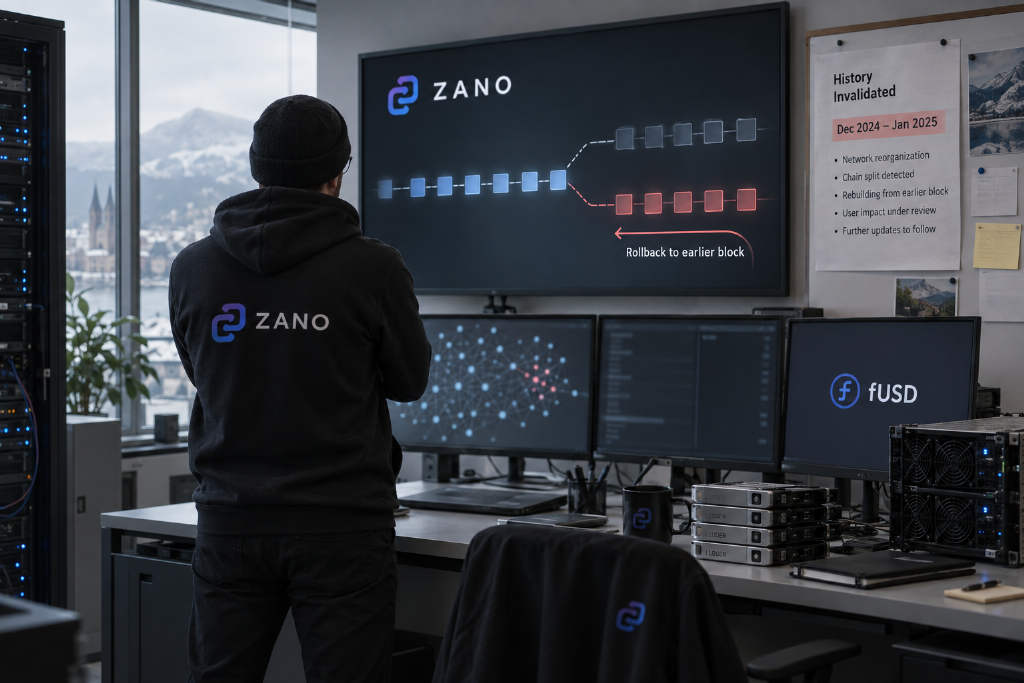
Privacy-focused blockchain Zano said its core team found a serious issue involving Gateway Addresses that allowed unauthorized ZANO and fUSD to enter circulation, while the project said core consensus itself was not affected. To remove that unauthorized activity, the chain has been restarted from block height 3,833,000, a point before hard fork 6, which affects roughly one month of on-chain history.
The project said nodes, miners, stakers and service providers must upgrade, while mobile wallet nodes and wrapping services will be restarted one by one. Third-party wallets and exchanges need to update on their own, and users were told to make sure they are connected to the restored chain before sending funds. Zano also said transactions confirmed during the affected period are not part of the recovered chain. It advised users to keep transaction IDs and trade records, then resend only after upgrading their wallets and checking the final status. Operators running full nodes, mining, staking, mining pools, exchanges, cross-chain services or payment services were told to install the emergency release and verify checksums as soon as possible.
Zano said its core team identified a serious issue with Gateway Addresses that allowed unauthorized ZANO and fUSD to enter circulation, while the project said core consensus was not affected.
To remove the unauthorized activity, the privacy blockchain said it has restarted from block height 3,833,000, a point before hard fork 6. The move affects about one month of on-chain history.
Upgrade requirements
Zano said nodes, miners, stakers and service providers need to upgrade. Mobile wallet nodes and wrapping services will be restarted one by one. Third-party wallets and exchanges must update independently, and users should confirm they are on the restored chain before making transfers.
Handling affected transactions
According to the project, transactions confirmed during the affected period are not part of the recovered chain. Zano advised users to keep transaction IDs and trade records, then resend only after upgrading their wallets and checking final status.
The project also said anyone running a full node, mining, staking, operating a mining pool, or providing exchange, cross-chain or payment services should install the emergency version and verify checksums as soon as possible. Regular users can download a new wallet from the official website, and the upgrade does not require a seed phrase.
This article was originally published by Bit.Fan. For more cryptocurrency news and market insights, visit www.bit.fan. Disclaimer:
The market information, project data, and third-party content displayed on this platform are for industry information sharing only and do not constitute any form of investment advice or return commitment.
Cryptocurrency trading carries high risks. Users should fully assess their risk tolerance and make independent decisions. All profits, losses, and legal responsibilities are borne by the users themselves.