
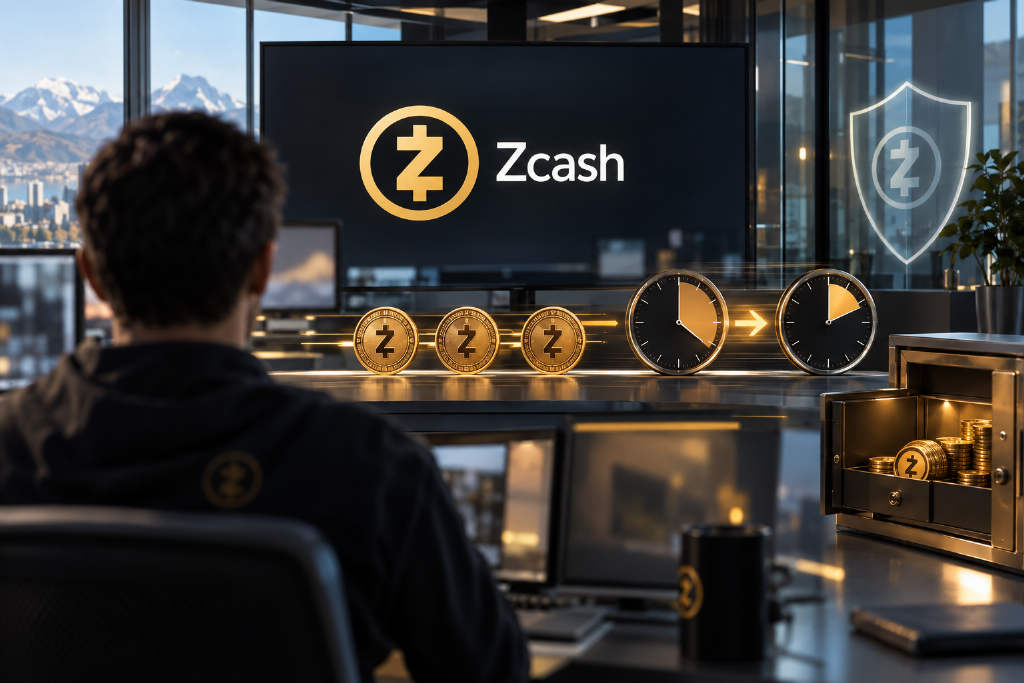
Zcash developers are targeting Nov. 5 for the NU7 upgrade, a change that would cut the network’s target block time from 75 seconds to 25 seconds and make private payments faster to confirm.
NU7 would also begin setting aside part of Zcash’s transaction fees for future miner compensation. Under the current plan, those funds would start returning through block rewards in February 2031.
Upgrade schedule and voting outcome
The final mainnet decision is scheduled for Oct. 20, when developers are expected to decide whether to activate the upgrade and select an activation height. That leaves Nov. 5 as a target date, not a confirmed launch.
According to CoinDesk, the timetable follows discussions among the core builder teams Zcash Foundation, Project Tachyon, Valar, ZODL and Shielded Labs. The groups and engineering teams reached unanimous agreement on the contents of the upgrade after a series of community and coinholder polls.
About 2.4 million ZEC took part in the vote, equal to 66% of the eligible pool. Of those votes, 98.9% supported keeping Zcash’s existing halving schedule, while 96.6% selected February 2031 as the point when collected fees should begin returning to miners.
What NU7 changes on the network
The most visible change in NU7 is the reduction in block time from 75 seconds to 25 seconds. Blocks are batches of transactions added to the blockchain by miners, and a payment gets its first confirmation when it appears in one. For an exchange or bridge that waits for a fixed number of confirmations, a shorter target block time would reduce the time needed to release ZEC to about one-third of the current wait.
Zcash developers say that at a retail checkout counter, this would still be slower than tapping a payment card. Even so, the shorter delay would make direct private payments more practical.
Producing three times as many blocks would not mean producing three times as much ZEC. The proposal cuts the reward paid with each block by three and extends the halving interval from 1.68 million blocks to 5.04 million blocks, leaving issuance over time largely unchanged.
NU7 would also introduce Zcash’s Network Sustainability Mechanism. Under ZIP-235, roughly 60% of transaction fees would be temporarily removed from circulation instead of being paid directly to miners. Those coins are intended to return through block rewards beginning in February 2031, adding to miner income as regular issuance declines through successive halvings.
Private payments and technical impact
Payments-focused projects such as Zcash are built around the idea that money can move directly from a person’s wallet to a business or another person over a blockchain, rather than through banks or card networks such as Visa and Mastercard. In that model, people can hold and spend digital money on their own device, including online and across borders, without a bank or card issuer processing each payment.
Public blockchains create a privacy problem. Paying from a visible address can expose the address balance, previous transactions and links to other addresses. A shielded Zcash payment hides the sender, recipient and amount from the public record, allowing a customer to pay without giving a merchant, or anyone watching the blockchain, a searchable trail into their finances.
On compatibility, the upgrade would disable the older transaction format but would not introduce any new formats. Wallets are not expected to need major changes, though full nodes, indexers and block explorers may require updates.
Next development milestones
Code completion is due by Sept. 30, after which NU7 is expected to reach the Zcash test network on Oct. 6. Developers will then make the final mainnet decision and choose an activation height on Oct. 20.
As described by CoinDesk, the proposal is designed to shorten confirmation times while preserving Zcash’s issuance and halving structure, and to redirect part of transaction fees into a future source of miner rewards.