
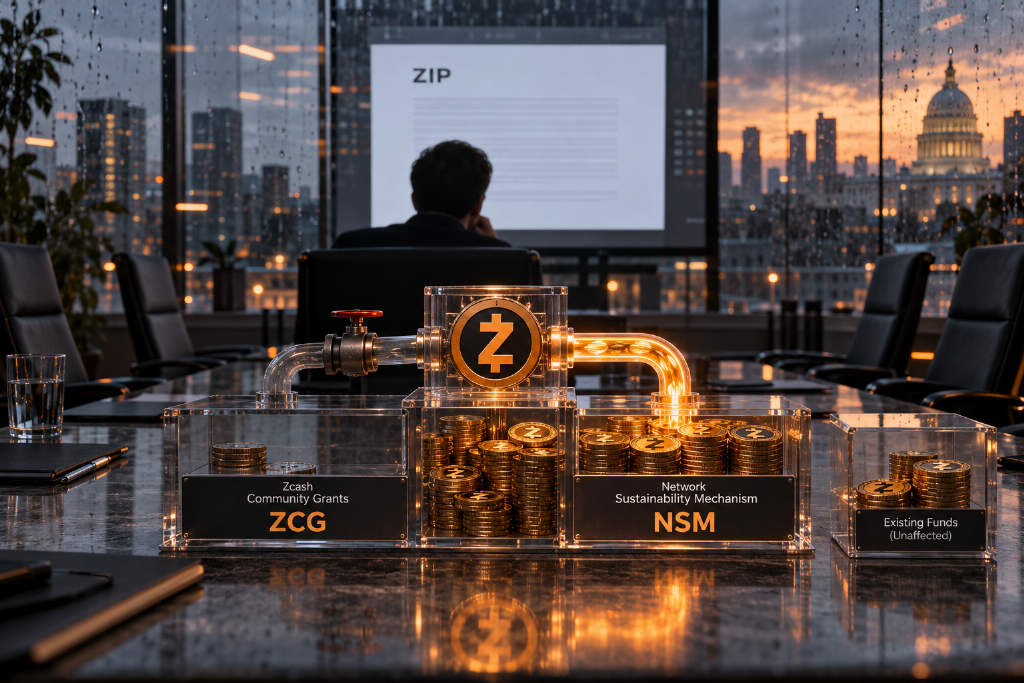
Zcash co-founder Sean Bowe says Zcash Community Grants, or ZCG, no longer needs an automatic cut from every block, and he has drafted a rule change to end it.
Late Monday, Bowe published a draft Zcash Improvement Proposal, or ZIP, that would terminate ZCG’s 8% share of the block subsidy and redirect that portion to the Network Sustainability Mechanism, or NSM, the protocol-level fund defined in ZIP 237, until the stream was already set to expire.
The draft does not claw back anything already in ZCG’s custody, which means the committee could continue funding projects from its reserves. The separate 12% stream allocated through coinholder voting is left untouched.
Swihart and Miers object to different parts of the plan
Josh Swihart, founder of Zcash developer ZODL, wrote on X that eliminating only one part of the development fund would be a mistake.
He said both the ZCG stream and the coinholder stream should be retired together and redirected to the NSM until the halving. In his view, a partial change would leave room for continued debate and politics.
Swihart also disclosed that ZODL recently received a retroactive coinholder grant. Ending the full fund structure, he said, would remove that potential source of financing for his company.
Cryptographer Ian Miers focused on the destination of the money. In a forum post, he said putting a cap on what any one organization can draw from the development fund was a very good idea, but warned that the NSM path could turn into a development fund in waiting, with reserves redirected later. He also argued that the approach would amount to paying miners with extra steps.
Bowe replied that the NSM already exists and is the path of least resistance. He added that issuance has to happen anyway, so the funds need somewhere to go.
A treasury tied to ZEC price assumptions
On X, Bowe wrote that ZCG was never designed to handle funding at this scale.
His proposal uses figures from ZCG’s public dashboard: 91,452.98 ZEC plus about $8.8 million in dollars, minus roughly $2.4 million in outstanding grant liabilities. Using assumed ZEC prices, he valued the pool at about $125.3 million at $1,300 per ZEC, $97.8 million at $1,000, and $52.1 million at $500.
Bowe noted that the dashboard figures have not been independently reconciled, and that the worksheet is marked “Updates required.”
At today’s subsidy level, the stream works out to 144 ZEC per day, or roughly $68.3 million a year under Bowe’s $1,300 price assumption.
ZCG’s own spending is much lower. The draft cites a Financial Privacy Foundation report showing $1.53 million in spending in the first quarter of 2026.


