
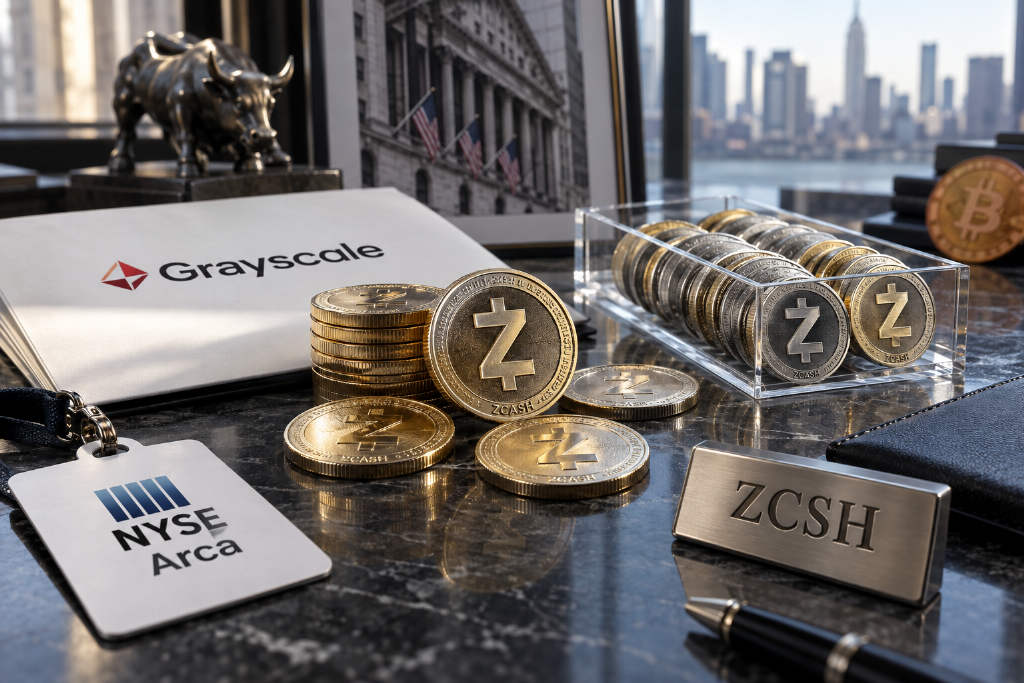
Zcash (ZEC) posted one of the strongest moves in crypto over the past week, gaining more than 43% while the broader market remained under pressure. The backdrop was unusually fragile: Bitcoin briefly dropped to $77,666, then recovered toward $79,000 during Asian trading, according to the source text.
The report says the key catalyst behind ZEC’s advance was Grayscale’s spot exchange-traded product, The Zcash ETF, ticker ZCSH, which is listed on NYSE Arca. Assets under management have moved past $500 million. Data cited from Bloomberg shows that the fund attracted more than $70 million in net new subscriptions within just two weeks of listing and also completed an in-kind token subscription worth about $100 million from an investment entity under Digital Currency Group.
As of now, ZCSH holds more than 550,000 ZEC. That amounts to roughly 3% of the network’s circulating supply, a level the article says has tightened spot availability during a period of constrained macro liquidity.
ZCSH expansion sits at the center of the rally
The article frames the move as a story of regulated access. Grayscale converted its Zcash trust structure into a spot exchange-traded product and brought it onto a mainstream exchange, creating a compliance-friendly route for traditional brokerage accounts, wealth management channels, and other institutional pools of capital to gain exposure to privacy-focused crypto assets.
According to Reuters, as cited in the source, Grayscale’s ZCSH began trading on the New York Stock Exchange’s fully electronic platform on Aug. 25, 2026. The report describes it as the first and only single-asset exchange-traded product globally that directly holds spot ZEC and is publicly issued in a regulated securities market.
That public listing changed the access point. Instead of relying on earlier private trust structures, qualified institutions, family offices, and retirement accounts can now buy exposure through conventional securities accounts without handling custody or private-key management themselves.
The article says regulatory filings submitted to the U.S. Securities and Exchange Commission show that ZCSH crossed the $500 million AUM mark within two weeks. It breaks that growth into two major components:
- more than $70 million in continuing net subscriptions from traditional brokerage channels;
- an in-kind token subscription worth about $100 million by Digital Currency Group International Investment Company through an authorized participant.
That transaction injected 85,705 spot tokens in exchange for fund shares, according to the report.
CoinGlass data cited in the piece also shows that standardized listed options on ZCSH were opened for trading on the same day the fund hit a record asset level. The text argues that listed options matter for two reasons. They give long-only institutions tools for volatility hedging and covered-call style strategies, and they may also push market makers to build larger spot inventories to hedge their exposure, adding another wave of spot demand.
How a 21 million cap and a 3% supply lock-up sharpened the move
The article places heavy emphasis on Zcash’s token economics. Using supply data from CoinMarketCap and CoinGecko, it says Zcash follows the same monetary design principles as Bitcoin: a fixed maximum supply of 21 million coins and a four-year halving cycle. About 16.7 million ZEC are currently mined and in circulation.
Against that supply base, a single regulated investment product locking up more than 550,000 ZEC within two weeks is presented as a meaningful market event. The source says this effectively froze nearly 3% of the liquid supply. It also cites Financial Times reporting on digital-asset liquidity tightening, saying long-dated limit-sell depth across major decentralized and centralized exchanges remains limited. If institutions keep removing coins from the market through in-kind subscriptions and spot accumulation, marginal sell-side liquidity can thin out quickly.
The article’s conclusion is direct: once liquid supply tightens, relatively modest aggressive buying can move the price in larger steps than usual.
It also notes that, as spot ETF inflows continued, market depth and turnover in related ZEC pairs on MEXC increased during cross-asset rotation.
Derivatives activity accelerated as futures open interest hit $2.8 billion
Spot buying was only part of the picture. The report says futures open interest surged to $2.8 billion in a short period, setting a record high. At the same time, exchange-listed options were approved for trading, giving both bulls and bears more tools to express positions.
In the article’s reading, that expansion in derivatives did not just boost speculative activity. It also improved liquidity concentration and sped up price discovery in the secondary market. Once more participants can trade volatility, hedge risk, or run cross-market books, pricing can become more sensitive to changes in spot supply.
Protocol upgrades and shielded-pool growth added on-chain support
The source text does not treat this as a purely macro or ETF-driven move. It also points to Zcash’s own technical progress and chain-level usage data.
According to the official development log from Electric Coin Company, the network has gone through major cryptographic upgrades including Sapling and Orchard. Those changes significantly improved zero-knowledge proof generation efficiency. On mobile light wallets, the time needed to generate a shielded transaction reportedly fell from tens of seconds in earlier periods to a few hundred milliseconds.
DefiLlama data cited in the article shows that the amount of ZEC stored in shielded address pools has climbed above 4.86 million, the highest level this year. The report treats that figure as a meaningful industry signal. In its view, it suggests that a large number of long-term holders are not leaving tokens on exchanges for short-term trading, but are instead moving them into the protocol’s shielded pools.
The article also says Zcash’s viewing-key mechanism lets users disclose transaction details when required for compliance audits or regulatory reporting. In that framework, it presents Zcash as a technical compromise between strict oversight and native privacy, one that may be gaining more acceptance among regulated institutional investors.
Bitcoin weakness did not lead to outright capital flight
ZEC’s rally took shape during a delicate macro period for crypto. Citing CNBC’s global market coverage, the article says mixed macroeconomic data and disagreement over the Federal Reserve’s rate-cut path kept overall risk appetite defensive. Bitcoin bounced from $77,666 to near $79,000, but the broader mood remained cautious.
Even so, the source argues that capital did not leave crypto altogether. Instead, it rotated inside the asset class, searching for names with a clearer standalone catalyst. Privacy tokens, long associated with heavier regulatory scrutiny, saw that narrative shift after a compliant spot ETF won approval and then scaled faster than expected. The article says that repricing in expectations helped Zcash stand out as a relative leader while the broader market was still unstable.
Key downside risks the report says traders should watch
The article is clear that a strong setup does not remove short-term risk. It lays out several points that market participants should keep in focus:
- the 14-day daily RSI has already moved above 80, entering what the article calls an extreme overbought zone;
- the pace of further subscriptions into ZCSH still needs to be tested after the first two weeks of launch demand;
- large in-kind token swaps could eventually create hedging or basis-trading activity from early institutional holders of fund shares;
- if Bitcoin fails to hold the $78,000 support area and instead breaks lower toward $75,000, higher-beta altcoins may struggle to stay insulated.
James Mitchell: this looks like a structural liquidity squeeze
In the commentary section labeled as James Mitchell’s exclusive view, the move is described as a structural liquidity squeeze driven by a regulated spot access channel rather than a simple retail sentiment burst.
Mitchell argues that many secondary-market traders make an old assumption about Zcash, treating it as just another legacy concept coin with weak value capture. In his view, that misses the asset’s scarcity profile. Zcash has the same hard supply cap as Bitcoin, 21 million coins, while also embedding zero-knowledge privacy protection. When an asset with that profile, one the article says had been discounted for years because of compliance concerns, is wrapped into a New York-listed spot product by a major regulated asset manager, the supply-demand gap for institutional allocation becomes much harder to ignore.
He also points to token distribution on-chain. More than one-quarter of circulating supply sits in deep shielded pools, according to the article, while ZCSH absorbed another 3% of the circulating total in just two weeks. Mitchell says that kind of concentrated spot lock-up materially reduces the inventory available for borrowing and shorting.
For derivatives traders and cross-market quantitative desks, he says the more useful signals are not isolated candlestick patterns but the daily post-close changes in ZCSH net inflow shares and whether CoinGlass funding-rate data begins to show persistent positive drift. As long as the spot subscription channel keeps absorbing supply on a net basis, the article says pullbacks caused by broader market volatility may continue to act as areas where institutional demand steps in.
Questions raised and answered in the source text
Why did Zcash rise by more than 43% recently?
The source points first to ZCSH crossing $500 million in AUM within two weeks and locking up more than 550,000 ZEC, or about 3% of circulating supply. It says that created a strong tightening effect in spot supply.
How is ZCSH different from a traditional trust?
The article says ZCSH is a listed spot product with public price discovery and transparent creation-redemption channels. That allows both retail and institutional investors to trade it through standard securities accounts without dealing with the premium and discount dynamics common in earlier over-the-counter trust structures.
Why do Zcash’s tokenomics matter so much in this ETF narrative?
Because Zcash has a fixed maximum supply of 21 million coins and only about 16.7 million are currently circulating, the report says. With no path to increase issuance, rapid accumulation by institutional vehicles can drain exchange liquidity faster.
What role did Bitcoin’s range-bound trade near $78,000 play?
The article says Bitcoin’s consolidation pushed existing capital to look for crypto assets with an independent catalyst. Zcash, helped by large spot ETF inflows, became one of those names.
What risks matter most for traders here?
The source highlights the overbought RSI reading above 80, the chance of a broader market breakdown, and the need to monitor whether spot ETF inflows stay strong after the initial burst.
Why does growth in shielded-pool balances matter?
The article describes shielded pools as on-chain anonymous storage and transfer spaces built on zero-knowledge proofs. With more than 4.86 million ZEC now in those pools, it says a larger share of tokens has moved away from public trading venues, reducing liquid inventory.
The original article ends with a disclaimer that its information, data, and analysis are for general reference only and do not constitute investment, financial, legal, tax, or trading advice. It also notes that stocks, crypto assets, and related derivatives are highly volatile and uncertain, and that historical financial performance, quantitative indicators, and on-chain data do not predict future market performance.