

ZetaChain token holders voted on Sept. 20 to approve a proposal that would move ZETA and the project’s flagship AI application, Anuma, to Solana and gradually shut down ZetaChain’s own public chain once the related asset migration is complete.
The proposal passed with 99.4% support and 58% participation. The migration has not been carried out yet, and a second proposal is still required to settle the execution details. Even so, the vote makes the direction clear: ZetaChain is preparing to end operations as an independent Layer 1 and concentrate its resources on AI.
Why ZetaChain no longer wants to run its own chain
The shift did not begin with the migration proposal. On June 1, ZetaChain said it would pivot fully to AI and gradually stop its original cross-chain interoperability functions. From that point, Anuma, its consumer-facing AI product, and its private memory layer became the new center of the business.
That strategic change also changed the problem the team is trying to solve. In its earlier form, ZetaChain focused on asset and application interactions across different blockchains. Its underlying network was a core part of the product, because maintaining its own chain was directly tied to building cross-chain capabilities.
In the Anuma phase, the priorities look different. Users care more about whether the models are useful, whether context survives when they switch models, and who controls the personal information the AI remembers. That forces a fresh look at whether ZetaChain still needs to operate the base network itself and how much that work actually contributes to the user experience.
Running a public chain means maintaining consensus, a validator network and protocol upgrades. Running an AI product means improving model calls, memory retrieval and the user experience on an ongoing basis. As a Cosmos SDK-based chain, ZetaChain also has to process upstream security notices and patches, and each update requires coordination with dozens of independent validators.
From a resource-allocation standpoint, the team is redrawing the line around what it sees as essential. Its view is that operating an independent L1 no longer helps advance its private AI business. Instead, it has become a fixed task that keeps consuming resources without offering enough return.
Moving to another major chain could reduce the burden of maintaining a standalone consensus network and free up more resources for the product itself. At the same time, Anuma’s application security, key handling and data flows would still remain ZetaChain’s responsibility. A different chain can change the division of labor, but it does not replace product-level security work.
What makes Solana attractive for the move
In the article’s framing, Solana’s appeal goes beyond speed and a busy ecosystem. ZetaChain also sees ready-made agent infrastructure that could shorten the path from product design to deployment.
Solana already has an Agent Registry for AI agents, offering verifiable identity and reputation records. The x402 ecosystem allows network services to charge per call, which lets agents pay for access to APIs, data and content.
Those pieces line up with ZetaChain’s AI plans. If an agent is going to act on a user’s behalf, it needs to know what it is allowed to do, what information it can read and how it can pay for calls to outside services. ZetaChain wants to connect its private memory and application layer to that infrastructure while relying on Solana’s existing identity, wallet and payment rails for the rest.
That also explains why the migration plan is not limited to bridging ZETA over. As long as the original L1 remains in place, the project still carries the double burden of maintaining a network while building an AI business. A full migration is meant to bring technical investment, asset circulation and developer collaboration into the same ecosystem over time.
What Anuma is trying to offer
To understand why ZetaChain is willing to reorganize the business around Anuma, the article points to one core idea: personal memory that can persist across models.
As large language models improve, dependence on AI keeps growing. For people who use AI heavily over long periods, different tasks often call for different models. That means users repeatedly have to restate their expected output, writing preferences and task progress.
If that information can be stored independently of any single model, then models become tools selected for specific jobs, while the user’s accumulated working context remains available.
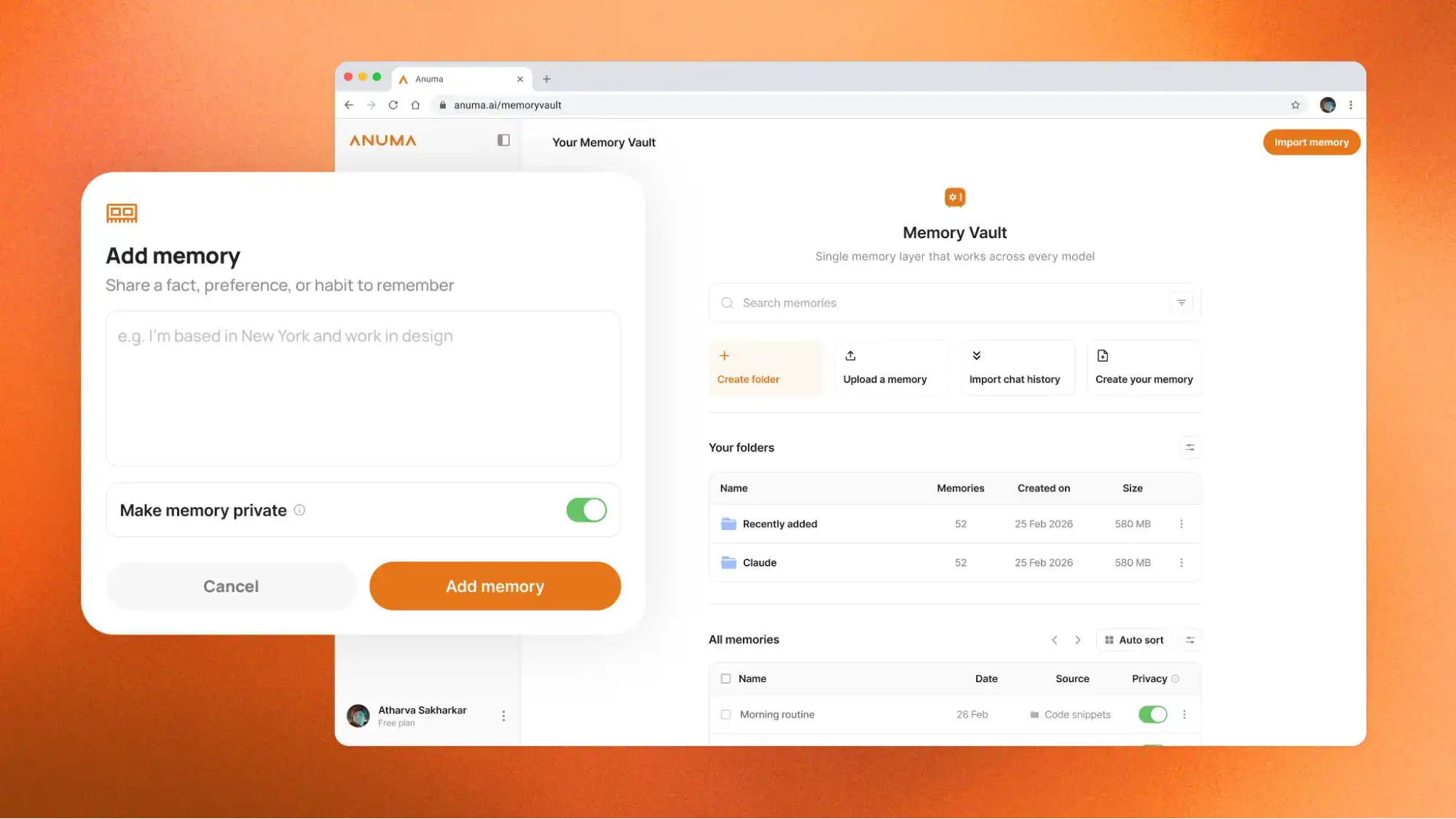
Anuma is built around that problem. It puts multiple models inside one application so users can switch between them while keeping existing memory, personal preferences and project background. Under the product design described in the article, users manage those memories instead of rebuilding context every time they change models.
Writing is one example. A user might use one model to organize source material and another to revise a draft. If both can access the same topic background and writing preferences within the user’s authorization scope, the cost of switching models falls. Information built up over time also keeps its value even if one model is replaced.
That creates a competitive path that does not depend on winning a race in raw model capability. Anuma does not need to spend heavily to train its own model. It needs to show that using different models through its product is more convenient and more continuous for the user.
Early usage data and the real product test
According to official figures cited in the article, Anuma had created 306,900 wallet accounts and handled about 1.27 million inference requests as of Sept. 22.
The next test is whether those accounts translate into sticky users and whether the product can keep attracting new ones. The article ties that directly to the quality of the memory system. The more useful the memory is, the more likely users are to keep using it. If memory regularly misses key points, cites outdated information or resurfaces in unrelated tasks, the experience deteriorates quickly.
In that sense, the business comes down to memory quality and whether users are willing to let the system participate in more of their daily work.
How privacy, wallets and model processing fit together
Beyond memory, Anuma also emphasizes privacy. Its technical description says memory uses a local-first storage model. Sensitive content is encrypted with wallet-derived keys, and any optional cloud backup is uploaded in ciphertext. In this setup, the wallet acts as the access mechanism for personal memory and becomes both an identity and key-management tool inside the AI product.
But encrypted memory storage and model-side input handling are not the same thing. Anuma’s website says that when users call closed-source models, the current message and related context are still sent to the provider, and that provider may apply its own data-retention policy. Private mode uses open-weight models and the corresponding inference infrastructure.
A business for developers, not just one app
If these capabilities only serve Anuma itself, ZetaChain’s growth would depend mainly on a single application. Opening them to third parties would widen the business.
The article uses a travel assistant company as an example. Such a company may be strong in destination information and itinerary planning, but it still has to deal with model integration, user memory, provider failover and call costs. Those tasks are related to the product, yet rebuilding them from scratch at every company raises both time and capital costs.
If Anuma can offer those functions as services, developers can build around their own core business. Users, once they grant permission, may also be able to carry existing preferences across different applications instead of recreating a profile inside every assistant.
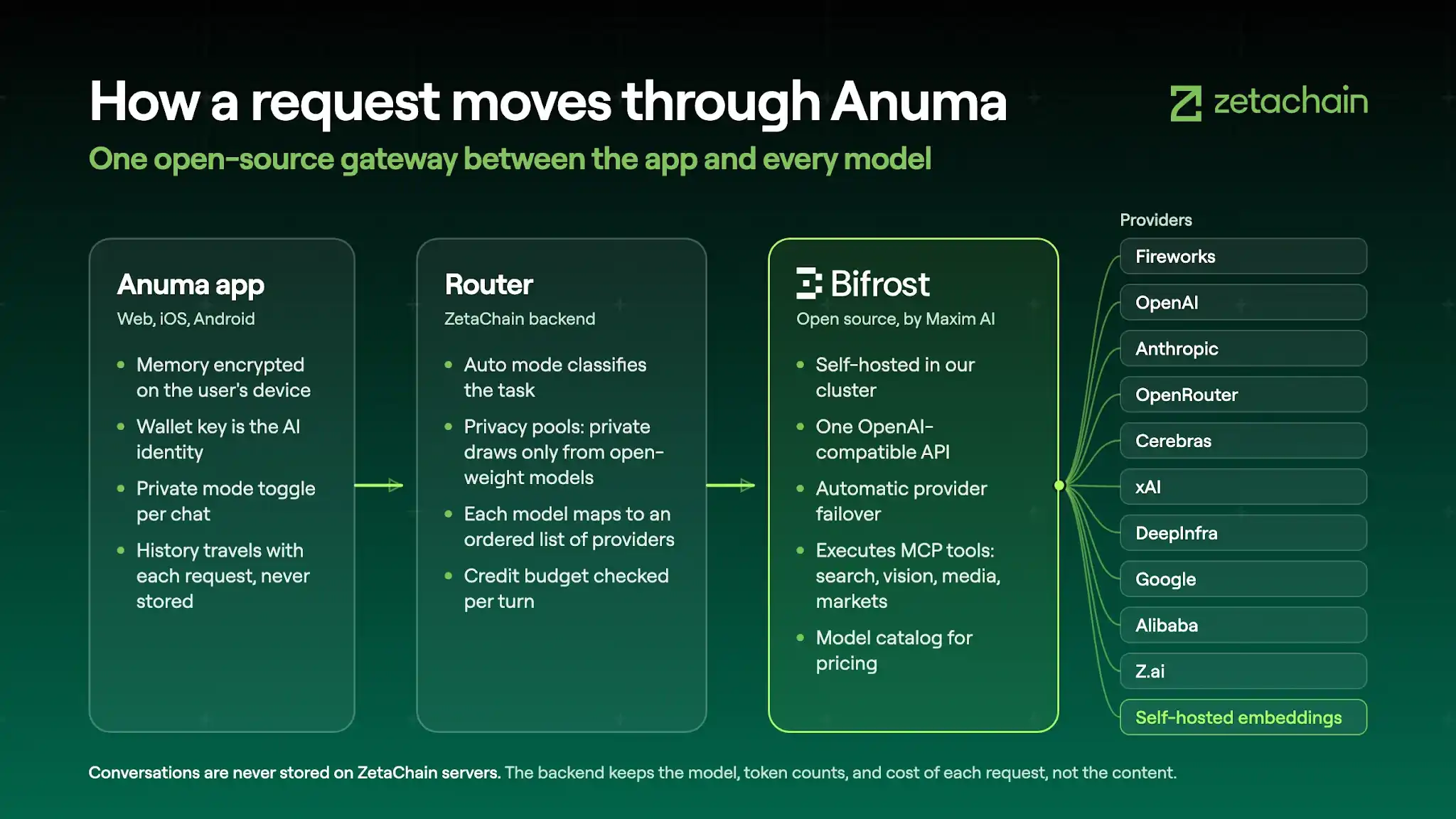
Anuma has already opened a development entry point for other applications and agents. Its public SDK and documentation include tutorials for web chat apps, mobile apps and agents, and support application creation, API account setup, model calls, streaming responses and tool execution.
The next stage of openness involves the production systems Anuma already uses internally. An engineering post published on Sept. 14 said Anuma uses Bifrost, an open-source gateway from Maxim AI, to connect different model providers. The team is exploring whether to open that routing layer so other applications and agents can also use provider failover, privacy model pools and cost accounting, combined with user-authorized shared memory.
The commercial logic is straightforward. Third parties would not only be able to call models; they could also use part of the operational stack needed to run around those models. Even if users are indifferent to Anuma as a model-aggregation app, other applications may still want the underlying capabilities.
The harder part is letting memory move across application boundaries while keeping authorization scopes clear. The same personal memory should not be exposed in the same way to every agent. A travel assistant may need travel preferences, while a work assistant may need project background. Handing over everything at once is not an ideal default.
ZetaChain’s September R&D direction, as cited in the article, includes granting and revoking memory access for applications and agents, writing related records on-chain and settling calls through x402. The longer-term idea is to let users package knowledge and methods into agents and earn income when those agents are called.
Opening the platform also creates new demands. Revoking authorization can stop future access, but it cannot automatically retrieve information already received by outside services. Third-party developers will also care about pricing, interface stability and data-export arrangements. Because Anuma plans to run both its own application and developer services, it has to give partners enough reason to rely on it over time.
After the move, ZETA still has to prove its role
For any blockchain project, token economics sit close to the foundation of the business. Once the project moves to Solana, ZETA has to find a new place inside that structure.
According to the official announcement cited in the article, native ZETA would convert 1:1 into a Solana SPL token, with the name, total supply and original vesting schedule unchanged. The plan does not involve ZETA already issued on Ethereum and BNB Chain, and post-migration staking and reward arrangements are still undecided.
Execution still depends on a second proposal. Before that, the team needs to coordinate exchange conversions and then determine the snapshot, claiming process and chain shutdown schedule. Existing validation and staking continue to operate until implementation begins.
Those steps address how assets move. The longer-term issue is how the token functions in the new business. Put more plainly: why would users still need ZETA?
On Solana, network fees are paid in SOL, so ZETA cannot simply keep its old role as the native gas token of a standalone chain. It has to build demand through application-layer rules. The article points to ZETA Access as one existing path: users lock ZETA to receive credits that can be used for AI calls. The team wants to extend that access model beyond Anuma as more applications integrate, so ZETA can serve a broader private-AI usage base.
But there is still an economic gap between token lockups and a sustainable business. Locking tokens can reduce circulating supply during the lock period, yet it does not generate operating revenue. Each model inference, by contrast, carries a real cost. Whether users are willing to keep using that structure, how credits are redeemed and what revenue covers inference spending will all shape whether the mechanism can last.
More third-party applications would also need to translate into token demand through explicit rules. Do developers need to hold or lock tokens to integrate? For how long? How are fees distributed? Only when those details become clearer will the link between application growth and ZETA demand come into focus.
The product still decides the outcome
In the end, the whole transition still depends on whether the product can create durable usage demand. Anuma is trying to widen its use cases. A recently tested feature called Nearby uses personal interests and preferences to help users discover nearby people they may connect with, extending memory from chat into real life.
Whether in social discovery or in future third-party applications, the team still has to prove that long-term memory can produce features users want to return to repeatedly. For ZETA, those features also need to support a clear and sustainable token use case.
The article presents ZetaChain’s decision as a concrete example of how the relationship between infrastructure and applications can change. When the product direction shifts, infrastructure that once had to be operated in-house can be handed off to an outside network. Ending an independent L1 removes part of the maintenance burden, but it also puts the success or failure of the transition much more directly on the product itself.
Shutting down its own chain is only the start of that tradeoff. Whether users keep using the product, whether developers are willing to pay to integrate and whether those demands can give ZETA a lasting role are the questions that now matter most for ZetaChain.