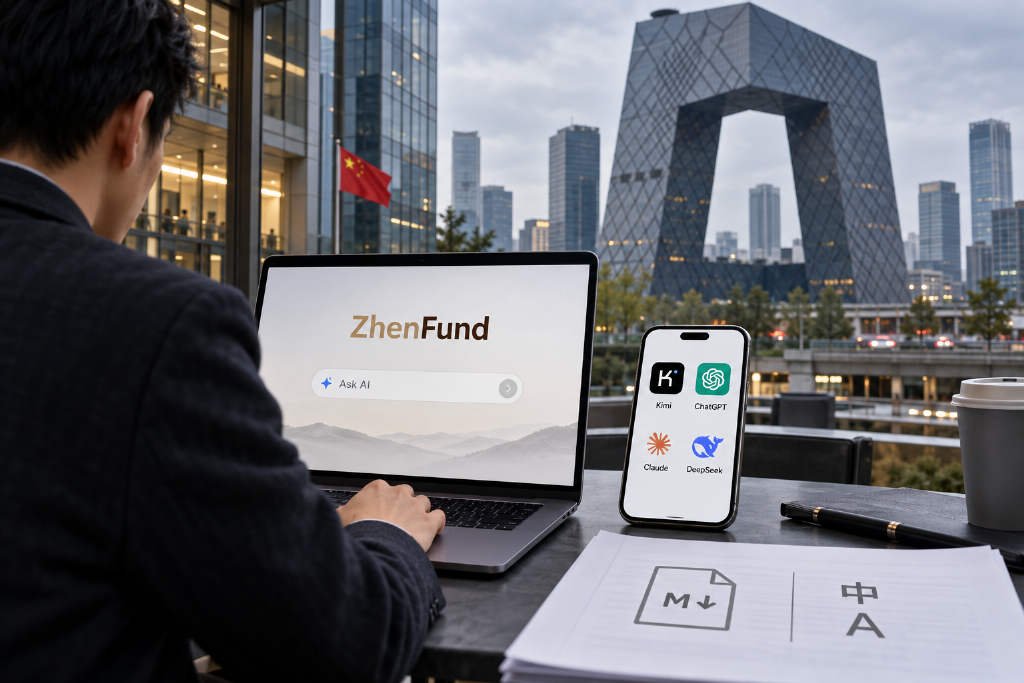
Early-stage investment firm ZhenFund has launched an Ask AI feature on its official website, giving founders a new way to search the firm’s public information through major AI models. According to ChainCatcher, users can ask which teams ZhenFund has backed, what sectors it has been watching recently, and which events may suit them.
The feature is built on a bilingual file named zhenfund.md, which organizes public information including ZhenFund’s investment team, portfolio companies, focus areas, founder events, and contact details. After a user clicks any AI entry point on the site, the page redirects to Kimi, ChatGPT, Claude, or DeepSeek. A preset prompt is filled in automatically so the selected model reads the file first and then answers the question.
The setup turns existing public materials into a searchable interface rather than publishing a separate standalone chatbot on the site itself.
Early-stage investment firm ZhenFund has launched Ask AI on its official website, according to ChainCatcher.
Founders can use the feature to ask which teams ZhenFund has invested in, what areas it has been focusing on recently, and which events may be relevant to them.
ZhenFund said it compiled public information including its investment team, portfolio companies, focus areas, founder events, and contact details into a bilingual file called zhenfund.md.
After users click any AI entry point, the website redirects them to Kimi, ChatGPT, Claude, or DeepSeek. The system pre-fills the prompt so the model reads the file before answering.
This article was originally published by Bit.Fan. For more cryptocurrency news and market insights, visit www.bit.fan. Disclaimer:
The market information, project data, and third-party content displayed on this platform are for industry information sharing only and do not constitute any form of investment advice or return commitment.
Cryptocurrency trading carries high risks. Users should fully assess their risk tolerance and make independent decisions. All profits, losses, and legal responsibilities are borne by the users themselves.