

Zhipu founder Tang Jie used a July 11 internal letter to push the company’s narrative away from coding and toward AGI, according to a MarsBit market analysis that ties the move to rising valuation pressure after recent share unlocks.
Over the past six months, the article says, Zhipu became one of the most prominent AI companies in China. Its market value at one point rose above HK$1 trillion, its MaaS platform ARR reached 1.7 billion yuan, and that ARR expanded 60-fold over the past year. After the first batch of shares was unlocked on July 8, the stock did not see a collapse-style pullback.
Still, Tang’s nearly 4,000-word letter, titled The Giant Wave Has Arrived, did not read like a victory note. The article says it barely mentioned celebration or revenue. Instead, it repeatedly focused on Long Horizon Task, Autonomous Agent, Self-Evolving, AGI and safety governance. Coding, the business line that the piece says helped lift Zhipu’s market value from the HK$100 billion range to HK$1 trillion, was largely absent.
MiniMax became the warning sign
The article places Tang’s message in the context of MiniMax’s recent repricing. After its shares were unlocked in early July, MiniMax’s stock fell sharply and its market value dropped below HK$100 billion.
MarsBit says the selloff had several drivers: weaker-than-expected model iteration, lower market risk appetite, pressure on global AI concept stocks in the second quarter of 2026, stronger expectations for Federal Reserve rate hikes, and tighter enterprise IT budgets. But the article argues that the deeper change was in how investors valued these companies.
Once lock-ups expired, early backers had their first real chance to exit at scale. At that point, public investors and institutional limited partners began asking a different question: what is the company actually worth? The yardsticks then shifted to ARR, growth, retention and customer acquisition payback. That is the language of internet and SaaS valuation, not frontier-model aspiration.
Under that system, the piece says, MiniMax was no longer judged as one of China’s top large-model players with open-ended upside. It was judged more like a consumer AI tool company with annual revenue measured in the hundreds of millions of yuan.
Zhipu, the article argues, could see the same setup coming. MiniMax’s slump happened only days before Tang’s letter. Zhipu’s own market value had also pulled back, from above HK$1 trillion to HK$730 billion after the unlock.
Coding drove the company’s rise, but the letter downplayed it
The commentary looks back to early 2025, when much of the industry was still absorbed by the reasoning wave linked to DeepSeek. Reinforcement learning, chain-of-thought and compute shifting toward inference were central topics. In that environment, Zhipu moved resources away from general chat capabilities and toward coding.
According to the article, Tang later explained that once DeepSeek R1 arrived, the chat paradigm was largely over. The next stage of model competition would not be about sounding more human in conversation. It would be about completing work, and coding was the most efficient proving ground.
MarsBit says the fastest commercial AI track over the past year was AI-assisted software development, not chat, search or video generation. The reason was straightforward: the return on investment was easier to see. If a programmer works eight hours a day and AI saves two of those hours, the value proposition is easier to price.
The article cites Anthropic as the clearest global case. It says Anthropic’s ARR was below $100 million at the start of 2024, then surged as Claude improved in code generation and engineering work, with commercial revenue passing $47 billion in June 2026. It also notes that GitHub Copilot was among Microsoft’s fastest-growing commercial products over the past year, with enterprise customer numbers rising sharply year over year.
Zhipu, the article says, benefited from the same wave. Yet that success creates a new problem. The better coding performs, the easier it becomes for investors to place Zhipu in the box of mature software infrastructure or standard enterprise services.
That is why the article frames Tang’s omission of coding as deliberate. Once a story starts to pay off, markets stop treating it as the future. The piece uses Apple and Microsoft as examples of how valuation attention moves from one growth story to the next. In that reading, if AI coding becomes a stable and standardized software service, the next investor question is obvious: what comes after coding?
Agents became the next valuation chip
The article argues that Tang’s emphasis on Long Horizon Task, Autonomous Agent and Self-Evolving was not just a change in product focus. It was a shift in valuation narrative. The goal, in its telling, was to prevent Zhipu from being fixed in the market’s mind as “a coding company” and instead anchor it as “an AGI company.”
Those labels matter because the valuation models differ. For an AGI company, investors may spend less time on near-term revenue, retention or unit economics and more time on how close the company is to AGI and where it ranks on that path. The peer set then becomes OpenAI, Anthropic and Google DeepMind. The article notes that OpenAI and Anthropic are both valued at the trillion-dollar level.
MarsBit also says Zhipu is not alone in leaning into agents. Over the past year, OpenAI shifted product focus from GPT-5 onward toward Operator, Deep Research and Computer Use. Anthropic’s recent updates have centered on Computer Use and agents. Google, the piece says, has put more emphasis on its agent ecosystem than on chat.
In that framing, leading companies moved in the same direction not only because the technology had advanced, but because coding is now the present and agents need to represent the future.
A two-year “Touch High” plan and no push for short-term monetization
The article says Tang described an evolution from OPC, or One Person Company, to NPC, or No People Company. The jump is from AI writing code for programmers to AI carrying out work for organizations more broadly, from product building to running business functions.
He broke that path into three parts: Long Horizon Task for planning and execution across weeks or months, Autonomous Agent System for self-driven and coordinated agents, and Self-Evolving for AI training AI so progress is no longer bound by human labor.
Tang then announced a “Touch High” plan, with strategic investment over the next two years, and said the company would not pursue short-term application monetization.
MarsBit treats that as both a research decision and a valuation decision. These concepts have not yet been commercialized at scale. Without immediate revenue benchmarks, the market is pushed to price future potential instead. The commentary compares this playbook with OpenAI and Anthropic, which it says have repeatedly answered revenue questions by presenting new technical milestones and then larger ambitions once those milestones were absorbed.
The article adds that Tang cited Google DeepMind’s report From AGI to ASI, saying that even if a single model’s ability stops at the human level, superintelligence could still be forced out if compute keeps growing.
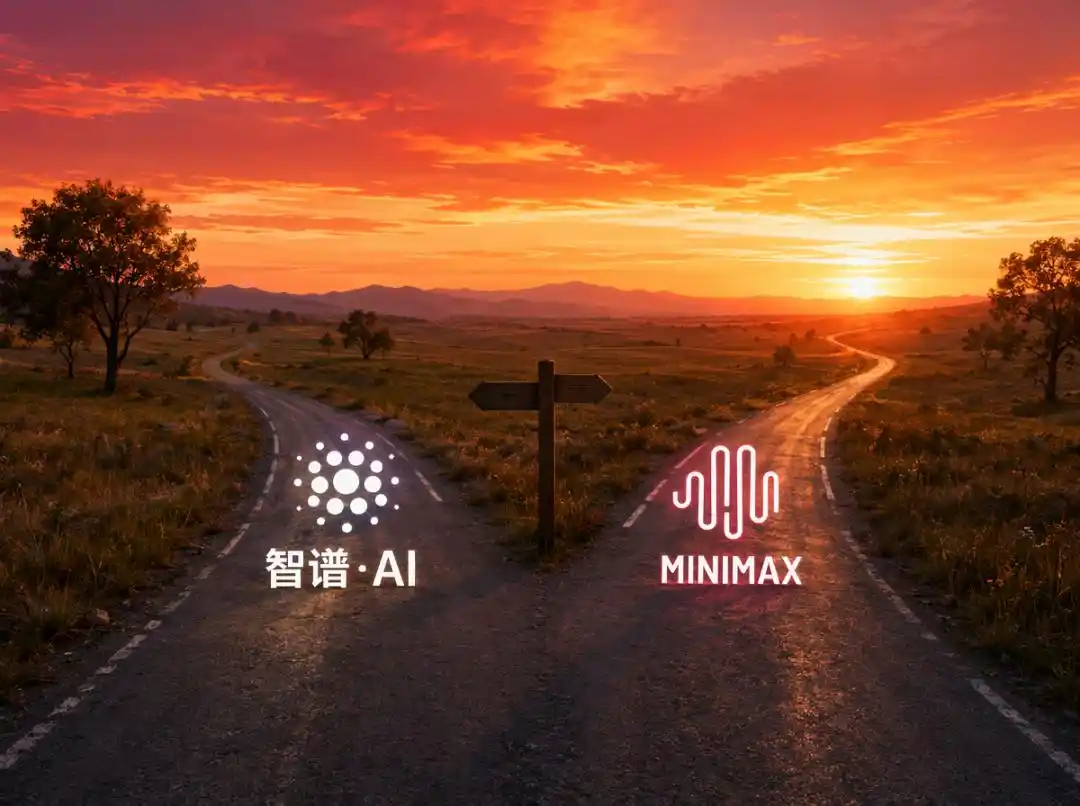
Two paths for China’s large-model companies
By July 2026, the article says, China’s AI sector is splitting into two clearer routes.
One is the monetization route represented by MiniMax: package the model as a product, target consumers, build subscriptions and prove commercial closure with revenue growth. Under that route, the market watches MAU, ARPU, renewal rates and gross margin. MiniMax’s selloff is presented as evidence that companies choosing this path will be judged by strict internet-traffic and financial metrics.
The other is the infrastructure route represented by Zhipu: keep building models, platforms and infrastructure, and support valuation through technical progress rather than revenue growth. In that setup, the comparison group is OpenAI and Anthropic.
The article says each route comes with its own failure mode. The first can stall when user growth peaks or monetization slows. The second can fail when research hits a plateau and promised breakthroughs do not arrive.
Tang’s own line in the letter was blunt, according to the article: failing to reach the top means failure. MarsBit reads that as both an internal order and a message to investors about which yardstick he wants them to use.
Its broader conclusion is that AI company valuation is moving from technology belief toward commercial delivery. MiniMax has already been forced into that test. Zhipu is trying to delay it by redefining the frame first. Whether that works, the article says, will depend on whether “Touch High” reaches a real technical ceiling or simply the limits of market patience.