

Speculation around Zhipu’s next large model picked up after some GLM Coding Plan users received a compensation notice tied to a reported “capability downgrade” issue. According to the information cited in the source article, the notice said users would receive an extra quota reset opportunity after the new model is released.
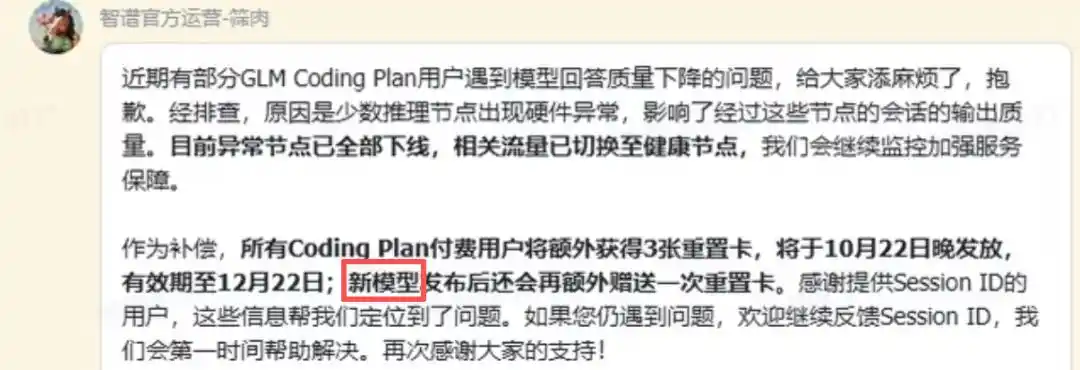
Zhipu has not publicly disclosed detailed information about its next model. Even so, that reference to a “new model” has been treated by online observers as an early signal that a release discussed as GLM-5.5 may be approaching.
A compensation notice put the spotlight on the next model
The immediate trigger was a compensation message sent to some GLM Coding Plan users. The notice addressed cases in which some users had encountered what the source described as a model “downgrade in intelligence.” It also said that once the new model goes live, users will receive one additional quota reset.
The wording did not identify the model by name, and it did not include a launch date. Still, with no formal product announcement yet in place, the mention of a “new model” became one of the clearest recent clues cited in public discussion.
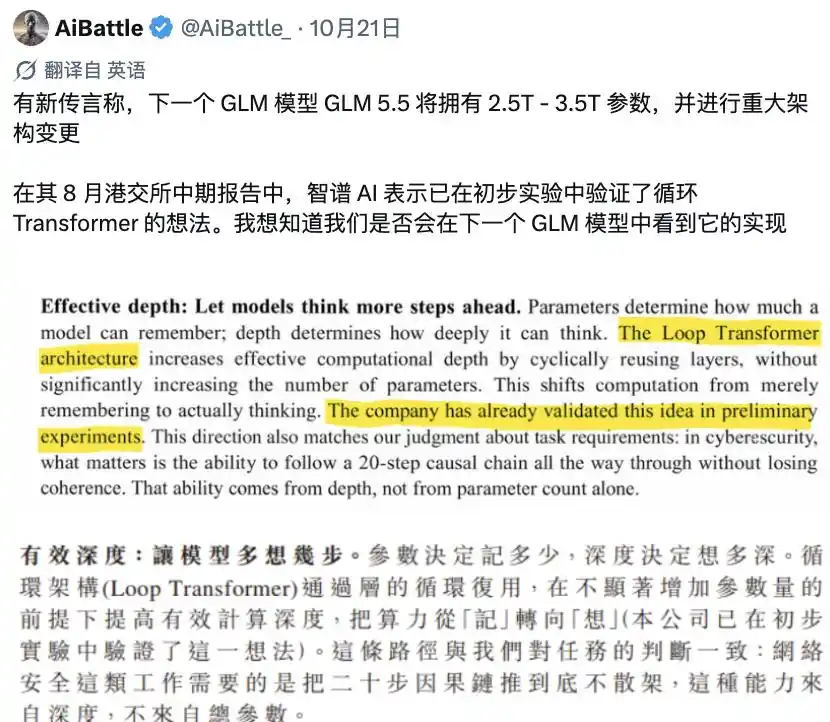
Rumors point to 2.5 trillion to 3.5 trillion parameters
One of the main topics in the recent discussion is model size.
The source says GLM-5.3, released in August, has roughly 743 billion total parameters and uses a mixture-of-experts, or MoE, architecture. Rumors circulating online suggest the next GLM model could reach 2.5 trillion to 3.5 trillion total parameters, above an earlier rumored figure of 1.6 trillion.
Using 743 billion as the reference point, that would put the next model at roughly 3.4x to 4.7x the size of GLM-5.3 in total parameters. But for MoE systems, total parameter count and the number of parameters activated during inference are not the same thing.
In practice, an MoE model typically activates only part of its expert networks when processing each token. That means a sharp increase in total parameters does not automatically imply inference compute will rise by the same multiple.

Even so, if the circulating figures are accurate, they would indicate that Zhipu is preparing a major expansion in model capacity.
GLM-5.3-Flash already tested a new architecture path
Another thread in the discussion is a possible architecture upgrade.
When Zhipu released GLM-5.3-Flash in August, it had already made substantial changes to the model’s underlying design, according to the source. The GLM series introduced a hybrid architecture that combines linear attention with sparse attention, and it also adopted mHC technology to improve internal information transfer and training stability.
The source says that combination allowed GLM-5.3-Flash to outperform GLM-5.2 in multiple evaluations while cutting inference pricing to about one-tenth of GLM-5.2. That suggests Zhipu has already tested a route that aims to improve model capability and inference efficiency at the same time.

If that architecture can be extended to the trillion-parameter range, the next GLM model could expand capacity while still lowering inference costs. Zhipu, however, has not confirmed any implementation details for GLM-5.5.
Loop Transformer remains an open question
A separate point of interest is whether Loop Transformer could be used in the next GLM model.
The source says Zhipu discussed Loop Transformer in an interim report released in August and said it had validated related ideas in preliminary experiments. The stated goal was to let AI systems “think more deeply.”
In simple terms, Loop Transformer allows a model to repeatedly call the same set of network layers, increasing the number of internal computation rounds without a large increase in parameter count. The intended result is greater effective reasoning depth.
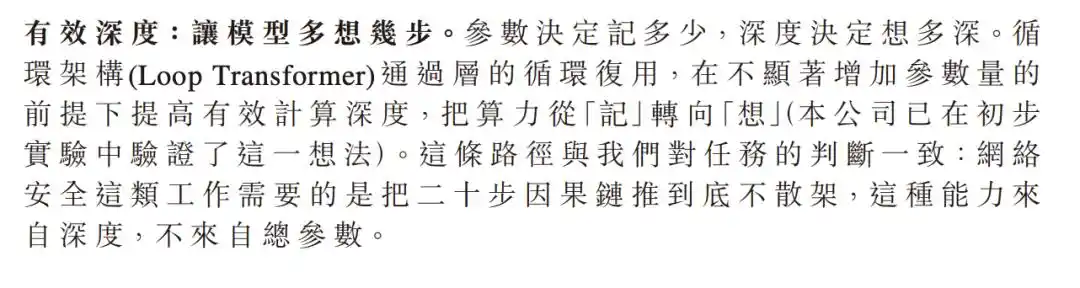
According to the source, Zhipu’s view is that parameter scale determines how much information a model can store, while computational depth affects how complex its reasoning can be. That matters in tasks such as programming and cybersecurity, where a model may need to complete more than a dozen or even dozens of consecutive judgments to reach the right answer.
The article cites one example from the report: a cybersecurity task may require a model to reason through a 20-step causal chain while maintaining logical consistency at each step. Loop Transformer is being explored as a way to improve a model’s ability to sustain reasoning across that kind of long chain and handle multi-step tasks more effectively.
At the same time, more loop iterations also bring extra compute overhead. How to balance deeper reasoning with runtime efficiency remains an unresolved issue. Zhipu has not confirmed whether the technology will be used in GLM-5.5.
Zhipu’s 2026 release cadence shows a clear direction
The source outlines a steady upgrade path for Zhipu’s models this year:

- GLM-5 was released in February.
- GLM-5.1 followed in April.
- GLM-5.2 went live in June, with a focus on complex tasks and long-duration agent execution.
- GLM-5.3 arrived in August and continued to strengthen coding capabilities.
- GLM-5.3-Flash then appeared as Zhipu explored new approaches to architecture and inference efficiency.
Viewed together, that sequence shows continued work on coding, agent performance, deeper reasoning, and inference efficiency. The compensation notice, combined with online discussion about parameter scale, architecture changes, and Loop Transformer, has pushed GLM-5.5 into focus.
For now, Zhipu has not publicly confirmed the release date, final name, parameter count, or use of Loop Transformer for the next model. What can be confirmed from the source material is limited to the compensation notice’s reference to an extra quota reset after the new model launches, along with Zhipu’s previously disclosed information on GLM-5.3, GLM-5.3-Flash, and Loop Transformer.
The source also lists two X posts as references: https://x.com/teortaxesTex/status/2113073759359811767 and https://x.com/ai_funss/status/2112902395365933107. The original article was published by MarsBit and credited to Mengyao from the WeChat public account Quantum Bit.



