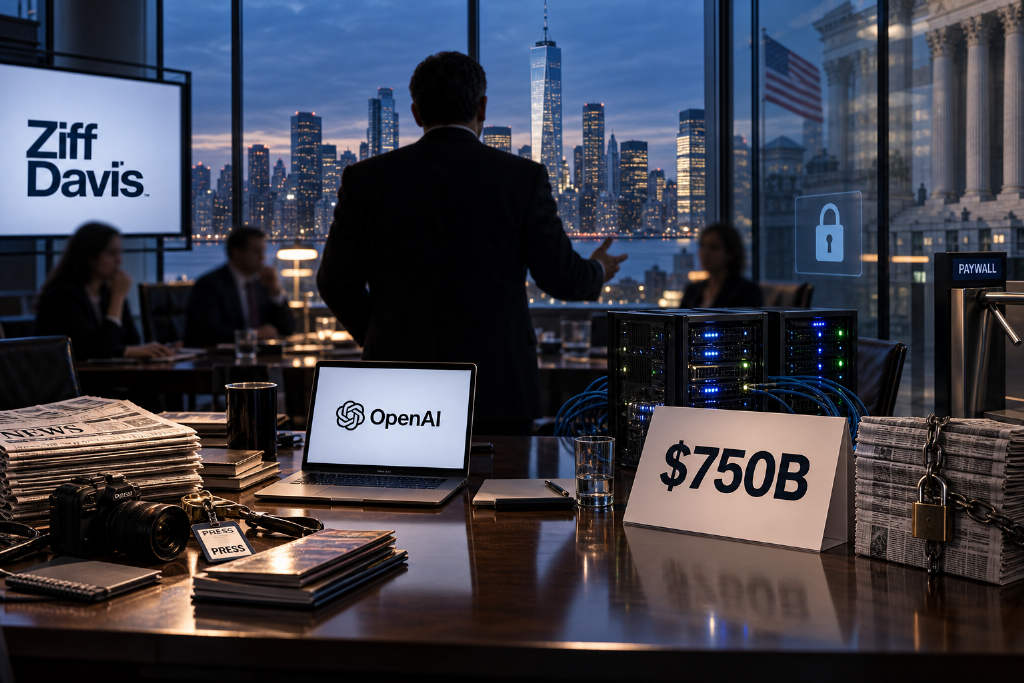
Vivek Shah, CEO of digital media and internet company Ziff Davis, said OpenAI should be able to pay licensing fees to news publishers if it can spend about $750 billion on computing infrastructure by 2030. His comments addressed the U.S. Department of Justice’s position in a copyright case in the Southern District of New York, where the government argued that licensing deals between AI companies and publishers could increase industry burdens and restrict AI development. Shah pushed back on that view, saying many publishers have already reached licensing agreements with OpenAI and other leading AI companies, while platforms such as Cloudflare and Tollbit are lowering the operational costs tied to licensing and royalty payments. He also argued that content licensing would represent only a small expense relative to projected compute spending. Using the U.S. music business as a comparison, Shah said annual royalty and licensing payments there total less than $20 billion. A similar figure for the news publishing industry, he said, would have limited impact on overall LLM company spending while creating an important revenue stream for content producers. Shah added that without a workable licensing framework, publishers may respond with paywalls and technical restrictions that block AI scraping, raising the cost for consumers to access free information and narrowing income channels for creators.
On Sept. 14, BlockBeats reported that Ziff Davis CEO Vivek Shah said OpenAI has the capacity to pay licensing fees to news publishers if it can spend $750 billion on computing power by 2030.
Shah made the remarks while commenting on the U.S. Department of Justice’s position in a copyright case in the Southern District of New York. He said the government’s view is that licensing agreements between AI companies and publishers could add burdens to the industry and restrict AI development. In his view, that argument does not match what is already happening in the market.
According to Shah, a large number of publishers have already reached licensing partnerships with OpenAI and other frontier AI companies. He also said platforms including Cloudflare and Tollbit are reducing the operational costs involved in licensing and royalty payments.
He added that OpenAI had previously told investors it expects to spend about $750 billion on computing power by 2030, while content licensing fees are small by comparison.
Shah used the U.S. music industry as an example. He said the sector’s annual royalty and licensing payments are less than $20 billion. If the news publishing industry received fees on a similar scale, he said, the effect on total spending by large language model companies would be limited, while the payments would provide meaningful income to a wide range of content producers.
Shah also warned that without a reasonable licensing mechanism, publishers may turn to paywalls and technical restrictions to block AI systems from scraping content. That, he said, could raise the cost for consumers to access free information and reduce revenue channels for creators.
This article was originally published by Bit.Fan. For more cryptocurrency news and market insights, visit www.bit.fan. Disclaimer:
The market information, project data, and third-party content displayed on this platform are for industry information sharing only and do not constitute any form of investment advice or return commitment.
Cryptocurrency trading carries high risks. Users should fully assess their risk tolerance and make independent decisions. All profits, losses, and legal responsibilities are borne by the users themselves.