
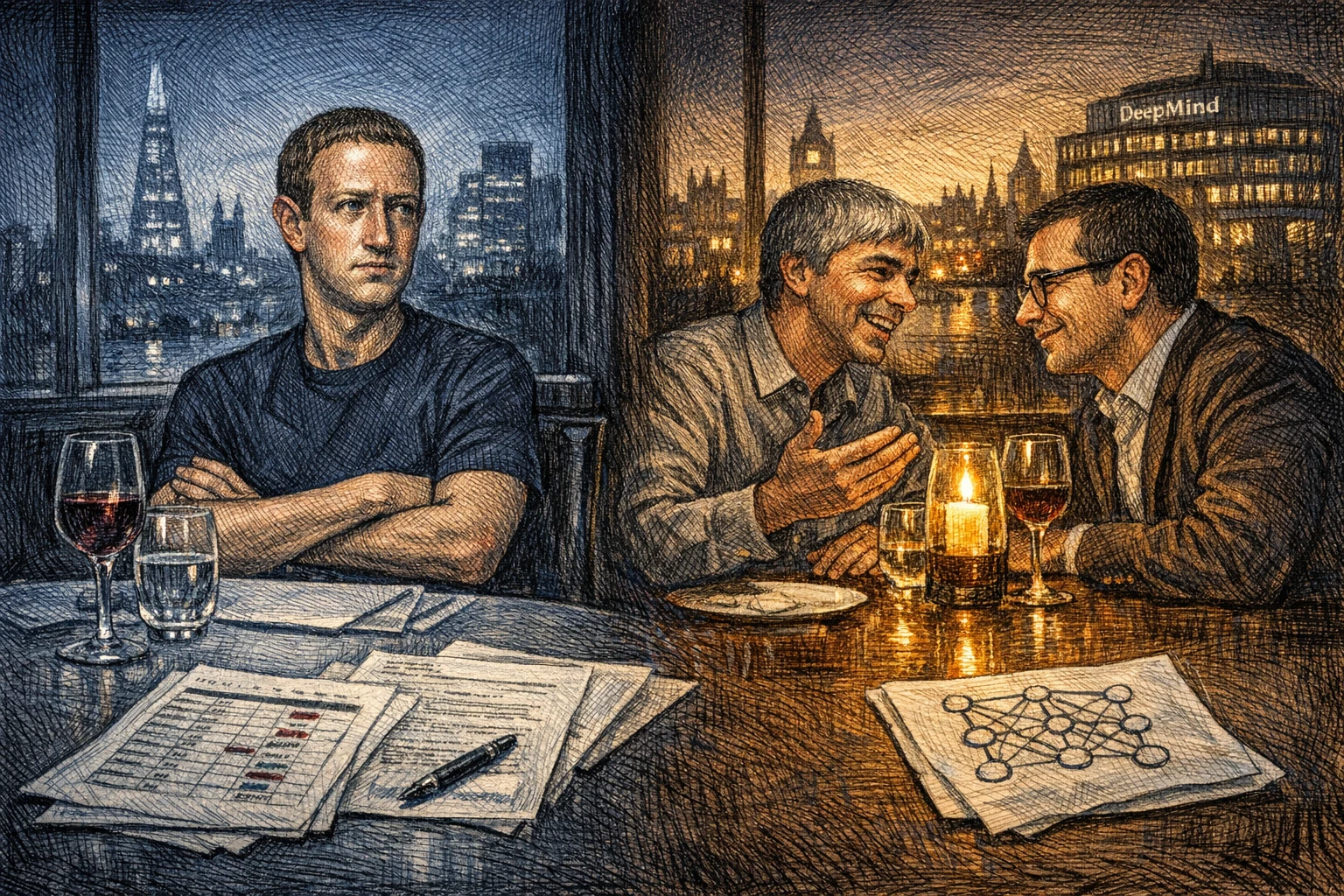
In 2013, two tech giants locked horns over a London-based AI startup called DeepMind. One offered more money. The other served dinner — literally.
A Birthday Party Spark
The story starts at Elon Musk's birthday party. Google CEO Larry Page cornered DeepMind founder Demis Hassabis and pitched bluntly: "Your goal is to build AGI. Why not leverage the resources I already have?" Hassabis was sold. He told friends, "I'm tired of chasing funding. Let me go to Google, grab a ton of compute power, and solve AI." That was almost a yes.
But Facebook was equally aggressive. Its corporate development head Amin Zoufonoun crafted a deal that lowered the equity price but packed massive signing bonuses for founders. On paper, Facebook's terms were richer.
The Dinner That Cost Zuckerberg the Deal
Hassabis was invited to Zuckerberg's house for dinner to discuss the acquisition. To test whether Zuckerberg would be a focused boss, Hassabis deliberately steered the conversation from AI to VR, AR, 3D printing — each new tech. Zuckerberg lit up for every one of them.
"That told me everything," Hassabis later said. "Facebook offered more, but I wanted someone who genuinely believes AI is more important than anything else." Co-founder Mustafa Suleyman felt the same. He raised AI governance concerns with Zoufonoun, who brushed them off. That sealed Facebook's fate.
Bluff, Negotiate, Win
Suleyman meanwhile played hardball with Google. He falsely hinted that Peter Thiel and Elon Musk were backing DeepMind, creating a bidding illusion. "Of course, those guys weren't really supporting us," he admitted later. The bluff worked. Hassabis laid down three non-negotiables: DeepMind must stay in London, no military applications, and an independent ethics and safety board of scientists and philosophers.
Google's lead negotiator Don Harrison called those terms "a big headache." Yet Google conceded all. "We wouldn't have agreed unless we absolutely believed Demis represents the future of our AI strategy," Harrison said. In January 2014, Google bought DeepMind for $650 million. Author Sebastian Mallaby calls it "a bargain by today's standards." Google poured billions into DeepMind over the next decade.
Zuckerberg didn't fold. He poached NYU professor Yann LeCun, a deep learning pioneer, to run Facebook AI Research, which immediately tried to hire DeepMind researchers. The talent war shifted from the boardroom to the lab door.
A decade later, Hassabis won the 2024 Nobel Prize in Chemistry for AlphaFold. Suleyman left to found Inflection AI and later became Microsoft AI CEO. That one dinner changed the trajectory of the entire AI industry.