News

Bitcoin
2026-07-12 11:16:18

Bitcoin Mining Difficulty Falls 5% to 127.17T

Bitcoin’s mining difficulty was adjusted downward by 5% to 127.17T at block height 957,600, according to CloverPool data cited by BlockBeats on July 12. The adjustment took place at 4:09:11 a.m. Beijing time. Current network data shows the seven-day average hashrate stands at 866.28 EH/s. The update reflects the latest scheduled difficulty change on the Bitcoin network and provides a snapshot of recent computing power across the chain. No additional details were disclosed in the source report beyond the difficulty level, block height, adjustment time, and seven-day average hashrate.

40

Bitcoin Mining Difficulty Falls 5% to 127.17T
Anthropic
2026-07-12 10:57:11

SemiAnalysis says Anthropic is nearing SaaS-like economics, with a $6 trillion base-case valuation

SemiAnalysis argues that Anthropic has crossed a line few expected an AI lab to reach this early: it is no longer just a capital-hungry research company, but a business showing software-like economics at scale. According to the report cited by Z Finance, Anthropic quietly filed for an IPO with the U.S. Securities and Exchange Commission in July 2026. By the third quarter, the company’s GAAP operating profit, or EBIT, had exceeded $1 billion, with a 6% operating margin. Annual recurring revenue rose from $9 billion at the end of 2025 to more than $60 billion. The report contrasts that performance with OpenAI, which it says was still running at roughly a -100% EBIT margin in the second quarter of 2026. SemiAnalysis attributes Anthropic’s surge to a business mix led by API usage rather than subscriptions, strong adoption of Claude Code, 500% net dollar retention, and gross margins above 60%. It also introduces EBTIT, a metric that strips out training spend to show the cash-generating power of inference, and says Anthropic posted a 36% EBTIT margin in the second quarter. Using a base case of $300 billion in ARR by the end of 2027 and a 20x ARR multiple, SemiAnalysis arrives at a $6 trillion enterprise value. The report frames Anthropic’s planned IPO as more than a company milestone: it sees the listing as an opening move in a broader shift in AI financing, from private capital toward public markets built to fund massive compute infrastructure.

40
SemiAnalysis says Anthropic is nearing SaaS-like economics, with a $6 trillion base-case valuation
BlockBeats
2026-07-12 10:52:26

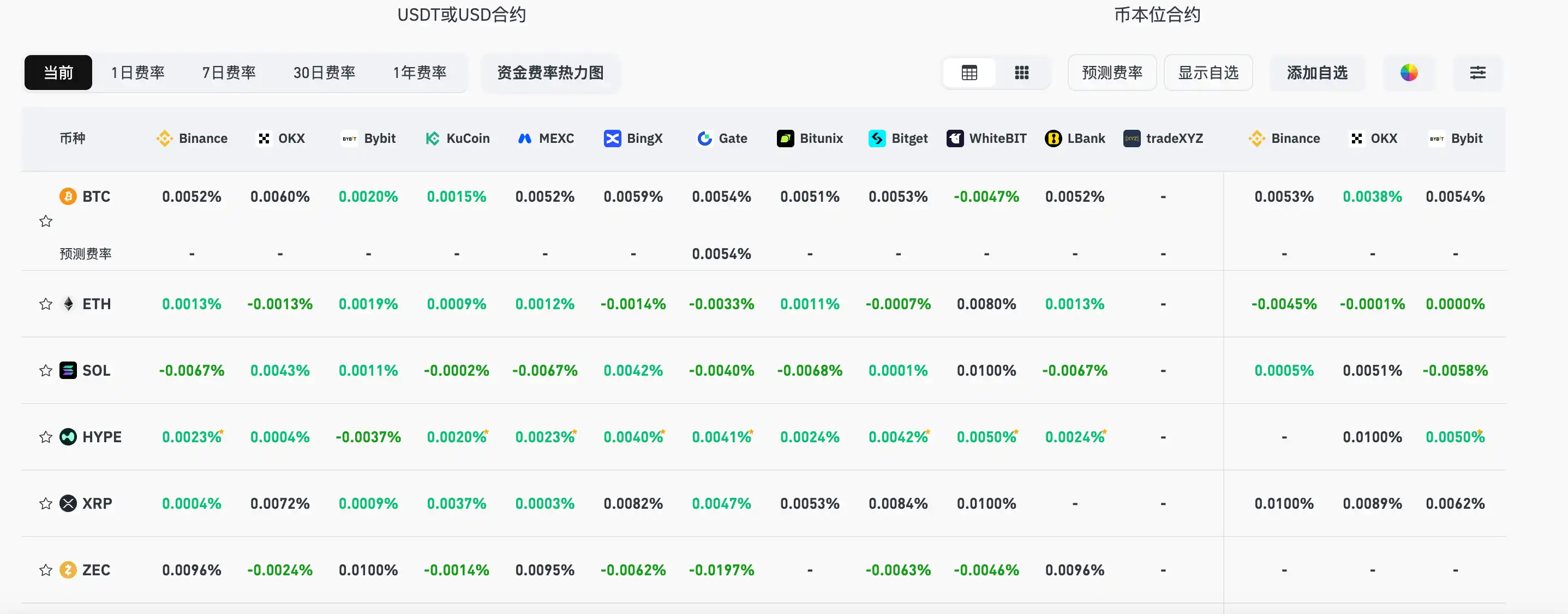
Coinglass data shows funding rates on major CEXs and DEXs have turned clearly bearish

BlockBeats reported on July 12 that data from Coinglass showed a clear shift back to bearish positioning across funding rates on major centralized and decentralized exchanges, as Bitcoin edged lower and stayed range-bound during the day. The reading points to a notable cooling in market sentiment in perpetual futures markets. The report also outlined how funding works in crypto derivatives. Funding rates are used mainly in perpetual contracts to keep contract prices close to the underlying asset. The payment is exchanged between long and short traders rather than collected by the trading platform itself. In practice, the mechanism changes the cost or return of holding a perpetual position so that prices do not drift too far from spot. According to the thresholds cited by BlockBeats, a 0.01% funding rate is considered the baseline. A rate above 0.01% usually signals a broadly bullish market, while a rate below 0.005% is generally read as a bearish signal. Based on current readings from major CEXs and DEXs, the market has moved back into a clearly bearish state.

40
Coinglass data shows funding rates on major CEXs and DEXs have turned clearly bearish
Ethereum
2026-07-12 10:52:06

Vitalik and Aya’s Hong Kong remarks point to a more distributed future for Ethereum

Foresight revisited a conversation between Vitalik and Aya in Hong Kong, framing it around Ethereum’s move toward a "multi-node future." The central idea was concise: a resilient ecosystem does not depend on a single center, but on the steady emergence of new nodes, new ways of working together, and new builders. The source material was brief and did not add details on timing beyond identifying the exchange as a Hong Kong conversation previously made in April. It also did not provide extended quotes, policy implications, or market data. Within those limits, the message presented a clear view of ecosystem durability: resilience comes from continued decentralization in participation and coordination, rather than concentration. That leaves the focus on structure, not price action. In this framing, Ethereum’s next phase is tied to whether it can keep expanding the number of active contributors and collaboration paths across the ecosystem.

40
Vitalik and Aya’s Hong Kong remarks point to a more distributed future for Ethereum
Quantum Compu
2026-07-12 10:46:17

IOSG says quantum computing won’t end crypto, but it could force a full Web3 security overhaul

IOSG argues that quantum computing is not a doomsday button for cryptocurrencies, but it does pose a serious long-term threat to the cryptographic foundations of Web3. In a reposted article by 0xjacobzhao, the firm says the real danger is not that blockchains suddenly stop working, but that a cryptographically capable fault-tolerant quantum computer could derive private keys from already exposed public keys and produce valid signatures on-chain. That would put extreme pressure on three core properties of public blockchains: permanently public ledgers, irreversible asset transfers, and self-custodied private keys. The article says the industry’s problem is no longer a lack of post-quantum cryptography. Instead, the hard part is coordination. Bitcoin and Ethereum face different migration problems: Bitcoin must deal with exposed legacy UTXOs, signature-size expansion, and governance disputes over dormant coins, while Ethereum is working on a broader migration across accounts, validator signatures, data availability, and zero-knowledge systems. IOSG points to a 5 to 8 year “engineering comfort window” before quantum risk becomes much harder to manage, even though broader Q-Day estimates remain centered around 2035 to 2045, with faster scenarios falling in the 2030 to 2035 range.

40
IOSG says quantum computing won’t end crypto, but it could force a full Web3 security overhaul
ChainCatcher
2026-07-12 10:44:29

Wallet tracked by Ai Yi exits CASHCAT trade with about $14,400 in profit

ChainCatcher reported, citing on-chain analyst Ai Yi (@ai_9684xtpa), that wallet address 0xae0…72b92 bought $1,190 worth of CASHCAT six days ago at $0.00664. The position was fully sold eight hours ago at $0.17585, according to the monitoring update. The trade ended with an estimated profit of about $14,400 and a return rate of 1211.4%. The transaction was presented as an on-chain trading case involving a short holding period and a full exit from the position.

40
Wallet tracked by Ai Yi exits CASHCAT trade with about $14,400 in profit
BlockBeats
2026-07-12 10:40:08

Trader Exits CASHCAT Position After Six Days With More Than 12x Return

A trader fully exited a CASHCAT position after holding it for six days, locking in more than a 12x return, according to on-chain analyst Ai Yi (@ai_9684xtpa) cited by BlockBeats. The monitored address bought $1,190 worth of CASHCAT at an average entry price of $0.00664 six days earlier. About eight hours before the report, the trader sold the entire position at an average price of $0.17585 and closed out the trade. The final profit was reported at $14,400. The update was published by BlockBeats on July 12 as a 7x24 flash item.

40
Trader Exits CASHCAT Position After Six Days With More Than 12x Return
TCS
2026-07-12 10:37:19

TCS plans AI deployment team of up to 8,900 and looks for acquisition opportunities

Tata Consultancy Services (TCS) is assembling a frontline AI deployment engineering team of up to 8,900 people and is also looking for acquisition opportunities in AI, according to Reuters. Two company executives said the move reflects TCS's view that artificial intelligence will open new business lines rather than weaken its core IT outsourcing operations. The plan comes as investors debate how AI could reshape India’s $315 billion IT services sector. A widely held market view is that AI may reduce the need for large engineering teams, shorten delivery cycles, and put pressure on pricing and margins if clients seek a share of productivity gains created by AI. TCS is positioning itself against that backdrop by expanding its AI delivery capacity while scanning the market for deals.

40
TCS plans AI deployment team of up to 8,900 and looks for acquisition opportunities