AAOI
Nov 4, 2026

AAOI signs five-year InP wafer supply deal with Yunnan Xinyao, with 2027 contract value set at $194.4 million

Applied Optoelectronics (AAOI) has entered a five-year long-term supply agreement with Yunnan Xinyao, a subsidiary of Yunnan Germanium, for 4-inch N-type indium phosphide (InP) wafers. Under the deal, AAOI is set to buy 180,000 wafers a year from 2027 through 2031, for a total of 900,000 wafers. Yunnan Germanium said the 2027 contract value stands at $194.4 million, equal to 122.46% of its audited 2025 revenue. Rosenblatt said in a Nov. 3 report that InP wafers remain one of the tightest bottlenecks in the optical communications supply chain and argued the agreement secures a critical input for AAOI’s 800G and future optical transceiver ramp. The firm kept its Buy rating on AAOI, while also flagging risks tied to China’s dual-use export licensing regime, supplier concentration, annual price renegotiation, and foreign-exchange exposure. The report also linked the deal to a still-strong optical cycle, citing Fabrinet’s higher capacity targets, roughly two years of visibility for transceiver, OCS, NPO and CPO projects, and its view that Marvell’s planned acquisition of Lumentum is strategic rather than a sign of weakening demand.

900
AAOI signs five-year InP wafer supply deal with Yunnan Xinyao, with 2027 contract value set at $194.4 million
optical modules
Oct 12, 2026

Goldman raises optical module shipment outlook as Hubei firms trail Zhongji Innolight in scale and overseas reach

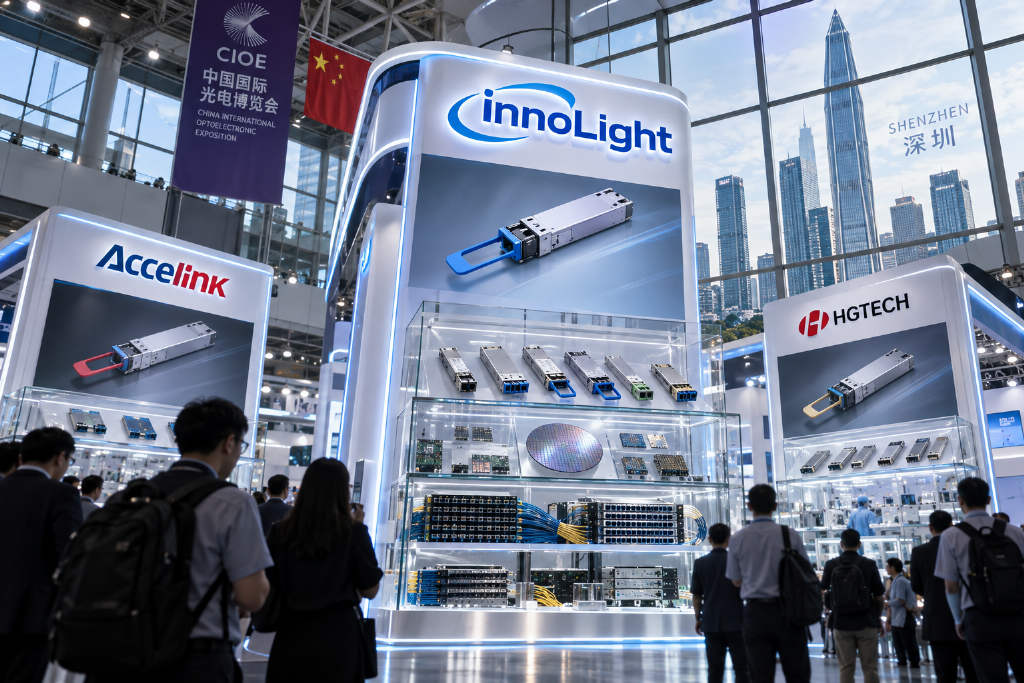
Goldman Sachs raised its 2026-2028 shipment forecasts for global optical modules on Sept. 7, lifting estimates for 800G-and-above products by 31%, 39% and 36%, and for 1.6T-and-above products by 29%, 61% and 50%. At the 27th China International Optoelectronic Exposition in Shenzhen, Hubei-based companies showcased products moving beyond 800G toward 1.6T, 3.2T, 6.4T and even 12.8T, showing that local technology development is keeping pace with the next wave of higher-speed products. Yet the gap with Zhongji Innolight remains wide in revenue, profit, capacity and access to North American cloud customers. The report cited revenue growth at Accelink, HGTECH, Linktel Technologies and Huilv Ecology, but said Zhongji Innolight’s first-half optical module revenue reached 41.355 billion yuan, nearly three times the combined optical module revenue of those four Hubei companies. Its profit also exceeded 13 billion yuan, above the four firms’ combined earnings. Interviewees told Zhidian Finance that Hubei’s weakness is less about core technology and more about late capacity positioning, slower entry into the first wave of high-speed module demand, limited penetration of North American AI customers, and less flexible market-oriented mechanisms. Several experts said the next step for Hubei companies is to concentrate resources on certification, factory audits, overseas capacity and top-tier North American cloud accounts.

2640
Goldman raises optical module shipment outlook as Hubei firms trail Zhongji Innolight in scale and overseas reach
Elite Advanced Laser
Oct 7, 2026

Elite Advanced Laser posts 258% jump in August net profit as CPO and AI server demand accelerates

Elite Advanced Laser, a major optical communications packaging and testing company, disclosed its latest self-reported August figures after its stock met Taiwan’s attention-trading threshold. The company posted NT$1.248 billion in consolidated revenue for the month, up 110% from a year earlier, while pre-tax profit reached NT$281 million, up 121%. Net profit attributable to the parent came in at NT$143 million, a 258% increase, and monthly EPS rose to NT$0.98. The report linked the sharp improvement to stronger demand tied to AI data center buildouts by global cloud service providers, which has lifted demand for high-speed optical transmission and silicon photonics, including co-packaged optics, or CPO. Elite Advanced Laser said its 800G optical transceiver module packaging and testing capacity has entered scaled mass production, while higher-margin AI optical products are becoming a key earnings driver. The company is also stepping up expansion. Its 2026 capital expenditure plan has been raised from NT$1.1 billion last year to about NT$1.6 billion, mainly for advanced automated wafer-level testing equipment and cleanroom capacity. Its board has also approved NT$3 billion in unsecured convertible bonds to support working capital, equipment purchases, and bank loan repayment.

860
Elite Advanced Laser posts 258% jump in August net profit as CPO and AI server demand accelerates
Goldman Sachs
Sep 14, 2026

Goldman Sachs Raises High-Speed Optical Module Demand Forecast, Flags Supply Constraints for 2027

Goldman Sachs sharply lifted its demand forecasts for high-speed optical modules after visiting 15 optical communications companies in China, saying demand for 800G and above modules will reach 144 million units in 2027 and 171 million units in 2028, up 39% and 36% from its prior estimates. The bank said demand is being driven by AI server rack expansion, a shift in network architecture from scale-out to scale-up with broader inter-layer interconnection, and the continued move toward higher transmission speeds. Goldman also expects 1.6T optical module pricing to stay above $700, while 800G products may see only a single-digit price decline by 2027. At the same time, it said the industry bottleneck is moving from demand to supply, with shortages in DSPs, lasers and PCBs likely to cap actual shipments in 2027. The firm added that leading manufacturers are locking in capacity through prepayments, long-term supply agreements and investments in suppliers, a trend that could reinforce industry concentration and support pricing. In CPO, Goldman expects switch shipments to rise from 10,000 units in 2026 to 92,000 in 2027 and 131,000 in 2028.

2300
Goldman Sachs Raises High-Speed Optical Module Demand Forecast, Flags Supply Constraints for 2027
Goldman Sachs
Sep 7, 2026

Goldman Sachs Sharply Raises Optical Module Market Forecast: 2028 Scale Could Reach $148.5 Billion

Goldman Sachs has sharply raised its optical module market forecast, predicting the global market will reach $67.7 billion in 2026, $131.4 billion in 2027, and $148.5 billion in 2028, representing upward revisions of 33%, 81%, and 115% respectively. The revision is driven not only by AI server growth but also by the shift to high-speed network architectures and increased optical module demand per GPU/ASIC chip, fueling demand for 800G, 1.6T, and 3.2T modules.

1650
Goldman Sachs Sharply Raises Optical Module Market Forecast: 2028 Scale Could Reach $148.5 Billion
Semtech
Aug 27, 2026

Morgan Stanley Raises Semtech Price Target to $195 on 1.6T and Data Center Growth

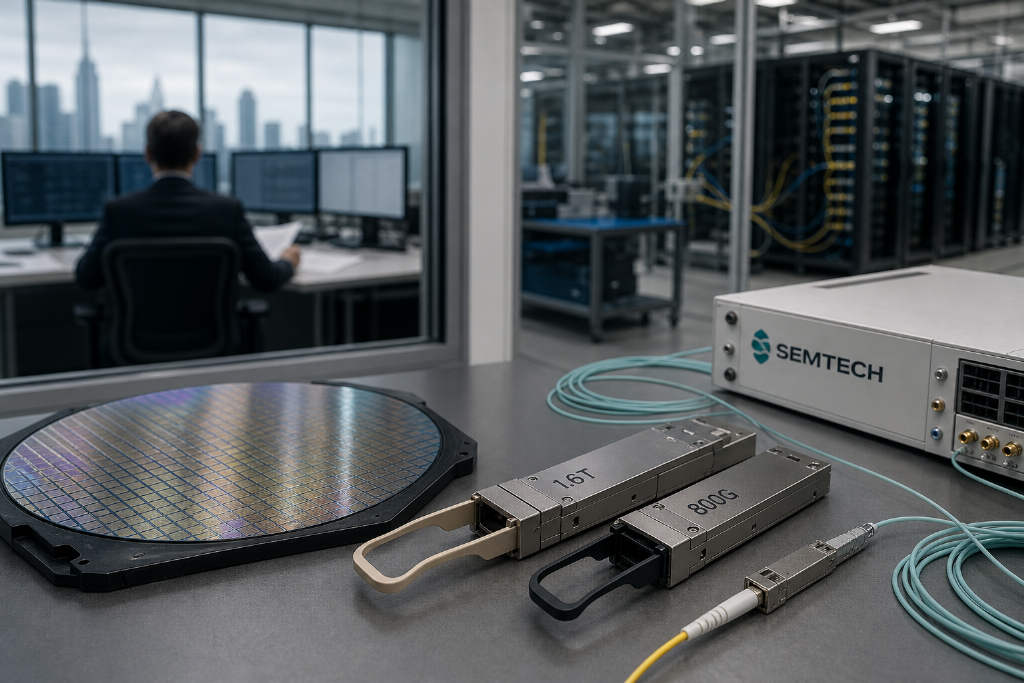
Morgan Stanley said in an Aug. 25 research note that Semtech posted record second-quarter data center revenue of $100 million, up 39% quarter over quarter and 91% from a year earlier, driven by continued strength in 800G FiberEdge and faster-than-expected 1.6T FiberEdge certifications. The bank expects 1.6T FiberEdge and CopperEdge to account for more than 50% of data center revenue in the third quarter and lifted its price target on the company to $195 from $175 while keeping an Equal-weight rating. The note also highlighted strong third-quarter guidance, with data center revenue expected to reach about $145 million, up 45% sequentially and 160% year over year. Morgan Stanley raised its forecasts for fiscal 2027 and fiscal 2028 revenue, gross margin, and earnings per share, while arguing that supply is becoming a bigger constraint than demand. Outside the data center segment, the report said LoRa also reached a record high and pointed to longer-term opportunities in NPO, CPO, and 3.2T optical markets.

2740
Morgan Stanley Raises Semtech Price Target to $195 on 1.6T and Data Center Growth
Optical Interconnect
Aug 7, 2026

Optical interconnect earnings point to strong 800G demand, with capacity and margins now in focus

WhiteLine Daily said the latest earnings round reinforced the same industry message: demand for optical interconnect products remains strong, with 800G already shipping at volume and 1.6T beginning to ramp. Applied Optoelectronics reported $108 million in second-quarter data center revenue, up 140% year over year, and said demand could stay above capacity through at least mid-2027. The company is expanding its U.S. manufacturing base and is targeting monthly capacity of more than 650,000 units by year-end, but near-term execution still depends on line ramp, yield, and delivery speed. MACOM offered a second signal from upstream, reporting $342.2 million in quarterly revenue, up 36% year over year, and a next-quarter revenue guide midpoint of about $420 million, above prior market expectations. Management also flagged shortages in InP DFB lasers, suggesting demand for pluggable optical modules is now pushing constraints back into the laser supply chain. WhiteLine Daily said the next phase for the sector will hinge less on proving demand and more on whether suppliers can turn expansion plans into shipments without losing yield, pricing discipline, or gross margin.

3310
Optical interconnect earnings point to strong 800G demand, with capacity and margins now in focus
AAOI
Aug 7, 2026

AAOI posts record revenue again, but profit and cash flow still lag

Applied Optoelectronics (AAOI) reported its second-quarter results on Aug. 6, marking the company’s fifth straight quarter of record revenue. The headline growth looked strong, helped by a 140% year-over-year increase in data center revenue and a 44% rise in CATV revenue. But the rest of the financial statements told a more mixed story. AAOI said GAAP gross margin fell to 27.7% in the quarter, while non-GAAP gross margin came in at 29.8%. The company also remained loss-making on a GAAP basis even as non-GAAP net profit turned positive. In the reconciliation, the biggest item was a $14.26 million tax adjustment tied to the excluded items, accounting for about 50.5% of the total bridge difference. Cash flow showed the strain of expansion more clearly. In the first half, net cash outflow from operating and investing activities totaled $707 million, driven by receivables, inventory, and spending on plants, equipment, and prepayments. Financing activity brought in $980 million, including $1.028 billion in net proceeds from common stock issuance. AAOI ended the period with $509 million in cash, cash equivalents, and restricted cash, with the increase mainly coming from equity financing rather than a broad turnaround in operating cash flow.

2890
AAOI posts record revenue again, but profit and cash flow still lag
Total 9 items
Go topage