Longban Media
Sep 8, 2026

Longban Media’s AI video unit reported just $11 in June revenue as stock surge draws exchange warning

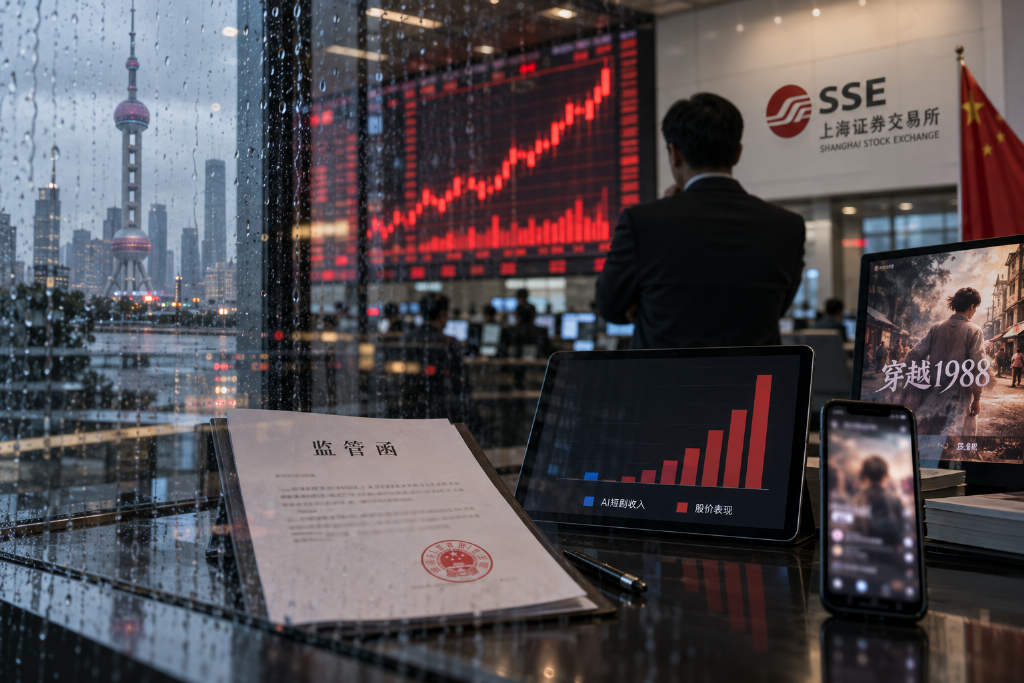
Longban Media, a listed publishing company in Heilongjiang, became one of the hottest AI-related trades in China’s A-share market after disclosing progress on its AI comic drama project. From Aug. 31 through the latest seven trading sessions, the stock posted seven straight limit-up moves, with its share price rising from RMB 9.58 to RMB 18.82 and market value climbing from RMB 4.3 billion to RMB 8.3 billion. The rally later collided with a stark revenue disclosure. In a Sept. 4 risk notice, the company said its AI video business generated about RMB 80 in June and about RMB 75,000 in July, accounting for less than 0.01% of its audited 2025 operating revenue. The Shanghai Stock Exchange then issued a regulatory warning to Longban Media and board secretary Sun Fujun, citing inaccurate disclosure, inadequate risk warning and inconsistencies across filings that could mislead investors. At the center of the dispute is the company’s AI comic drama "Across 1988," which Longban said had completed 170 episodes, surpassed 120 million views across platforms and posted a Hongguo popularity score above 40 million. The case has drawn attention because the project’s disclosed income remained tiny while the company’s valuation added roughly RMB 4 billion in a matter of days.
1520
Longban Media’s AI video unit reported just $11 in June revenue as stock surge draws exchange warning
Moore Threads
Sep 7, 2026

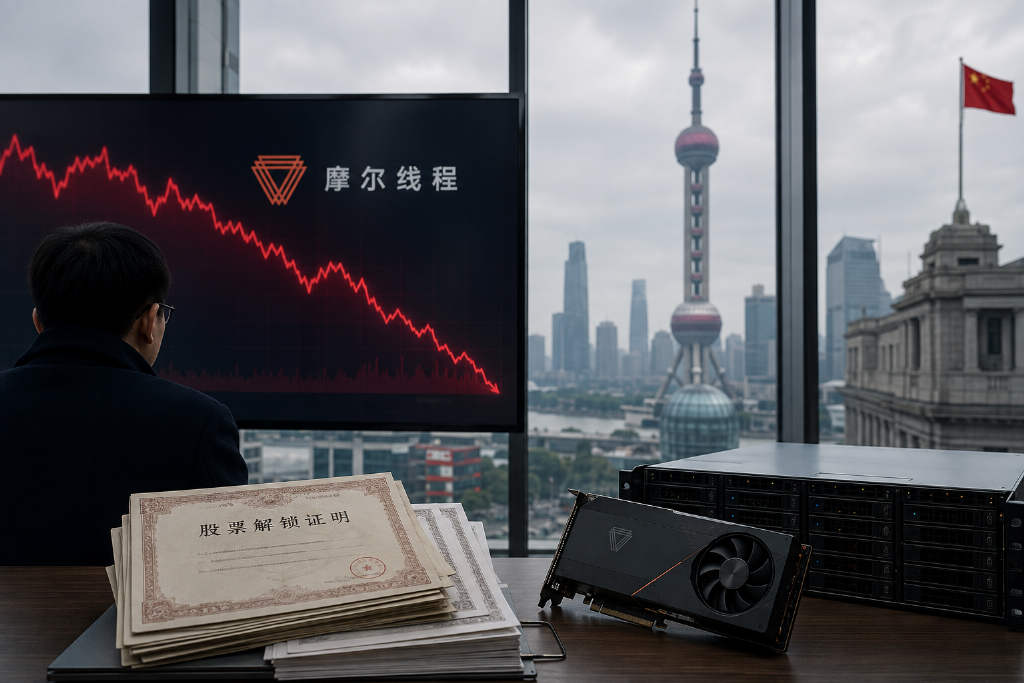
Moore Threads hits 20% daily limit down in Star Market debut-era first, says operations remain normal

Chinese GPU company Moore Threads fell to the 20% daily down limit in early trading on Sept. 7, its first such move since listing on Shanghai’s STAR Market in December 2025. By the midday break, the stock was at CNY 415.48, down CNY 103.87 from the previous session, with market capitalization slipping below CNY 200 billion to about CNY 195.3 billion. The immediate trigger was a large lock-up expiry. A total of 25.7745 million shares from the IPO offline placement tranche became tradable that day, equal to 5.48% of total share capital. Based on the Sept. 4 close of CNY 519.35, the unlocked shares were worth about CNY 13.386 billion. The company’s free float rose from 30.2255 million shares to 56 million shares after the unlock. In response, a company securities affairs representative told media that the event was a normal post-listing capital-market milestone and that the newly tradable shares were mainly held by public funds and offline investors that participated in the IPO subscription process. The representative added that production and operations are normal and that the company’s fundamentals have not seen any material change. Moore Threads’ latest interim report showed first-half 2026 revenue of CNY 1.736 billion, up 147.42% year over year.

870
Moore Threads hits 20% daily limit down in Star Market debut-era first, says operations remain normal
Moore Threads
Sep 7, 2026

Moore Threads Hits 20% Intraday Limit Down as IPO Lockup Shares Become Tradable

Chinese GPU maker Moore Threads (688795.SH) fell to the 20% intraday limit on Sept. 7, pushing its market capitalization below 200 billion yuan. The move came on the same day that 25.7745 million shares from its IPO offline placement lockup became eligible for trading, according to a company announcement. Yicai contacted the company’s securities affairs representative by phone while posing as an investor. A staff member said the session coincided with a large unlock day for offline placement restricted shares and asked investors to view the situation rationally. The staff member also said the company’s fundamentals remain normal. The report was cited by ChainCatcher in a 7x24 news update.

1410
Moore Threads Hits 20% Intraday Limit Down as IPO Lockup Shares Become Tradable
UBS Securities
Sep 2, 2026

UBS Strategist Meng Lei Sees 15% A-Share Earnings Growth in 2026

UBS Securities China equity strategy analyst Meng Lei has raised his overall earnings forecast for A-share companies. In his latest comments, he said aggregate earnings of all A-share companies are expected to grow by 15% in the full year 2026. Meng attributed that view to an earnings recovery, incremental capital entering the market and a global technology narrative, and he expects A-shares to keep up a steady rebound for the rest of the year. Still, he flagged two uncertainties that could limit further upside. One is tied to macro factors: geopolitical developments, U.S. Treasury yields and oil price swings may weigh on the valuations of rate-sensitive technology sectors. The other is about positioning: with mutual funds already heavily overweight technology stocks, a wave of so-called “break-even redemptions” — investors exiting once their holdings return to the original cost basis — could restrain the rebound. Jinshi carried his comments, and the report appeared on Odaily.

1910
UBS Strategist Meng Lei Sees 15% A-Share Earnings Growth in 2026
A-shares
Sep 1, 2026

China A-shares close lower, with Shenzhen Component and ChiNext down more than 1%

China’s A-share market ended lower on Sept. 1 after trading in a volatile range through the session, with all three major indexes finishing in negative territory. By the close, the Shanghai Composite had slipped 0.16%, while the Shenzhen Component fell 1.02% and the ChiNext Index lost 1.32%. On the sector front, agricultural stocks moved against the broader trend and posted gains, while computing hardware names including PCB-related stocks came under pressure. Turnover for the day reached 2.05 trillion yuan. The move capped a broadly weaker session for mainland equities, according to BlockBeats.

1930
China A-shares close lower, with Shenzhen Component and ChiNext down more than 1%
STAR Market
Sep 1, 2026

STAR Market first-half net profit tops last year’s full-year level, with CXMT surging 3427.76%

China’s STAR Market posted sharply higher earnings in the first half of 2026, according to data cited by the Shanghai Stock Exchange. Companies on the board generated a combined 1.01 trillion yuan in revenue, up 38.6% year over year, while net profit reached 144.887 billion yuan, up 437.6% and already above the full-year level recorded last year. Wind data showed that 409 of the 616 listed companies were profitable in the period, while 334 posted year-over-year net profit growth and 133 more than doubled profit. Semiconductors were the standout sector. Newly listed ChangXin Memory Technologies recorded 77.605 billion yuan in net profit attributable to shareholders, up 3427.76%, making it the board’s top profit earner. The company said stronger global demand for computing power, capacity allocation by major manufacturers, tight DRAM supply, and higher prices drove margin gains. Biwin Storage also reported strong numbers, while Semiconductor Manufacturing International Corp. and Huahong Group posted profit growth. Innovative drugmakers were another bright spot, supported by outbound licensing activity. Still, the results were uneven across sectors. Wind data showed 207 companies remained loss-making, and JinkoSolar posted the largest loss at 3.076 billion yuan as photovoltaics stayed under pressure.

1540
STAR Market first-half net profit tops last year’s full-year level, with CXMT surging 3427.76%
stock etf
Aug 31, 2026

Stock ETFs See $7.3 Billion Yuan Outflow in a Day as Semiconductor and STAR Market Funds Attract Inflows

China’s stock ETF market posted a net outflow of 5.255 billion yuan on Aug. 28 as A-shares gave up early gains and the three major indexes closed lower, with turnover across Shanghai and Shenzhen reaching 2.1 trillion yuan. Wind data showed total shares outstanding in stock ETFs fell by 2.219 billion units that day, while the sector’s total assets stood at 3.51 trillion yuan across 1,551 products as of Aug. 28, 2026. Even with the broader pullback, money rotated into selected themes. Semiconductor- and chip-related ETFs, along with products tracking the STAR 50 Index and ChiNext Index, ranked among the strongest inflow destinations. Among the top 20 stock ETFs by daily net inflow, nine were tied to semiconductors or chips, drawing nearly 2.6 billion yuan combined. Over the past five trading days, ETFs linked to the ChiNext Index absorbed more than 4.6 billion yuan, while CSI 500-related ETFs pulled in more than 2.7 billion yuan. Fund managers quoted in the report said they remain focused on structural opportunities, with one highlighting China’s “engineer dividend” and another pointing to AI, cloud, computing, storage, and networking as key areas for the second half of the year.

1500
Stock ETFs See $7.3 Billion Yuan Outflow in a Day as Semiconductor and STAR Market Funds Attract Inflows
Rockchip
Aug 31, 2026

Rockchip hits limit-up after strong sales of open-source robot Microduck

Rockchip’s shares opened limit-up in China’s A-share market on Aug. 31 after the launch of Microduck, an open-source bipedal robot released by Pollen Robotics, a unit under Hugging Face, drew heavy orders. Microduck is priced at $399, stands about 25 centimeters tall, and supports walking, picking up objects, getting back up after a fall, and even wearing roller skates. According to BlockBeats, the product generated more than $1 million in orders within six hours of launch and more than $2.6 million within 24 hours. Based on the $399 price tag, that implies roughly 6,500 pre-orders. Delivery times for new orders have already been pushed out to four to six months. The robot’s main controller uses Rockchip’s RK3566 chip. Its onboard computing platform handles 15 motors, a camera, LiDAR, and a 50Hz robot policy loop. Market analysis cited strong sales of Hugging Face’s Microduck as a catalyst behind the stock move.

1560
Rockchip hits limit-up after strong sales of open-source robot Microduck
Total 129 items
Go topage