Agora
Oct 23, 2026

Agora CEO Zhao Bin outlines five-level conversational capability framework at iRTE2026

Agora founder and CEO Zhao Bin presented a "five-level conversational capability" framework during a speech at the iRTE2026 Real-Time Intelligence Conference, laying out an evolutionary path for conversational AI from basic response generation to deeper understanding and relationship-based communication. According to the event remarks cited by Techub News, the framework breaks conversational ability into five levels, starting from expression based on the system’s own perspective and moving toward communication built on deep relationships. The stated goal is to enable AI systems to do more than interpret the immediate context of a conversation, extending that ability to long-term context so they can better understand a person’s real intent. Zhao also said that as AI shifts from single-turn question answering to sustained interaction, real-time interactive infrastructure is becoming an important technical layer linking models, agent runtime frameworks, and users. Agora said its conversational AI engine is built around full-duplex interaction to support stable and synchronized real-time conversations. The company added that it will continue improving conversational AI development tools and toolkits for developers building agents with complete logic and execution capabilities.


840
Agora CEO Zhao Bin outlines five-level conversational capability framework at iRTE2026
Agora
Oct 23, 2026

Agora Says Initia Exploit Affected Third-Party Product Using AUSD

Agora said the Initia exploit involved a third-party product that used AUSD, not any smart contracts deployed by Agora on Initia. Ethereum records cited in the report show that 1.4 million AUSD left a bridge adapter. The company’s statement narrows the scope of its direct exposure by saying it has no smart contracts live on Initia. The article also points to a related report from The Defiant stating that Agora froze an AUSD account linked to the Initia exploit. The report was published by The Defiant on Oct. 23, 2026.

1090
Agora Says Initia Exploit Affected Third-Party Product Using AUSD
Agora
Oct 6, 2026

Agora’s OCC approval clears path for AUSD shift to a U.S. trust bank

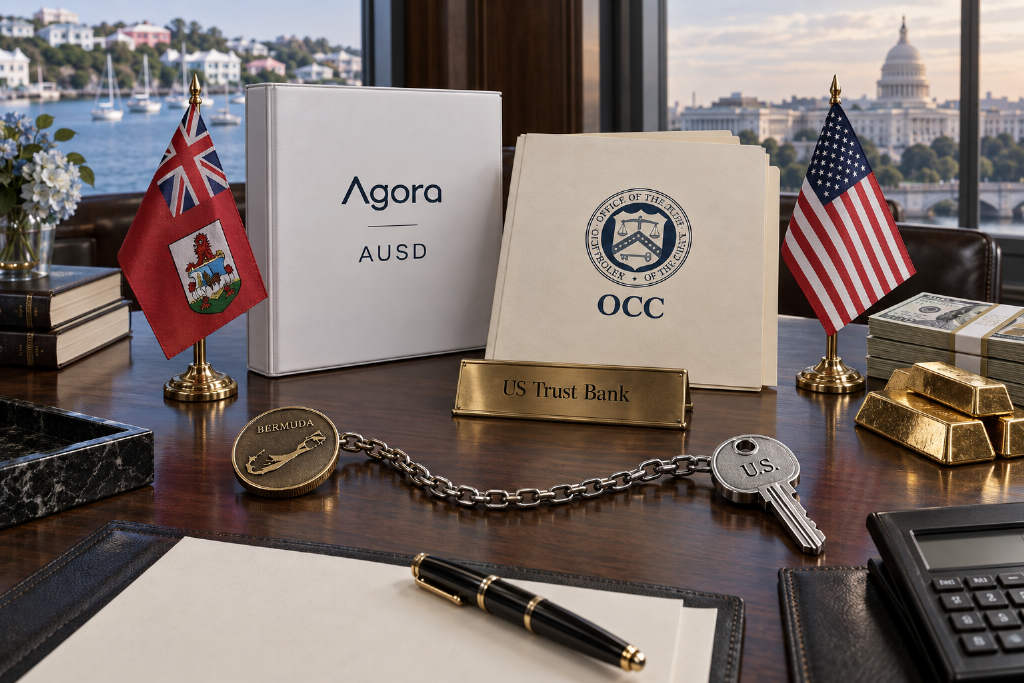
Agora has received approval from the Office of the Comptroller of the Currency, setting up a planned transfer of AUSD issuance and reserve management to a U.S. trust bank. Under the arrangement described in the report, the new bank would assume responsibilities now handled by Agora’s Bermuda entity. The move is not immediate. Before the bank can open, it still has to satisfy capital, liquidity, and compliance requirements. The report did not provide a launch date or additional operating details. The development points to a restructuring of where AUSD-related functions would sit, with issuance and reserves intended to move from an offshore entity to a U.S. banking structure once the remaining conditions are met.

980
Agora’s OCC approval clears path for AUSD shift to a U.S. trust bank
Agora
Oct 6, 2026

Agora wins OCC approval to form U.S. trust bank for AUSD issuance and reserves

Stablecoin issuer Agora has received approval from the Office of the Comptroller of the Currency, or OCC, to move ahead with plans for a U.S. trust bank, according to The Defiant. The proposed entity is intended to take over issuance and reserve management for AUSD. The report says the new trust bank will assume functions currently handled by Agora’s Bermuda entity, shifting those responsibilities into the planned U.S. structure. The bank is not yet ready to begin operations. Before it can formally open, it still has to meet regulatory requirements tied to capital, liquidity, and compliance. The development centers on a structural change in how AUSD issuance and reserves would be managed, with the trust bank positioned as the vehicle for that transition once the remaining conditions are satisfied.

1220
Agora wins OCC approval to form U.S. trust bank for AUSD issuance and reserves
Agora
Sep 21, 2026

Agora wins preliminary conditional OCC approval to form a national trust bank

Agora has received preliminary conditional approval from the Office of the Comptroller of the Currency, or OCC, to establish a national trust bank, according to an official announcement cited by BlockBeats on Sept. 22. The approval is not final. The company still needs final clearance before the trust bank can begin operating. If that final approval is granted, the bank will operate under OCC supervision. The update points to a regulatory step forward for Agora, with the federal banking regulator setting the framework for how the proposed trust bank would be overseen once fully authorized.

870
Agora wins preliminary conditional OCC approval to form a national trust bank
South Korea
Jul 19, 2026

South Korea unveils won internationalization roadmap with offshore settlement network plan

South Korea has released a "won internationalization roadmap" aimed at shifting the Korean won from a regulated currency toward a freely convertible one, according to ETNews as cited by ChainCatcher. A central part of the plan is the creation of an offshore won settlement network, a provisional-name system that the Bank of Korea is expected to pilot in September this year and formally launch in January next year. The roadmap also includes digital-asset payment infrastructure designed to support the issuance, distribution, and trading of won-denominated stablecoins. In parallel, the government plans to begin a pilot next year to advance tokenized government bonds linked to the Bank of Korea’s wholesale central bank digital currency, or CBDC. South Korea is also set to officially join Agora, the cross-border digital payments project led by the Bank for International Settlements that brings together eight central banks. The plan outlines a broader push to expand the won’s role in international settlement while connecting that effort with digital asset payment rails and official-sector tokenization initiatives.

2370
South Korea unveils won internationalization roadmap with offshore settlement network plan
Bitcoin
Jul 17, 2026

Bitcoin Crowdfunding Platforms Are Reworking How Humanitarian Funds Reach People in Crisis

A Forbes report highlighted how conventional crowdfunding and payment rails can fail people caught in war, sanctions, and financial exclusion, even after money has been raised successfully. The story centered on Sami Jamal Al-Shannat, who raised more than £55,000 on GoFundMe for family members in Gaza, only to find that the platform could not pay Gaza directly. After a 3.9% fee, the remaining money had to be sent to a named beneficiary in a supported country, leaving the final transfer dependent on personal trust. Sami said that arrangement later broke down and he still has not received the full amount. The report examined how Bitcoin-based platforms such as Geyser and Agora are trying to redesign that structure. Geyser uses project reviews and a network of more than 100 field partners to assess credibility, while Agora separates validation from fund custody by letting donations go straight to wallets controlled by recipients. Interviewees including Michele Morucci, Mary Kate, Femi Longe, and Lyudmyla Kozlovska argued that the issue is not only moving money across borders, but deciding where trust should sit when traditional financial intermediaries cannot serve affected regions. They also stressed that direct payments do not remove the need for verification, oversight, or accountability.

2230
Bitcoin Crowdfunding Platforms Are Reworking How Humanitarian Funds Reach People in Crisis
Total 14 items
Go topage