Solana
Nov 12, 2026

Layer33 Calls for Pause to Weekly SFDP Exits and Disclosure of Rule Rationale

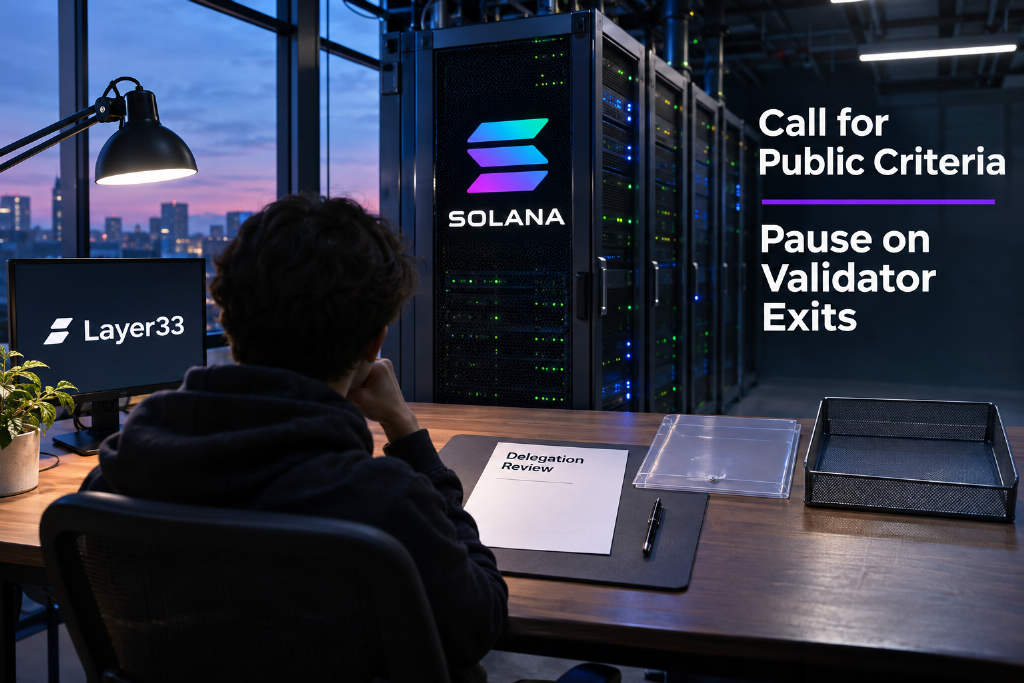
Independent Solana validator coalition Layer33 has responded to changes to the Solana Foundation Delegation Program, or SFDP, calling for a pause in weekly exit batches until the foundation improves its communication with contributors. Layer33 said it accepts the foundation’s view that the network has grown beyond the program’s launch period, that the validator set has matured, and that it now faces challenges that were not anticipated earlier. It said the delegation mechanism should evolve, but objected to replacing long-term contributors with participants serving 12-month terms. The coalition also cited the foundation’s statement that Alpenglow community-cluster participants provided critical help and should receive direct rewards. Layer33 said the SFDP still holds more than 10 million SOL in remaining delegations, meaning the existing program would not need to be dismantled to provide substantial rewards. For validators remaining in the program, it said delegations would fall from about 85,000 SOL to 55,000 SOL, a reduction of roughly 30,000 to 35,000 SOL. Layer33 also said some operators had shut down their nodes and canceled Breakpoint travel. Its updated requests include disclosure of the program’s analysis, an impact assessment, formal consultation with current members, and contribution-based delegation criteria and applications.

20
Layer33 Calls for Pause to Weekly SFDP Exits and Disclosure of Rule Rationale
Marinade
Oct 27, 2026

Marinade says Agave 4.3.2 slot-skipping bug will not trigger validator bond penalties before fix

Marinade said nodes running Agave 4.3.2 with Alpenglow are skipping about half of the slots in the first block-production window of each epoch. The team said the fix has already been merged into the codebase, but the patched release has not gone live yet. Until that version is released, Marinade said its Protected Staking Rewards, or PSR, mechanism will not deduct validator bond collateral because of those skipped slots. It also said the Staking Auction Marketplace, or SAM, will not count the affected slots as uptime misses. Marinade’s position is that validators should not be held responsible for a client-side defect. The update addresses how the protocol will treat validator performance while the software issue remains unresolved and clarifies that the temporary exemption applies before the repaired version is published.

1610
Marinade says Agave 4.3.2 slot-skipping bug will not trigger validator bond penalties before fix
Solana
Oct 27, 2026

Solana deploys Alpenglow on mainnet, cutting block finality to milliseconds

Solana has rolled out the Alpenglow upgrade on its mainnet as of Oct. 21, replacing the previous voting system that took several seconds to reach block finality. The new system is designed to reduce final confirmation time to the millisecond level. The Solana Foundation has recorded the transition, according to a Techub News brief citing Crypto.news. The update centers on block finality rather than a broader protocol change described in detail, and no additional technical specifications were provided in the source. The report identifies the deployment date, the system being replaced, the intended speed improvement, and the fact that the switch has been logged by the Solana Foundation.

670
Solana deploys Alpenglow on mainnet, cutting block finality to milliseconds
Solana
Oct 27, 2026

Solana’s Firedancer starts charging 1 SOL per bug report after AI-driven submission surge

Solana validator client Firedancer has changed its bug bounty rules after a recent audit contest generated a heavy review backlog and a large volume of duplicate submissions. Under the updated terms, researchers must now burn 1 SOL for every bug report they file. The token is permanently removed from circulation, and the fee is not refundable even if the report is invalid, out of scope, or duplicates an earlier finding. Reports submitted without the burn are not eligible for rewards. Jump Crypto, which built Firedancer as an alternative to Solana’s main Agave client, said the move is meant to reduce spam and free engineers to investigate real vulnerabilities. A $1 million audit competition that ran from April 9 to May 9 drew 809 reports from 162 researchers, but those submissions resulted in only 127 unique security findings. Nearly half of valid reports were duplicates, and Jump said it believes AI agents helped discover or write nearly every submission. The firm is also raising payouts for a limited period. Eligible findings will receive double the standard reward through Nov. 20, while bugs specific to Solana’s new Alpenglow voting system can earn triple. Critical Alpenglow issues may qualify for as much as $300,000.

1330
Solana’s Firedancer starts charging 1 SOL per bug report after AI-driven submission surge
Solana
Oct 21, 2026

Solana switches mainnet to Alpenglow, retiring TowerBFT consensus

Solana moved its mainnet to the Alpenglow consensus protocol on Wednesday, ending the network’s use of TowerBFT, the voting system it had relied on since 2020. The official Solana account said at 13:59 UTC that Alpenglow was live, while protocol developer Anza had posted the same update five minutes earlier. Chain data reviewed by Unchained showed the final TowerBFT-era block at slot 459,652,999 around 13:54:00 UTC, with Alpenglow’s genesis certificate pointing to that block. After eight empty slots, slot 459,653,008 arrived at 13:54:03 UTC, and block heights continued sequentially without signs of a rollback. Both Anza and Solana said finality dropped from 12.8 seconds to 150 milliseconds. Under Alpenglow, validators no longer submit votes as transactions. Instead, votes move between nodes as BLS-signed messages aggregated into certificates, a change intended to free blockspace for users. The rollout on Wednesday covers Votor, the voting component of the design, while Rotor, the planned replacement for Turbine’s block propagation system, remains scheduled for a later phase with no date announced.

1330
Solana switches mainnet to Alpenglow, retiring TowerBFT consensus
Solana
Oct 21, 2026

Solana to launch Alpenglow on Wednesday in its biggest network overhaul since 2020

Solana is set to activate Alpenglow on Wednesday in what CoinDesk described as the network’s biggest overhaul since 2020. The upgrade will replace the voting system Solana has used since that year and is aimed at cutting finality to roughly 150 milliseconds. The rollout follows months of testing, a process that included a failed migration and a rollback before the planned launch. CoinDesk reported the update in a brief item published on Oct. 21, 2026, with Shaurya Malwa listed as the author. The change marks a notable shift in how the network handles confirmation, with Solana targeting much faster finality through the new system.

1020
Solana to launch Alpenglow on Wednesday in its biggest network overhaul since 2020
Solana
Oct 21, 2026

Solana launches Alpenglow upgrade, targeting 150-millisecond finality

Solana’s Alpenglow upgrade went live on Wednesday in what ChainCatcher described as the network’s biggest upgrade since 2020. The change moves validator voting off-chain and bundles votes into certificates, with the stated goal of locking transactions in one to two rounds and cutting final confirmation time from about 6 seconds to roughly 150 milliseconds, or about 40 times faster. If that target is achieved on mainnet, Solana’s settlement speed would move closer to the trading and payment experience seen on centralized exchanges. The upgrade also changes validator economics. Current validators spend about 2 SOL per day on voting fees, a cost that doubled after Solana recently reduced block times to about 200 milliseconds. Under Alpenglow, those voting fees are removed and replaced with a fixed validator ticket fee of 0.8 SOL per epoch, or about 24 hours, which is expected to lower validator costs by about 60%. The rollout followed a difficult testnet process. Since early May, the testnet was wiped and restarted six times. One migration failed across the network and had to be rolled back, though a later migration succeeded, according to a post from Galaxy Digital, one of roughly 100 validator operators on the testnet. The switch began at epoch 1064 on Wednesday, with the actual change taking place at slot 459,653,000 after a 5,000-slot transition.

920
Solana launches Alpenglow upgrade, targeting 150-millisecond finality
Solana
Oct 14, 2026

Solana sets Oct. 21 for Alpenglow rollout, targeting 150ms finality

Solana has scheduled its next major network upgrade, Alpenglow, for Oct. 21, tying activation to the start of epoch 1064 at around 15:00 UTC, according to the Solana Foundation. The upgrade replaces TowerBFT, the consensus system currently used by validators, and is designed to cut transaction finality from about 12.8 seconds to roughly 150 milliseconds. In practical terms, that narrows the gap between a transaction appearing confirmed and becoming irreversible, a change aimed at payment flows, DeFi applications, and trading operations that need near-instant settlement certainty. The first component going live is Votor, a new voting protocol that moves validator voting off-chain. Under the design described by the Foundation, validators exchange messages directly, package votes into certificates, and can finalize a block after one round of voting, or two at most. A block finalizes immediately if 80% or more of stake backs it in the first round. If support falls between 60% and 80%, a second round using a 60% threshold determines whether the block is finalized or skipped. Ordinary users are not expected to take any action, and wallets, apps, transaction formats, programs, and fees remain unchanged. Validators, however, will need an additional 0.8 SOL per vote account to cover the new Validator Admission Ticket, a per-epoch fee that is burned. Rotor, the second half of Alpenglow and a replacement for Turbine, is still without a launch date.

1710
Solana sets Oct. 21 for Alpenglow rollout, targeting 150ms finality
Total 39 items
Go topage