Anthropic
Nov 7, 2026

Anthropic’s $895 Billion Compute Bet Relies on Risky Financing

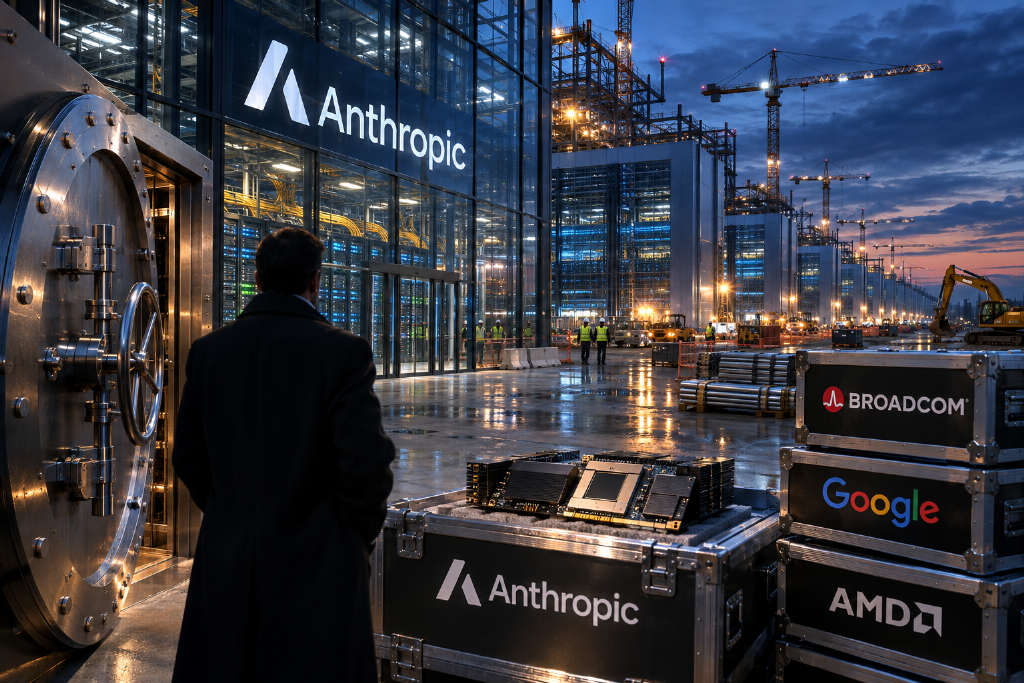
Anthropic’s updated IPO filing shows that its push to build large-scale artificial intelligence capacity depends on financing arrangements that could shift part of the risk to chip suppliers, lenders and investors. The company added third-quarter financial data to the filing this week, reporting that rising compute costs are narrowing its profit margin. It also disclosed commitments for additional data-center construction that could total as much as $895.4 billion through 2045. Broadcom has agreed to a $63 billion equipment-financing arrangement tied to Anthropic’s purchases. If Anthropic defaults, Broadcom could face as much as roughly $43 billion in potential liability once the equipment has been delivered and deployed. Google and AMD have also linked some funding to Anthropic’s leasing or deployment of their hardware. The Broadcom transaction involves Bank of America, Citigroup, Morgan Stanley and Blackstone, which will fund a new company to buy Broadcom chips and networking equipment and lease them to Anthropic, with delivery expected in 2027. Analysts cited by Fortune warned that custom TPU hardware could be harder to re-lease than Nvidia GPUs, leaving residual-value and guarantor risks central to the financing structure.
410
Anthropic’s $895 Billion Compute Bet Relies on Risky Financing
Anthropic
Nov 7, 2026

Anthropic’s IPO Faces a Valuation Reckoning as AI Stocks Sell Off

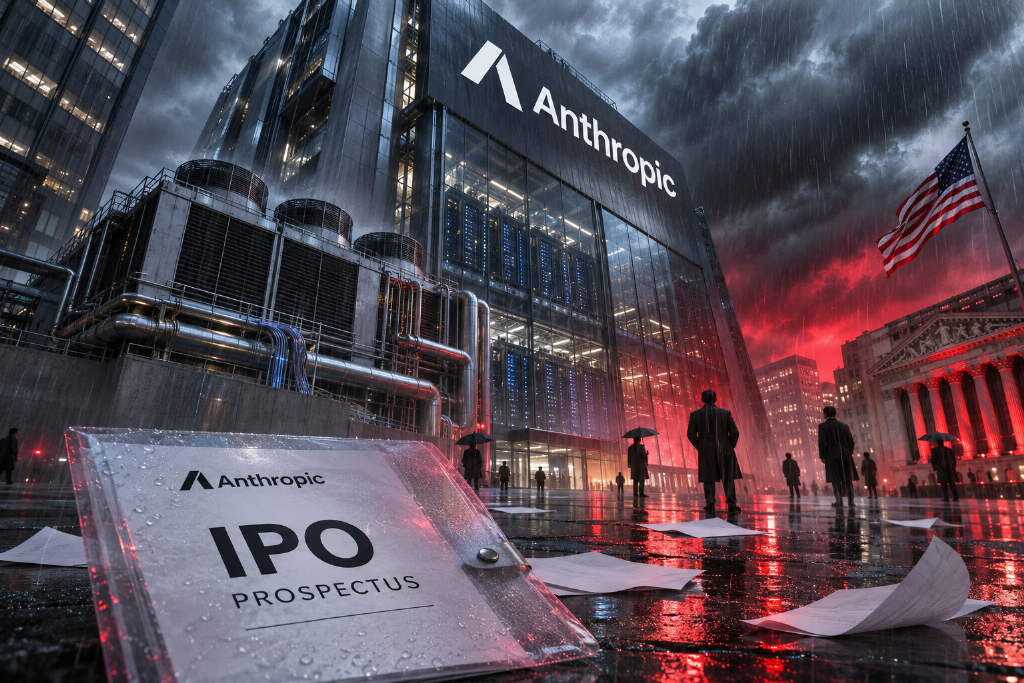
Anthropic’s planned public offering is facing pressure from a broad sell-off in technology stocks, doubts over data-center expansion and a valuation reset that has taken expectations from $2 trillion to as low as $1.1 trillion. The company had been viewed as a candidate for the largest IPO fundraising event in global capital markets, but investors are now questioning whether it can launch a roadshow during the week of Nov. 9 and complete a listing in November. Anthropic has not announced a final offering price or listing date. Its latest filing reported third-quarter revenue of $16.956 billion and long-term computing purchase and lease commitments of $895.4 billion. The company held about $131.9 billion in cash and short-term investments as of Sept. 30. At the same time, key Claude Code employees Cat Wu and Austin Lau joined OpenAI. OpenAI is also raising capital, with its target reduced from about $30 billion to $20 billion and its valuation target cut to $1.25 trillion. The IPO could become a public-market reference point for valuing frontier AI companies, but the financing environment has become less accommodating.

380
Anthropic’s IPO Faces a Valuation Reckoning as AI Stocks Sell Off
Artificial Intelligence
Nov 7, 2026

AI Safety Candidates Gain Ground in US Congressional Elections

Candidates supporting stricter regulation of artificial intelligence won key congressional contests with backing from a political funding group that received partial funding from Anthropic PBC. The group’s funding totaled $110 million. The developments came as Americans have grown increasingly uneasy about rapidly advancing AI technology, according to Bloomberg. The report, carried by Techub News, did not provide further details on the individual candidates, the specific contests, or the structure of the funding group beyond its partial support from Anthropic PBC.

1040
AI Safety Candidates Gain Ground in US Congressional Elections
Anthropic
Nov 7, 2026

METR Says Anthropic Models Are Advancing at Twice Last Year’s Pace

AI safety research group METR said Anthropic’s models are improving at roughly twice the pace seen a year earlier after an 11-week investigation into the company, according to The Verge. METR said Anthropic’s progress over the past year was equivalent to about two years of earlier progress. As of October, the group attributed most of the acceleration in research and development to AI, with that contribution continuing to grow. The current gains mainly come from AI assisting human researchers, rather than models working autonomously. In an informal survey, Anthropic employees who used the company’s strongest internal model reported that their average work efficiency was about 12 times higher than without AI assistance. Anthropic heavily redacted the public report. Sam McCandlish, the company’s co-founder, said the omitted information involved commercially sensitive material and could also help other companies speed up their research and development.

480
METR Says Anthropic Models Are Advancing at Twice Last Year’s Pace
Anthropic
Nov 7, 2026

Anthropic Product Lead Explains Why Claude Code Emerged From Experimentation and Why Many Internal Prototypes Never Shipped

Anthropic’s S-1 filing says enterprise customers embedding Claude into business-critical workflows have produced stronger retention and higher monetization than consumer AI users. In a podcast interview, Dianne Na Penn, product lead for Anthropic’s research and laboratory teams, described a product culture built around monthly planning, longer-term assumptions and bottom-up experimentation. The team oversees core model products from Claude 2 through the Claude 5.5 family and has helped incubate Claude Code, MCP, Skills and Claude Design. Penn said Claude Code was not created in a single breakthrough moment. API customers, internal teams and outside users had been testing coding workflows for a long time before command-line interaction and a Harness that allowed more agent loops combined into a compelling product experience. The team also debated whether to offer a fine-tuning API, given that rapid model upgrades could leave enterprise-built systems two or three generations behind. Penn said many internal prototypes never reached the market because their purpose was to generate ideas or validate technology. She also discussed how product managers work with researchers, the company’s demanding onboarding process, its annual training program and the role of forward-deployed engineers in carrying customer insight back to product and research teams.

460
Anthropic Product Lead Explains Why Claude Code Emerged From Experimentation and Why Many Internal Prototypes Never Shipped
Anthropic
Nov 7, 2026

METR Says Anthropic Model Development Speed Has Doubled as Internal Model 4 Emerges

A METR assessment has brought Anthropic’s previously undisclosed Model 4 into public view and described a sharp acceleration in the company’s model-development pace. The report says Anthropic models improved on clearly defined tasks at twice the rate recorded across the March 2024 to October 2025 period. Model 4, trained in September and October 2025, scored 178.6 on Anthropic’s internal AECI measure, ahead of the public Opus 5.5 and Mythos 5.1 models. It cleared a 50% accuracy threshold on all 15 listed benchmarks, while removing three problematic benchmarks would raise its score to 179.7. METR estimated that about 80% of the roughly twofold research acceleration came from AI assistance rather than faster training-compute growth. Anthropic employees reported productivity gains rising from 1.3–1.4 times in spring 2025 to about 12 times while using Model 4 in October 2026. The report also said Anthropic’s public version omitted much of a roughly 100-page submission, including a redacted forecast table. METR researcher Ryan Greenblatt described the findings as a major signal for ASI within one to two years, while the report connected the discussion to the AI 2027 scenario.

570
METR Says Anthropic Model Development Speed Has Doubled as Internal Model 4 Emerges
Anthropic
Nov 5, 2026

Former AMD AI Vice President Sharon Zhou joins Anthropic

Former AMD AI Vice President Sharon Zhou said on X that she has officially joined Anthropic and will return to work on frontier AI models. Zhou previously held a senior role at AMD, where she was responsible for AI research and related work. In June 2025, she led part of the team from startup Lamini to join AMD and took the position of AI vice president. In 2026, her responsibilities expanded further, and she reported directly to AMD CEO Lisa Su. The update outlines a new move for Zhou after her time in a key AI leadership role at AMD.

1130
Former AMD AI Vice President Sharon Zhou joins Anthropic
Policy Regulation
Nov 5, 2026

All-In panel says Democratic limits on new data centers could hit the AI sector

On the night of the U.S. midterm elections, the Silicon Valley podcast All-In held a live discussion on how a Democratic victory could affect the artificial intelligence industry. Host Chamath Palihapitiya said AI investment has become a major pillar of U.S. economic growth and argued that data center construction depends heavily on power supply. If Democrats were to restrict new data centers in places such as Texas, he said, the broader AI industry could take a hit. Host Jason Calacanis said the tech industry, which had previously backed Donald Trump, should now engage directly with Democrats and work with them on AI regulation. He also argued that repeated warnings from the tech sector about AI causing human extinction and mass unemployment had intensified public fear of the technology. Brad Gerstner, founder of Altimeter Capital and a regular All-In guest, said many Democratic winners are seeking a stronger voice in AI regulation rather than trying to shut the industry down. He estimated that 10 GW to 15 GW of U.S. data center power capacity originally planned for 2027 may fail to come online on schedule. Gerstner added that he remains bullish on AI model companies and said Altimeter, already an investor in Anthropic, still wants to be one of the biggest buyers in a future Anthropic IPO.

610
All-In panel says Democratic limits on new data centers could hit the AI sector
Total 1728 items
Go topage