R3
Oct 20, 2026

R3 co-founder says banks are shifting blockchain focus from cost savings to revenue generation

R3 co-founder Todd McDonald said banks are moving beyond early blockchain experiments and into practical commercial use, with a growing focus on launching new products and reaching new customers rather than simply cutting costs. Speaking on StrataMedia’s Talking Tokens podcast, McDonald said open blockchain networks have the stronger long-term edge and argued that all markets will eventually move on-chain. He also said R3, long known for building private blockchain networks for banks, is now working with the Solana Foundation to turn the next generation of Corda into a Solana-based protocol. The company is starting with yield vaults that would let investors deposit stablecoins and receive tokens backed by real-world assets. Looking ahead, McDonald said fixed income and alternative assets could become the next major tokenization themes over the coming year, outpacing the currently more established tokenized dollars and money market funds. R3 added that its on-chain real-world asset volume has surpassed $10 billion, and listed Bank of America, HSBC, Wells Fargo and Barclays among its investors.

740
R3 co-founder says banks are shifting blockchain focus from cost savings to revenue generation
UK
Oct 20, 2026

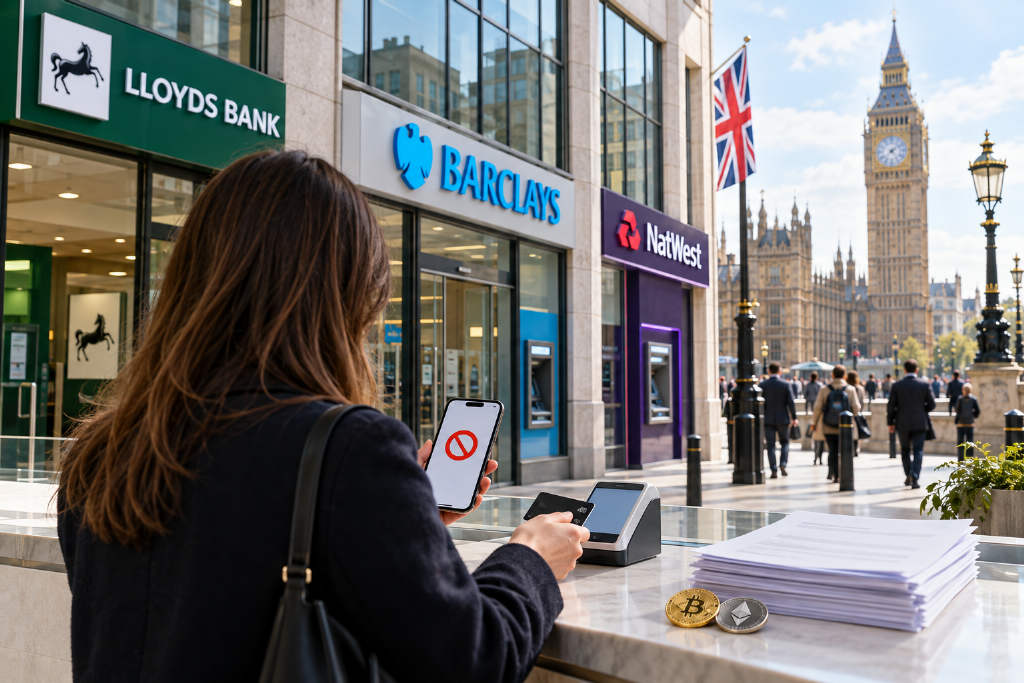
More Than 10,000 Complaints Filed Over UK Banks’ Crypto Transfer Restrictions in 90 Days

Crypto advocacy group Stand With Crypto said 9,803 people used its online tool to file 10,092 complaints with UK banks over a 90-day period from May to August 2026, citing restrictions on transfers to crypto platforms. Lloyds Banking Group drew the highest number of complaints at 2,297, followed by Barclays with 1,569 and NatWest Group with 1,278. The figures have renewed attention on access to crypto services in the UK ahead of the country’s planned digital asset regulatory regime in 2027. The report said banks are taking different approaches to crypto-related transfers. Barclays and HSBC UK were listed as capping such payments at £2,500 per transaction and £10,000 every 30 days, while six banks, including Starling Bank, TSB and Chase UK, were listed as fully blocking crypto-related transfers. Zumo CEO Nick Jones told Cointelegraph that banking restrictions remain a common problem for UK crypto founders and may weaken the country’s ambition to become a global crypto hub.

700
More Than 10,000 Complaints Filed Over UK Banks’ Crypto Transfer Restrictions in 90 Days
UK
Oct 20, 2026

UK banks drew nearly 10,000 complaints over crypto transfer curbs, with Lloyds topping the list

A new tally cited by crypto advocacy group Stand With Crypto shows that UK bank restrictions on crypto-related transfers triggered 10,092 complaints from 9,803 users over a 90-day period from May to August 2026. Lloyds Banking Group received the most complaints at 2,297, followed by Barclays with 1,569 and NatWest Group with 1,278. The report also outlined how some banks cap crypto-related payments, while others block them outright. Barclays and HSBC UK were listed as limiting such transfers to £2,500 per transaction and £10,000 over 30 days. Six banks, including Starling Bank, TSB and Chase UK, were identified as fully prohibiting crypto-related transfers. Lloyds and Revolut were also the subject of complaints despite not publishing formal restriction policies. Revolut’s help page says some crypto trading platforms do not support transfers, and a spokesperson said the issue may be technical rather than a clear policy restriction. The figures come as the UK plans to introduce a new cryptoasset regulatory regime in October 2027, with industry participants warning that banking access remains a barrier for the sector.

800
UK banks drew nearly 10,000 complaints over crypto transfer curbs, with Lloyds topping the list
Mastercard
Oct 19, 2026

Mastercard launches stablecoin risk intelligence service for institutions

Mastercard said at the Money20/20 USA conference on Monday that it has launched a new risk intelligence product called Stablecoin Security, aimed at helping financial institutions assess the risks tied to stablecoin payments before funds move on-chain. The service provides banks with risk scores through an API, allowing them to plug the data into existing fraud prevention and compliance systems. According to Mastercard, the product tracks the source of funds across the full lifecycle of a stablecoin payment and screens for links to fraud, scams, sanctions breaches, and other forms of financial crime. It also analyzes transaction context before assigning a risk score. The company cited research from the Bank for International Settlements, which found that nearly 60% of 593 million stablecoin transfer events observed in 2025 took place through complex multi-step transactions rather than simple peer-to-peer payments. Mastercard said the finding highlights the need for pre-transaction security checks. Ann Johnson, executive vice president of security solutions at Mastercard, said stablecoins are creating new possibilities for moving value, but financial institutions need the right intelligence and controls to participate with confidence.

630
Mastercard launches stablecoin risk intelligence service for institutions
World
Oct 19, 2026

World launches World ID verification suite for banks and financial institutions

World, the identity project co-founded by OpenAI CEO Sam Altman, has introduced a World ID verification product suite aimed at banks and financial institutions, marking the protocol’s first version tailored to a specific industry. Unveiled by World co-founder Alex Blania at the Money20/20 conference, the suite combines three existing products and is positioned as a tool to help institutions address deepfake fraud and AI-driven identity impersonation across customer accounts, employee workflows, and AI agent use cases. The package includes the World ID app, a wallet for storing and presenting what World calls user Proofs; World ID for Zoom, which lets call participants verify that the other party is a real person rather than a deepfake and has now moved from limited testing in April to full launch; and World ID for Agents, also called AgentKit, which allows users to delegate Proofs to AI agents for presentation to third-party platforms. World said it is working with OpenExchange, Bain Capital, VanEck Funds, and Outtake as design partners to explore banking and financial services applications, but did not disclose bank customers or pricing. The company also cited a Deloitte forecast that AI-related fraud losses in the U.S. could reach $40 billion by 2027, up from about $12.3 billion in 2023.

930
World launches World ID verification suite for banks and financial institutions
Sentora
Oct 17, 2026

Survey finds about three-quarters of U.S. digital asset holders want banks to manage those assets

A 2026 survey by Sentora of 10,000 U.S. cryptocurrency holders found that about three-quarters of American digital asset holders want to manage those assets through the banks where they already have accounts. Sentora also said that balances held in exchange accounts reflect, to some extent, the level of services banks provide. The findings point to demand among U.S. crypto holders for banking channels to play a larger role in digital asset management, according to the survey results shared by Sentora.

740
Survey finds about three-quarters of U.S. digital asset holders want banks to manage those assets
Spain
Oct 15, 2026

Spanish Banks Arrange Syndicated Financing on Blockchain

Techub, citing Finextra, reported that multiple banks in Spain have arranged syndicated financing on a blockchain. The available public information does not identify the banks involved, disclose the size of the financing, or specify which blockchain platform was used. No additional operational or transaction details were provided in the source material. The report is limited to the fact that the financing arrangement took place on-chain, while key details about participants, scale, and technical infrastructure remain undisclosed at this stage. As a result, the transaction structure, timeline, and implementation setup cannot be independently assessed from the information currently available.

880
Spanish Banks Arrange Syndicated Financing on Blockchain
stablecoin
Sep 3, 2026

21 Major Banks Plan to Establish Company and Issue Stablecoin by Year-End

A consortium of 21 major banks, including Bank of America, Citigroup, and Goldman Sachs, has announced plans to establish a new company to issue a stablecoin by the end of 2026. The stablecoin is expected to be listed on exchanges in the first half of 2027. The initial focus will be on a USD-pegged stablecoin, with plans to expand to other G7 currencies later. The project aims to provide a bank-grade, compliant stablecoin with institutional risk management, intended for use in cross-border payments and digital asset settlement. The new company is scheduled to be formed before the expected effective date of the GENIUS Act on January 18, 2027. The news was reported by PaymentsDive, as cited by Techub News.

800
21 Major Banks Plan to Establish Company and Issue Stablecoin by Year-End
Total 109 items
Go topage