Chainlink
Aug 22, 2026

Chainlink executive says AI will cut blockchain build costs and bring agents and robots on-chain

Andrew McCormick, head of institutional strategy at Chainlink Labs, said AI is set to sharply reduce the cost of building and engineering blockchains, reinforcing what he described as a multichain future. Speaking in an interview at the 2026 Wyoming Blockchain Symposium, McCormick argued that the next wave of on-chain activity may come less from human traders and more from automated systems that need to transact with each other and interact with crypto-based economic infrastructure. He said AI agents could place trades on behalf of holders when they are away from the screen, making use of tokenized market opportunities outside traditional trading hours. He also pointed to a more physical use case: humanoid robots operating in ports and factories could eventually use stablecoins, digital assets, and blockchain rails to communicate and settle payments. McCormick summed up that scenario by saying it had a "Star Wars vibe," but added that it is already happening. McCormick also tied the multichain thesis to interoperability. He cited Wyoming’s Frontier Token, which the Wyoming Stable Token Commission has moved from LayerZero to Chainlink’s Cross-Chain Interoperability Protocol, or CCIP, for cross-chain issuance and distribution. The broader backdrop, as referenced in the source article, includes recent launches from Gemini, TON Tech, Robinhood, Binance, and Solana’s Pay.sh collaboration with Google Cloud.


1600
Chainlink executive says AI will cut blockchain build costs and bring agents and robots on-chain
Nethermind
Aug 20, 2026

Nethermind joins Chainlink as node operator and development partner

Blockchain infrastructure firm Nethermind has partnered with Chainlink, taking on roles as a node operator and development partner for the network. The collaboration will support Chainlink’s Cross-Chain Interoperability Protocol, or CCIP, as well as data feeds and broader institutional adoption efforts. Nethermind said its Ethereum execution client accounts for roughly 25% to 30% of node share on the network, and that its enterprise-grade infrastructure can add redundancy to Chainlink’s data feed operations. According to CryptoBriefing, the company has also provided blockchain-as-a-service offerings to regulated institutions and has compliance frameworks and enterprise service-level capabilities in place. The update was carried by Techub News.

1850
Nethermind joins Chainlink as node operator and development partner
Wyoming
Aug 19, 2026

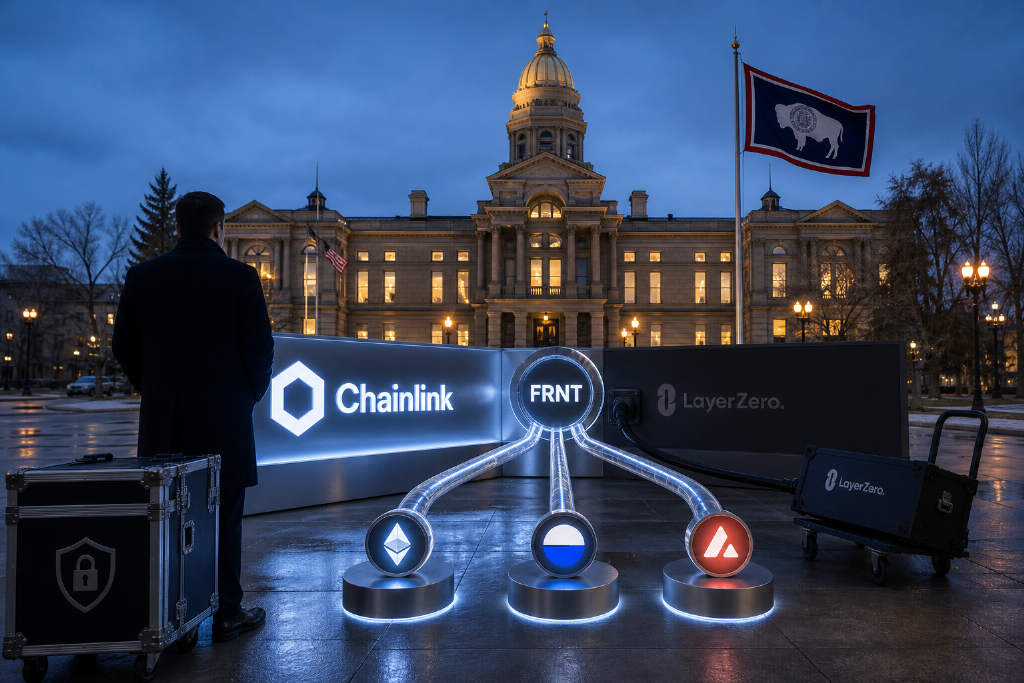
Wyoming moves FRNT from LayerZero to Chainlink CCIP for cross-chain operations

Wyoming’s Stable Token Commission has migrated Frontier Stable Token, or FRNT, from LayerZero to Chainlink’s Cross-Chain Interoperability Protocol, known as CCIP, and said the LayerZero token implementation will be fully retired after a comprehensive security review is completed. Under a multi-year contract, CCIP will serve as FRNT’s sole cross-chain infrastructure. The move is notable because it marks the first public case of a U.S. government entity replacing blockchain infrastructure on security grounds, according to the information provided. FRNT is also described as the only stablecoin issued by a U.S. public institution and backed by fully reserved fiat holdings. Revenue generated from those reserves supports Wyoming school foundation programs. FRNT has been deployed on Ethereum, Base and Avalanche, and its market capitalization is currently below $1 million. The decision comes four months after a LayerZero-based Kelp DAO bridge was attacked, leading to the theft of about 116,500 rsETH, valued at roughly $292 million at the time. That incident triggered broader security reviews and a wave of migrations. So far, nearly $15 billion in related assets have moved from LayerZero to Chainlink, with Kelp, Solv Protocol, Re, Kraken and later BitGo among the projects and firms cited.

1840
Wyoming moves FRNT from LayerZero to Chainlink CCIP for cross-chain operations
FLock.io
Aug 12, 2026

FLock.io partners with Chainlink as FLOCK adopts CCT for cross-chain transfers

Decentralized AI platform FLock.io said it has entered an official partnership with Chainlink, with its native token FLOCK now using Chainlink’s Cross-Chain Token, or CCT, standard. Under the arrangement, Base serves as FLOCK’s primary issuance network, while the token is connected across Ethereum, BNB Chain, Hyperliquid HyperEVM, and Robinhood Chain. FLock said developers, node operators, and FLOCK holders can move the token between supported networks through Transporter using Chainlink’s Cross-Chain Interoperability Protocol, or CCIP. The company framed the integration as part of a broader plan to build liquidity setups tailored to the asset structure and trading characteristics of different blockchain ecosystems. It also said FOMO, short for FLock Open Model Offering, will support issuance, trading, and liquidity expansion for its Model Token across multiple chains. That effort is set to extend gradually to additional AI assets and tokenized stocks, giving users on different networks a wider range of liquidity and trading options.

2600
FLock.io partners with Chainlink as FLOCK adopts CCT for cross-chain transfers
Standard Chartered
Aug 10, 2026

Standard Chartered Starts Chainlink Coverage With $200 Target by 2030

Standard Chartered has initiated coverage on Chainlink and set a $200 price target for the end of 2030, implying roughly a 25-fold gain from the token’s current level near $8. The call comes from Geoff Kendrick, the bank’s global head of digital assets research, who outlined a staged path for LINK at $13 by the end of this year, then $41, $82, $133, and finally $200 by the end of the decade. In the same note, Kendrick kept his long-term forecasts for Bitcoin at $500,000 and Ethereum at $40,000 by end-2030. The bank’s thesis rests on projected growth in tokenized assets and DeFi. Kendrick expects on-chain tokenized assets to rise from about $340 billion now to $4 trillion by the end of 2028, while assets deployed in DeFi are forecast to expand 37-fold to $2.7 trillion by 2030. Standard Chartered argues that because Chainlink charges for data delivery and cross-chain asset movement, protocol fees could increase about 25 times over that period. The note also points to Chainlink’s existing market position, institutional customer base, and recent CCIP traction, while listing slower tokenization adoption, failed pilot conversions, market-share pressure, and technical failures among the main risks.

1090
Standard Chartered Starts Chainlink Coverage With $200 Target by 2030
BitGo
Aug 4, 2026

BitGo switches WBTC’s exclusive cross-chain provider from LayerZero to Chainlink CCIP

BitGo is changing the exclusive cross-chain service provider for its $7.3 billion Wrapped Bitcoin (WBTC) from LayerZero to Chainlink’s Cross-Chain Interoperability Protocol, or CCIP, according to CoinDesk. The move comes after the $292 million Kelp cross-chain bridge exploit, which was followed by several projects disclosing plans to migrate from LayerZero to Chainlink. Based on disclosed figures, the total value tied to those migration announcements has reached $14.5 billion. BitGo said it will use CCIP for future assets while keeping control over token contracts, rate limits, and transfer settings. The shift puts BitGo among the latest firms to rework cross-chain infrastructure choices after the Kelp incident.

2520
BitGo switches WBTC’s exclusive cross-chain provider from LayerZero to Chainlink CCIP
Total 38 items
Go topage