Nvidia
Aug 24, 2026

Nvidia’s AVO scores 100 on ARC-AGI-3, clearing all 183 levels across 25 game environments

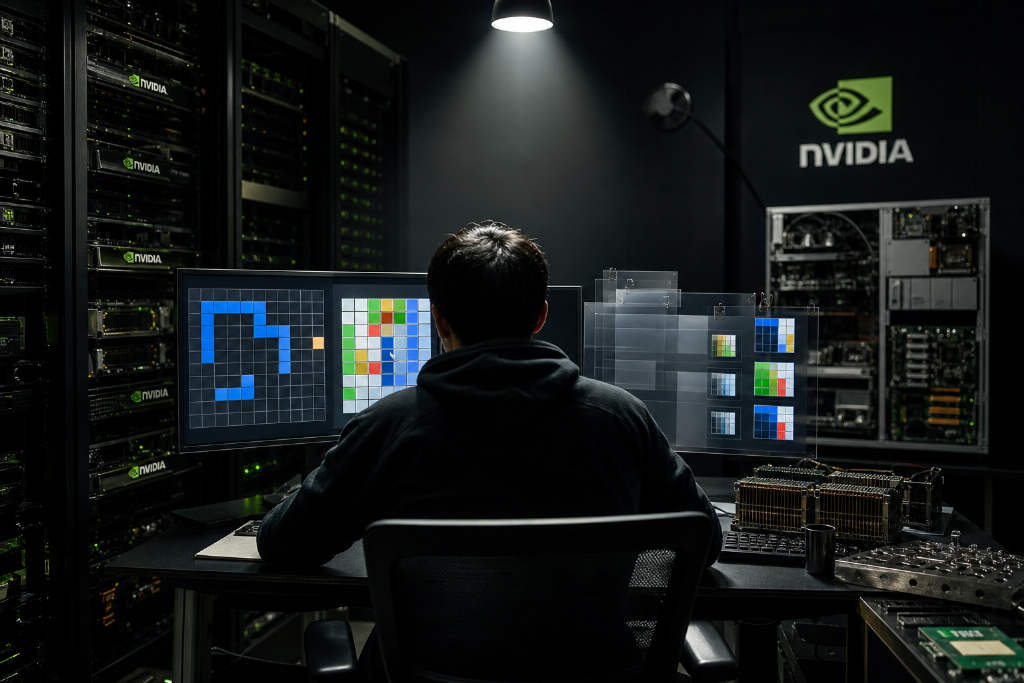
Nvidia said its general-purpose coding agent AVO achieved a perfect score on ARC-AGI-3, finishing all 183 levels across 25 game environments in 6,624 steps with an RHAE of 100.00. The result did not come from changing the base model. Instead, Nvidia wrapped Claude Opus 5 with a system layer that adds persistent memory and a supervisor, lifting performance from 30.16% for the standalone model to a full score in the benchmark setup described in the report. According to the source material, ARC-AGI-3 places agents in unfamiliar games without giving them explicit rules or goals. Some levels allow movement and rotate the entire scene when a blue-black block is touched, while others allow only clicking to cycle cell colors into a target pattern. Nvidia also noted that AVO worked entirely in text mode, receiving each frame as an exact 64×64 text grid rather than images or image tokens. The same architecture was originally built for GPU kernel optimization. A paper uploaded to arXiv on March 25, 2026, described AVO as an agentic mutation operator for autonomous evolutionary search. In tests on Nvidia’s B200, the system ran autonomously for seven days, explored more than 500 optimization directions, and produced 40 valid kernel versions. The report said its multi-head attention kernel was up to 3.5% faster than cuDNN and up to 10.5% faster than FlashAttention-4, with separate GQA results showing gains of 7.0% over cuDNN and 9.3% over FlashAttention-4 after about 30 minutes of autonomous work.
2370
Nvidia’s AVO scores 100 on ARC-AGI-3, clearing all 183 levels across 25 game environments
Jensen Huang
Aug 13, 2026

Nvidia CEO Jensen Huang: A100 GPUs to Stay Usable Through 2029, Calling Compute a Productive Asset

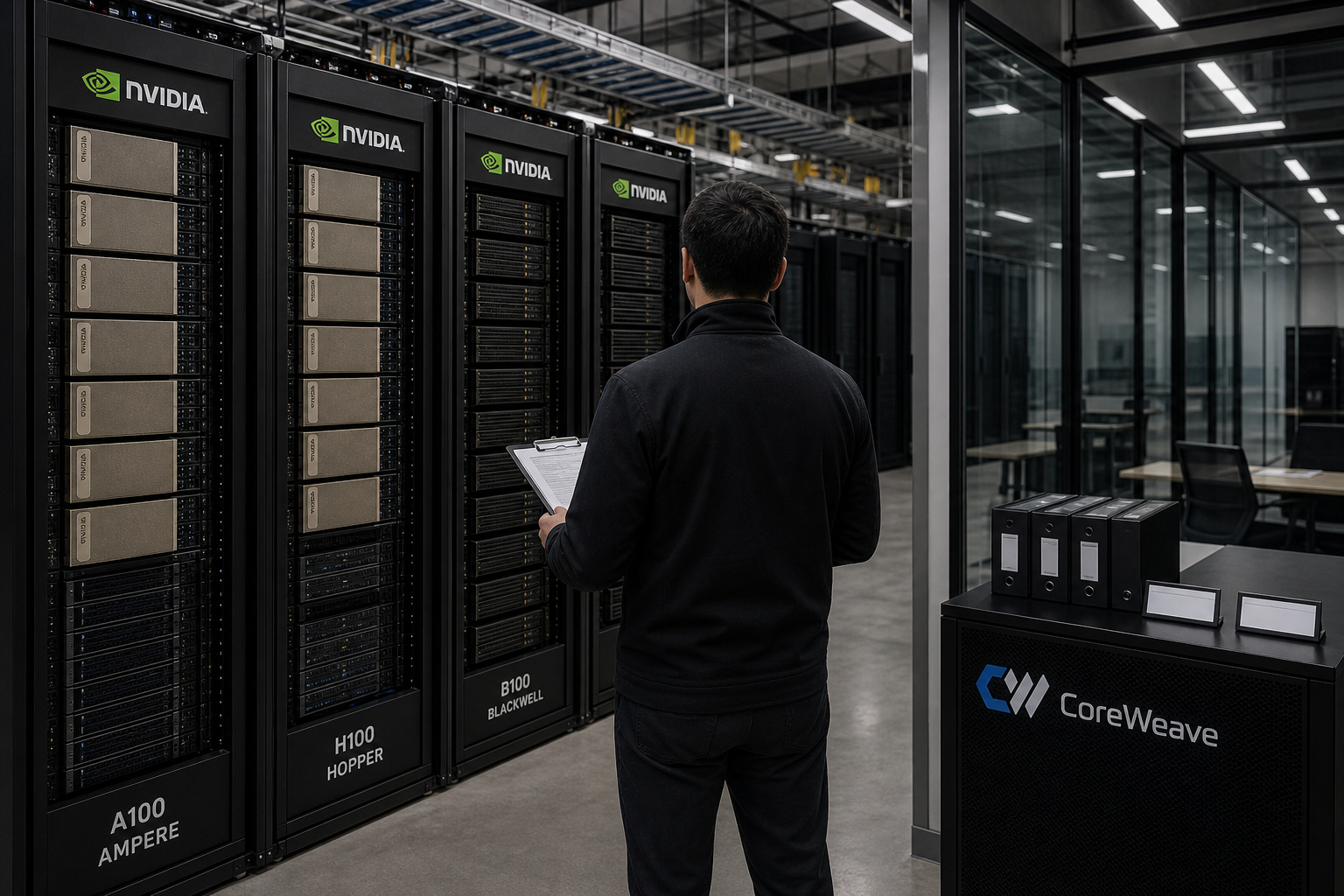
Nvidia CEO Jensen Huang said on Aug. 13 that A100 GPU clusters will remain available from 2020 through 2029, emphasizing that CUDA provides a unified platform for developers and engineers, enabling Ampere, Hopper, and Blackwell architectures to receive continuous upgrades. He noted that CUDA boosts the versatility of Nvidia's compute power, which enhances substitutability, leading to higher utilization and longer lifespan, positioning Nvidia's compute as a productive asset with rentability, durability, and financing attributes. Previously, CoreWeave extended its Nvidia A100 lease agreement to 2029.

2060
Nvidia CEO Jensen Huang: A100 GPUs to Stay Usable Through 2029, Calling Compute a Productive Asset
Nvidia
Aug 13, 2026

Huang Renxun: CUDA Extends GPU Economic Life, Making Compute a Financeable Asset

Nvidia CEO Jensen Huang reshared news that CoreWeave extended its Nvidia A100 GPU lease agreement to 2029. He said the 2020-era A100 will still handle compute tasks through 2029, crediting CUDA for enabling continuous upgrades across Ampere, Hopper, and Blackwell architectures. CUDA boosts utilization and cross-generation substitutability, turning Nvidia compute into a rentable, durable, financeable asset.

1910
Huang Renxun: CUDA Extends GPU Economic Life, Making Compute a Financeable Asset
Nvidia
Aug 6, 2026

Nvidia Scours China for 6G AI-RAN Base Station Suppliers, Targets Trial Network by 2027 or 2028

Nvidia is accelerating its push into telecom operator markets and scouring China for base station partners to develop 6G AI-RAN base stations that handle both communications and AI computing. Shenzhen Jiaxian Communication has been confirmed as one partner, collaborating with Nvidia on CUDA-based 6G AI-RAN base stations for over six months. The project is reportedly "urgent," with a target trial network in 2027 or 2028.

3220
Nvidia Scours China for 6G AI-RAN Base Station Suppliers, Targets Trial Network by 2027 or 2028
Nvidia
Aug 4, 2026

AI coding agents are testing Nvidia’s CUDA moat, but the pressure is building first in inference

Infinity, a one-year-old startup founded by former Google Brain researcher Jeremy Nixon, used its AI research agent Ignition to build CUDA-like software for d-Matrix in 10 hours, according to the source article. The work focused on generating and optimizing inference kernels and related low-level software, not recreating the full CUDA stack that Nvidia has spent nearly two decades building. That distinction matters. CUDA is not just a programming model but a broad software platform spanning kernels, compilers, runtime, optimized libraries such as cuBLAS and cuDNN, debugging and validation tools, plus higher-level frameworks including PyTorch and TensorFlow. In large-scale training, where stability, cluster coordination and performance tuning are critical, the article argues Nvidia’s software edge remains hard to dislodge. Inference looks different. Marshall Choy, chief business officer at South Korea’s AI chip company Rebellions, said CUDA is no longer the decisive factor there and called it a contest in open-source software. Companies including d-Matrix, Rebellions, Cerebras, Amazon with Inferentia, Google with TPU and AMD with MI300X are all targeting that opening. Even so, executives and former Nvidia insiders cited in the piece said code generation is only part of the story. Validation, production-grade optimization, migration costs and Nvidia’s own use of AI agents still leave the CUDA moat far from broken.

2530
AI coding agents are testing Nvidia’s CUDA moat, but the pressure is building first in inference
Anthropic
Jul 26, 2026

Anthropic researcher takes aim at Huang’s open-weight AI push, says CUDA and GPU drivers should be open too

An Anthropic core technical member, Julian Schrittwieser, has publicly mocked NVIDIA CEO Jensen Huang’s support for open-weight AI models, saying he is “looking forward to CUDA and GPU drivers being open sourced.” The comment was posted on X after Huang published his first personal tweet on Friday night, sharing an open letter titled “Open Weights and American AI Leadership.” The letter was co-signed by NVIDIA and more than 20 technology companies and organizations, including Meta, Microsoft, Andreessen Horowitz, Hugging Face, IBM, Mistral AI, Palantir, Perplexity, Mozilla, NVIDIA, and Y Combinator. It argued that the U.S. needs both leading closed-source models and leading open-source models, and that the government should not move too early to restrict open AI development. According to the report, Anthropic did not sign the letter. Schrittwieser’s post highlighted a tension around what companies mean when they endorse openness in AI, especially when key infrastructure such as CUDA and GPU drivers remains proprietary.

2800
Anthropic researcher takes aim at Huang’s open-weight AI push, says CUDA and GPU drivers should be open too
DeepSeek
Jul 24, 2026

Liang Wenfeng says compute, not talent, is China AI’s main gap as pressure builds on NVIDIA’s CUDA moat

DeepSeek founder Liang Wenfeng told investors that the biggest gap between China and the U.S. in artificial intelligence is access to compute, not a shortage of talent or a lack of model expertise. According to meeting notes obtained by Yicai, Liang said differences seen in talent, model capability and applications all trace back to one issue: computing resources. He said DeepSeek currently has compute roughly equivalent to 20,000 NVIDIA H-series GPUs, while the world’s most advanced models have reached 800 billion active parameters. China’s top models, by comparison, are still in the tens of billions. Liang estimated DeepSeek trails leading U.S. AI companies by 12 to 18 months, though he said the company achieved comparable results using about one-twentieth of the compute and aims to narrow that gap to 3 to 6 months under chip restrictions. The meeting notes and analysis compiled by Citrini analyst Jukan also point to a software and hardware shift away from NVIDIA dependence. DeepSeek is working with Huawei to optimize for Ascend chips, while using its in-house TileLang programming language and compiler to reduce reliance on CUDA. Jukan argued that if China reaches greater compute independence, NVIDIA’s software lock-in across training and inference markets could weaken, opening more room for alternatives such as Google TPU and Amazon Trainium.

1260
Liang Wenfeng says compute, not talent, is China AI’s main gap as pressure builds on NVIDIA’s CUDA moat
Nvidia
Jul 23, 2026

Citrini says coding AI is weakening CUDA’s moat, backs AMD and turns bearish on Nvidia

Citrini analyst Jukan, citing recent remarks from DeepSeek founder Liang Wenfeng, argues that AI-powered code generation and higher-level programming tools such as TileLang are cutting into the barriers that once protected Nvidia’s CUDA ecosystem. The argument is not that Nvidia hardware has already been displaced—DeepSeek still used Nvidia GPUs to train its V3 model—but that the software lock-in around CUDA is becoming less absolute as model builders rely more on self-developed compilers and newer programming layers. According to the view relayed by Jukan, DeepSeek has already reduced its dependence on Nvidia’s software stack through its own compiler and the TileLang environment. Liang had also said that if TileLang and the DeepSeek compiler were ported to Huawei chips, China’s chip ecosystem issues could be largely resolved within about a year, leaving capacity as the main remaining bottleneck. He described the China-U.S. chip gap as roughly 4x in hardware efficiency and about two years in time lag, and said DeepSeek is working closely with Huawei and expects to receive about 16,000 Huawei AI chips. Jukan framed that as a sign that CUDA’s moat is eroding, a negative for Nvidia and a possible tailwind for AMD’s ROCm software stack.

2420
Citrini says coding AI is weakening CUDA’s moat, backs AMD and turns bearish on Nvidia
Total 23 items
Go topage