CanSemi
Oct 14, 2026

CanSemi Debuts Above $100 Billion Yuan Valuation as Investors Bet on Silicon Photonics and Capacity Growth

CanSemi Semiconductor made its ChiNext debut on Oct. 13 and immediately drew attention for one reason: valuation. The company, which is still loss-making, opened at RMB 45 after pricing its IPO at RMB 12.01, a 274.69% jump that briefly put its market capitalization at about RMB 129.6 billion. It later closed at RMB 38.80, still up 223.06% on the day, with a market value of roughly RMB 111.7 billion. The pricing stands in sharp contrast to the company’s current financial profile. In the first half of 2026, CanSemi posted RMB 1.777 billion in revenue, up 68.76% year over year, but reported a net loss attributable to shareholders of RMB 1.052 billion and a gross margin of negative 24.46%. From 2023 through the first half of 2026, cumulative net losses exceeded RMB 7.5 billion. What investors appear to be buying is not present earnings, but a future built on rising utilization, improving product mix, and exposure to silicon photonics. Prospectus data show utilization climbed from 55.23% in 2023 to 96.38% in 2025, while the company says higher-value products such as SiPho, BCD power management, and HV display driver chips helped lift pricing. The market is also looking at a planned expansion to 120,000 wafers per month, nearly double the 63,300 wafers per month of actual capacity at the end of 2025. The company has said the earliest it expects to turn profitable is 2029, and that forecast depends on several assumptions, including revenue growth, margin recovery, capacity ramp-up, product commercialization, and government subsidies.
1100
CanSemi Debuts Above $100 Billion Yuan Valuation as Investors Bet on Silicon Photonics and Capacity Growth
CanSemi
Oct 13, 2026

CanSemi jumps 274.69% on ChiNext debut as IPO proceeds target capacity expansion

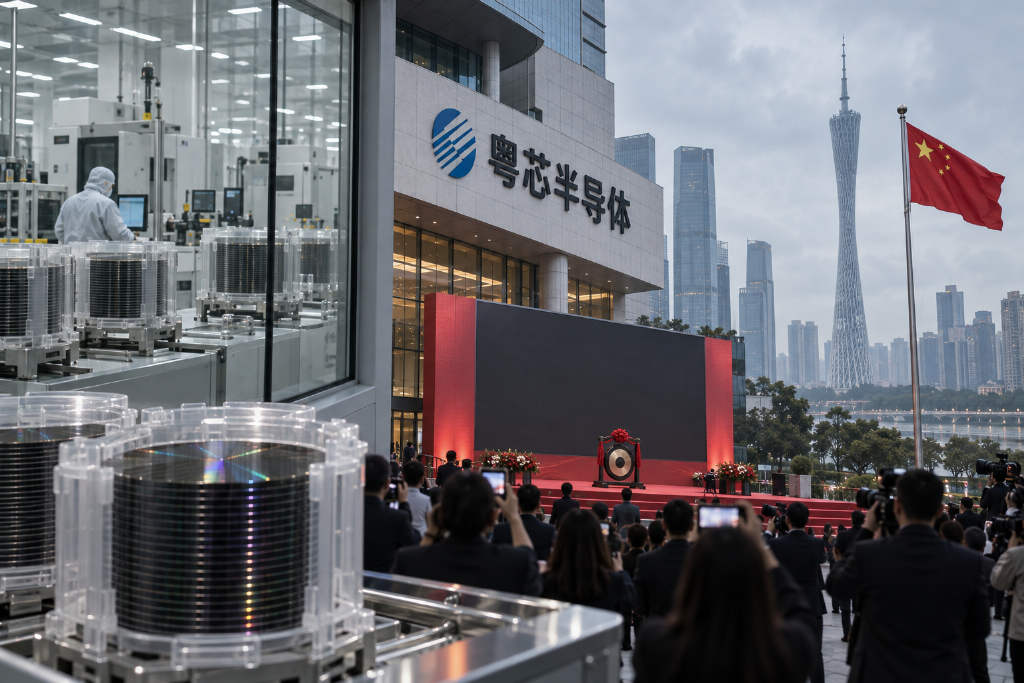
CanSemi Technology opened trading on Shenzhen’s ChiNext on Oct. 13 and surged 274.69% to 45 yuan per share, compared with its IPO price of 12.01 yuan. Based on a standard allotment of 500 shares, one winning subscription generated a paper gain of about 16,500 yuan on the first day. According to the prospectus and Wind data cited in the report, the company initially issued 513 million shares, with the total rising to 590 million after the full exercise of the over-allotment option. Online subscriptions came from 14.4354 million valid accounts for 423.383 billion shares, and the final online allotment after the callback mechanism was 179 million shares, with a winning rate of 0.0423786759%. CanSemi plans to raise a total of 7.5 billion yuan, with 3.5 billion yuan earmarked for capacity expansion, 2.5 billion yuan for R&D, and 1.5 billion yuan for working capital. The company said capacity utilization rose from 55.23% in 2023 to 96.38% in 2025, while the sales ratio reached 99.47%. Revenue increased from 1.044 billion yuan in 2023 to 2.582 billion yuan in 2025, but the company remained loss-making throughout the period, citing heavy depreciation and sustained R&D spending. It said, under a set of assumptions, it expects to break even on a consolidated basis as early as 2029.

950
CanSemi jumps 274.69% on ChiNext debut as IPO proceeds target capacity expansion
CanSemi
Sep 30, 2026

CanSemi races toward listing as Guangzhou pushes deeper into chip manufacturing

CanSemi Technology, a Guangzhou-based wafer foundry valued at RMB 30 billion, is nearing its stock market debut after taking just nine months from filing its listing application to reaching the verge of listing. Its offering drew heavy demand: the issue price was set at RMB 12.01 per share, with 179 million shares sold online, a winning rate of only 0.04238%, and a subscription multiple of 2,359.68 times. According to its prospectus, GF Securities served as sponsor and lead underwriter, while Guotai Haitong Securities acted as the contact lead underwriter. The company has become one of Guangzhou’s best-known semiconductor names since launching in Huangpu in 2017. It built China’s first 12-inch fab operated under a virtual IDM model, expanded across multiple production phases, and now plans total monthly capacity of 120,000 wafers with investment exceeding RMB 30 billion. Rather than competing head-on in leading-edge nodes, CanSemi chose 180-55nm specialty mature processes, targeting analog and mixed-signal chips and planning extensions to 40nm and 22nm. Its prospectus shows rapid revenue growth but continued losses tied to heavy upfront fab investment and capacity ramp-up. Revenue rose from RMB 1.02 billion in 2023 to RMB 2.51 billion in 2025, while the company said it could achieve consolidated profitability as early as 2029. The article frames CanSemi as part of a broader shift in Guangzhou, where projects including Guangxin and Zengxin are helping build out a fuller semiconductor supply chain.

1550
CanSemi races toward listing as Guangzhou pushes deeper into chip manufacturing