Policy and Regulation
Sep 19, 2026

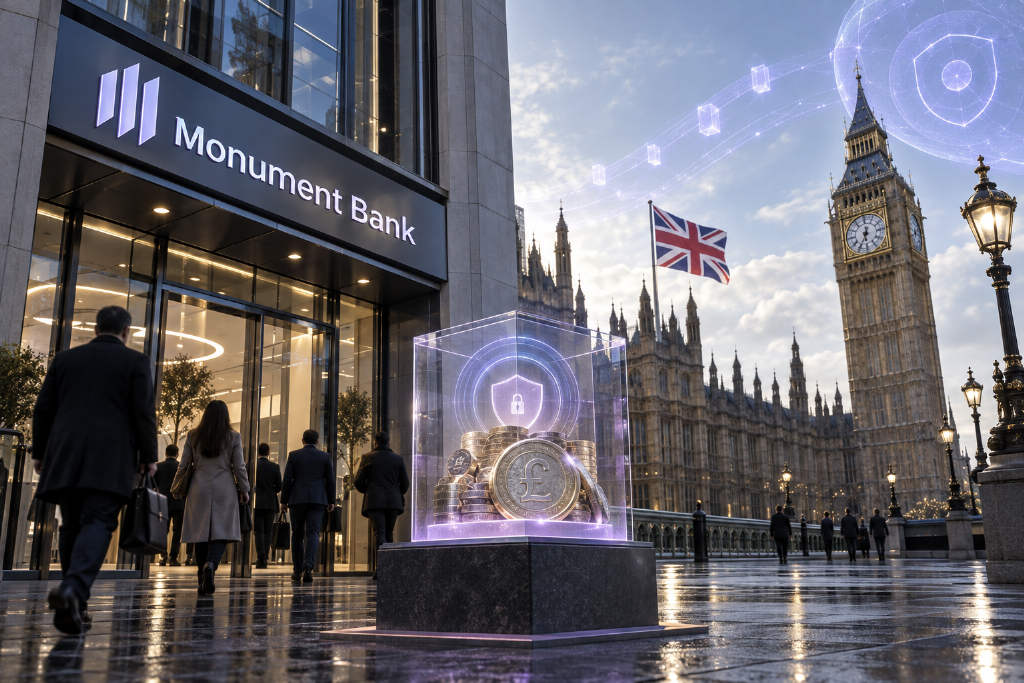
Monument Bank plans to tokenize up to £250 million in retail deposits on Midnight

Wall Street banks including JPMorgan and Citi have already moved large sums through blockchain-based systems, but those tokenized payment services remain largely limited to institutional clients and permissioned networks. JPMorgan’s Kinexys platform has processed more than $3 trillion, while Citi Token Services handles billions of dollars in cross-border payments each day, yet neither is open to ordinary savings customers. UK challenger bank Monument Bank is now trying to bring tokenization to retail depositors. The bank, which has a balance sheet of about $2.4 billion, plans to tokenize as much as £250 million, or roughly $335 million, of retail customer deposits on privacy-focused public blockchain Midnight. According to the report, the deposits would continue to earn interest, be fully backed by the bank, remain redeemable 1:1 for pounds sterling, and stay protected under the Financial Services Compensation Scheme. The project is designed to use zero-knowledge proofs to protect customer data while meeting regulatory requirements. Founder Mintoo Bhandari said most tokenization efforts today are still internal bank projects and have not yet given retail users direct access. Over time, Monument Bank also aims to offer services such as fractional private equity, tokenized structured products and Lombard loans through its regular banking app, and may license the infrastructure to other banks through Monument Technology.

1050
Monument Bank plans to tokenize up to £250 million in retail deposits on Midnight
Stablecoins
Sep 18, 2026

Banks Turn to Tokenized Deposits as SWIFT Pushes Weekend Cross-Border Transfers

Banks are using tokenized deposits and shared ledgers to keep cross-border payments moving outside normal banking hours, without replacing decades-old core systems. On Saturday, Sept. 5, DBS and Citi completed a U.S. dollar transfer from Singapore to New York in minutes using tokenized deposits and SWIFT’s new ledger. The article argues that the bottleneck in cross-border transfers has long sat with bank operating systems and settlement windows, not message delivery alone. Rather than rebuilding core banking infrastructure across dozens of jurisdictions, banks are creating parallel “side-core” systems that let balances move 24/7 while preserving legacy architecture underneath. The piece also frames this buildout as a direct response to stablecoin competition. Shared ledgers give banks a way to coordinate obligations, payment states, and net settlement across institutions, while keeping corporate clients inside the banking stack for credit, FX, treasury management, and support. At the same time, stablecoins still hold an edge in payments beyond the banking network, especially where banking access is weak or expensive. The emerging picture is not a winner-takes-all market, but a split model: bank deposits become programmable and always available, while stablecoins remain useful for open, cross-network transfers.

1220
Banks Turn to Tokenized Deposits as SWIFT Pushes Weekend Cross-Border Transfers
Citi
Sep 14, 2026

Citi says 20-year Treasuries offer attractive risk-reward as yields climb

U.S. Treasury yields rose sharply as higher oil prices fueled fresh inflation concerns, according to a ChainCatcher newsflash citing Citi. The bank said 20-year Treasuries now offer a favorable risk-reward setup for investors who can tolerate volatility. Citi strategist Jason Williams said bearish options on Treasuries would gain strength if yields move above 5.3%. He added that policymakers could step in to curb further increases in yields if that threshold is breached. The comments frame the recent sell-off in Treasuries around inflation worries tied to energy prices and highlight a level that Citi sees as important for both market positioning and possible policy response.

1060
Citi says 20-year Treasuries offer attractive risk-reward as yields climb
Goldman Sachs
Sep 12, 2026

Goldman Sachs shifts to a September Fed hike call as Wall Street converges on tightening

Goldman Sachs has changed its baseline forecast and now expects the Federal Reserve to raise rates by 25 basis points at the two-day meeting ending Sept. 16, reversing its earlier call for no change. The bank said the shift was triggered by August CPI data, which showed core CPI up 0.3% month over month versus a 0.2% market expectation, pushing market pricing for a September hike to about 90% at one stage and around 85% more recently. David Mericle, Goldman Sachs’ chief U.S. economist, said the revision was not driven by a fundamental reassessment of inflation. Instead, the bank argued that Fed credibility and market expectations had become the key factors. Goldman said August CPI only nudged its forecast for August core PCE to 0.26% and did not alter its broader inflation view. Other Wall Street firms have also moved toward a September hike after the CPI release, including JPMorgan, Citi and MUFG. Even so, the policy outlook after September remains far from settled. Goldman sees further hikes as possible but not its base case, while TD Securities expects three hikes in total. JPMorgan looks for moves in September and December, and Citi sees a single hike followed by a long pause until June 2027.

2220
Goldman Sachs shifts to a September Fed hike call as Wall Street converges on tightening
Citi
Sep 9, 2026

Citi to launch tokenized deposit cross-border transfer service for Japanese firms by year-end

Citi will roll out an international transfer service for Japanese corporate clients by the end of the year, according to CoinDesk. The offering will use tokenized deposits and enable instant cross-border payments on a 24/7 basis across five countries. CoinDesk said the move would make Citi the first foreign bank to provide this type of service in Japan. The report ties the launch specifically to Japanese businesses and frames the product as a cross-border payments service rather than a broader consumer banking rollout. No additional details on the five countries or the service structure were disclosed in the brief.

1390
Citi to launch tokenized deposit cross-border transfer service for Japanese firms by year-end
DBS
Sep 8, 2026

DBS and Citi’s New York office settle U.S.-Singapore dollar payment on Swift Digital Ledger

DBS and Citi’s New York office completed a U.S. dollar cross-border payment between Singapore and the United States on Sept. 5 using tokenized deposits through the Swift Digital Ledger. The transaction was carried out over the weekend and took only minutes, compared with traditional cross-border payments that can take up to two business days, reducing delays tied to time zones and weekends. Swift said this was the second confirmed real-time use case on the ledger after HSBC and Standard Chartered completed the first real-time tokenized deposit cross-border transaction in August. Swift had announced on July 9 that the ledger was available for initial use, with 17 banks preparing to pilot it. DBS is the only Asia-headquartered bank among the 12 members of the core design group. DBS COO Rachel Chew said the ledger links traditional banking infrastructure with emerging digital networks, while Citi South Asia Services Head Mridula Iyer said the weekend transaction showed that around-the-clock cross-border payments are now possible.

1490
DBS and Citi’s New York office settle U.S.-Singapore dollar payment on Swift Digital Ledger
DBS
Sep 7, 2026

DBS and Citi complete first weekend U.S. dollar cross-border payment using tokenized deposits

DBS said it completed the first weekend U.S. dollar payment between Singapore and the United States with Citibank’s New York branch on Sept. 5 through Swift’s Digital Ledger, with settlement carried out using tokenized deposits. According to DBS, the transfer was completed in minutes, while a conventional cross-border U.S. dollar payment can take as long as two business days. The test was designed to remove limits tied to banking hours, weekends and time-zone differences, allowing round-the-clock movement of funds across borders. DBS said possible use cases include cross-border e-commerce and digital services. Citi joined Swift’s 24/7 cross-border payments pilot based on tokenized deposits in July this year and plans to take part in building a U.S. tokenized deposit network. DBS, for its part, launched a blockchain-based banking system in 2024 that includes DBS Treasury Tokens for liquidity management.

1520
DBS and Citi complete first weekend U.S. dollar cross-border payment using tokenized deposits
Citi
Sep 7, 2026

Citi and DBS complete first weekend tokenized cross-border deposit transfer on Swift

Citi and DBS have completed their first weekend tokenized cross-border payment between Singapore and the United States, using tokenized deposits on Swift Digital Ledger to get around the limits of traditional banking hours. DBS said the transfer was settled in minutes, compared with the industry norm of as long as two business days for conventional cross-border transactions. The deal adds to a growing list of bank experiments with blockchain-based settlement rails designed to improve payment speed while keeping deposits within the banking system. Swift said in July that its blockchain-based ledger was ready for initial use and that it was preparing tokenized cross-border payment pilots with 17 major banks, including Citi, DBS, HSBC, BNP Paribas, UBS, ANZ and Standard Chartered. Citi is also part of a separate effort by major US banks to launch a tokenized deposit network in the first half of 2027 through The Clearing House. Earlier, in November 2025, DBS and JPMorgan said they planned to build a blockchain tokenization framework for onchain transfers between their deposit token ecosystems.

950
Citi and DBS complete first weekend tokenized cross-border deposit transfer on Swift
Total 114 items
Go topage