Grayscale
Nov 13, 2026

Grayscale Finds Bitcoin Explains About Half of Crypto Sector Return Swings

Grayscale research finds that crypto assets are becoming less correlated with Bitcoin, which now explains roughly half of the variation in returns across crypto sectors, according to Crypto Briefing. The report breaks down annualized volatility and the share attributed to Bitcoin for six sectors. Currency has volatility of 49%, with 43% attributed to Bitcoin. Smart contract platforms stand at 58% and 38%, while financials are at 59% and 30%. Utilities and services have volatility of 67%, with a 30% Bitcoin share. Consumer and culture come in at 76% and 46%. Artificial intelligence has the highest volatility, at 85%, with 35% attributed to Bitcoin. Bitcoin’s own recent annualized volatility is about 43%, below every sector tracked by Grayscale. The report says lower correlation does not mean lower risk, but sector-specific factors explain the other half of return variation and can help investors judge which sectors offer genuine portfolio diversification.


40
Grayscale Finds Bitcoin Explains About Half of Crypto Sector Return Swings
Bitcoin
Nov 7, 2026

Bitcoin-S&P 500 Correlation Reaches 0.8, Highest Level Since 2020

Glassnode said Bitcoin’s relationship with the stock market has reached an unusually close level, with the cryptocurrency’s correlation with the S&P 500 hitting 0.8 over the past 30 U.S. equity trading sessions. The firm noted that this reading has been far above the level seen for most of the period since 2020. The observation comes as market participants have periodically discussed Bitcoin’s relative strength. Glassnode said that, for now, macroeconomic factors continue to determine the broader direction of the market. The statement was published by Glassnode and reported by PANews on Nov. 7. It focuses on the recent correlation reading rather than providing a separate forecast for Bitcoin or equities. No additional price level, performance figure, or on-chain data was provided in the report. The 0.8 coefficient refers specifically to the relationship between Bitcoin and the S&P 500 across the last 30 U.S. stock-market trading days.

100
Bitcoin-S&P 500 Correlation Reaches 0.8, Highest Level Since 2020
Bitcoin
Oct 2, 2026

Fidelity’s Jurrien Timmer Calls Bitcoin a Key Low-Correlation Diversifier

Jurrien Timmer, global macro director at Fidelity Investments, has described Bitcoin as a key portfolio diversification asset. According to the brief cited by Techub News, Timmer said Bitcoin has relatively low correlation with stocks and near-zero correlation with long-term U.S. Treasury bonds. The item was attributed to U.Today. The comment places Bitcoin in the context of asset allocation rather than short-term price action, with the focus on its correlation profile versus traditional financial assets.

770
Fidelity’s Jurrien Timmer Calls Bitcoin a Key Low-Correlation Diversifier
Bitcoin
Sep 30, 2026

Bitcoin’s link to a stronger dollar may be weaker than many assume, analysis says

A stronger U.S. dollar is often treated as a headwind for Bitcoin and other dollar-priced assets such as gold. The usual logic is straightforward: when the dollar rises, debt servicing costs increase for borrowers with dollar liabilities, which can reduce appetite for risk assets. But fresh analysis cited by BlockBeats suggests that the market may be overstating how much the dollar actually drives Bitcoin’s day-to-day moves. Since Sept. 9, the U.S. Dollar Index has climbed about 2.6% and touched 101.69 on Tuesday, its highest level in two months. Over a similar period, Bitcoin pulled back from nearly $87,500 on Sept. 21 to the $83,000-$84,000 range. Even so, TradingView data showed that over the past 90 trading days, the correlation coefficient between Bitcoin and the dollar index was -0.41, while the coefficient of determination was only 0.17, meaning the dollar index explained roughly 17% of Bitcoin’s daily return fluctuations. The report also noted that the 30-day correlation reading of -0.45 was heavily influenced by two outsized sessions, Aug. 19 and Sept. 3, when Bitcoin rose more than 5% and the dollar index fell. Removing those two days lowered the figure to -0.19. Over a longer horizon, the average 90-day correlation since January 2020 was only -0.14, and it even rose to +0.22 in November 2024.

990
Bitcoin’s link to a stronger dollar may be weaker than many assume, analysis says
Bitcoin
Sep 29, 2026

Coinbase Institutional says BTC-gold correlation is near historic highs as returns diverge

Coinbase Institutional said on X that Bitcoin’s correlation with gold is close to historic highs, while cautioning that similar correlation does not mean the two assets deliver the same returns. The firm pointed to a clear split over the past month: BTC rose, while gold fell. In its view, that suggests marginal demand is still leaning toward Bitcoin even as interest rates move higher. Coinbase Institutional also said two indicators have moved lower at the same time. The 90-day correlation between BTC and gold has declined, and Bitcoin’s beta versus the Nasdaq 100 index has also fallen. The update highlights that BTC can still trade differently from traditional macro assets even when headline correlation remains elevated.

900
Coinbase Institutional says BTC-gold correlation is near historic highs as returns diverge
Bitcoin
Sep 25, 2026

Bitfinex says BTC traded more like gold than traditional risk assets when US 10-year yield hit 5%

Bitfinex said in a chart-based analysis published on Sept. 25 that Bitcoin behaved more like gold than a traditional risk asset when the US 10-year Treasury yield reached 5%. The exchange pointed to two correlation readings in support of that view. According to the data it cited, BTC’s correlation with gold has risen to 0.52, while the correlation between BTC and daily changes in Treasury yields has turned negative. The note frames Bitcoin’s recent market behavior through its relationship with gold and bond-yield moves, rather than through the lens typically used for broader risk assets. No additional timeframe or methodology details were provided in the brief update.

1000
Bitfinex says BTC traded more like gold than traditional risk assets when US 10-year yield hit 5%
Bitcoin
Sep 12, 2026

Bitcoin’s correlation with gold climbs as its Nasdaq-100 link weakens

Unchained said bitcoin and gold have moved much closer together over the past six months, raising questions for investors who have treated the two assets as separate hedges against fiscal excess and currency debasement. In Thursday trading, producer prices remained hot, while gold, bitcoin and the Nasdaq-100 each fell more than 1%. The 30-year U.S. Treasury yield closed at 5.37%, its highest close since the Treasury resumed issuing the bond in 2006. Using daily price data going back to 2019, Unchained found bitcoin’s four-month correlation with gold had risen to 0.56 from about 0.22 in March. Over the same period, bitcoin’s correlation with the Nasdaq-100 fell from 0.54 to 0.36. The report said that marked the highest reading in its dataset since 2019, with the prior peak in November 2020. It also noted that published readings this month start at 0.50, while Bitwise has described the current level as the highest in nearly six years. The article added that methodology matters: whether calculations use daily returns or price levels, what lookback window is chosen, and which gold contract is used can all change the result.

1490
Bitcoin’s correlation with gold climbs as its Nasdaq-100 link weakens
Bitcoin
Sep 7, 2026

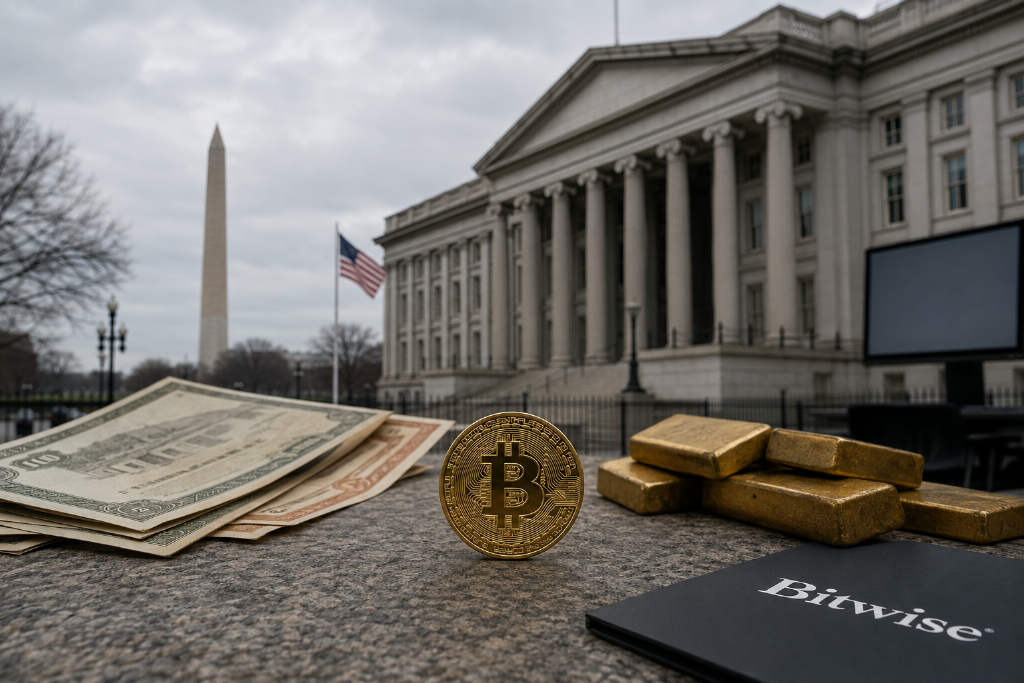
Bitwise: Bitcoin Shows Lower Correlation to 10-Year Treasury Yield Than Gold

Bitwise data reveals that Bitcoin has a lower correlation to the 10-year U.S. Treasury yield than gold, showing greater resilience during bond market declines. In late August, the 90-day rolling correlation between Bitcoin and gold rose above 0.5, the highest since 2020, as U.S. federal debt surpassed $40 trillion. The Treasury doubled its long-term bond buyback program to $4 billion, and Bitcoin surged 22.4% in a week. Analysts attribute gold's high correlation to its role in institutional fixed-income portfolios, while Bitcoin remains outside traditional yield models.

1330
Bitwise: Bitcoin Shows Lower Correlation to 10-Year Treasury Yield Than Gold
Total 33 items
Go topage