XRP
Oct 13, 2026

Evernorth debuts on Nasdaq as XRPN, bringing a 473 million XRP treasury to public markets

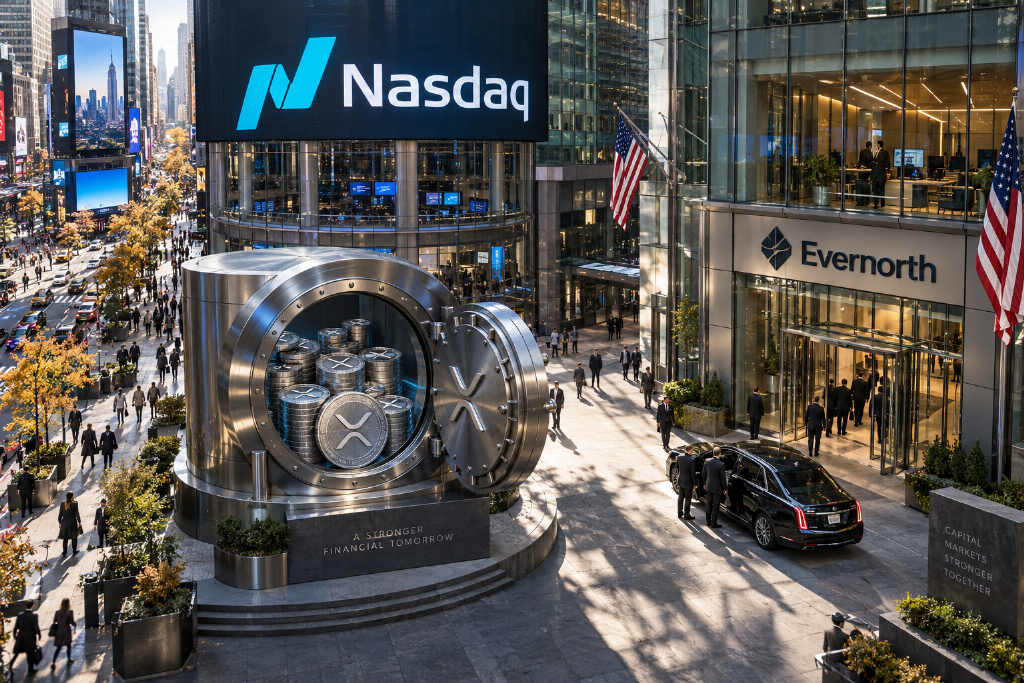
Ripple-backed Evernorth has completed its merger with special purpose acquisition company Armada Acquisition Corp. II and begun trading on Nasdaq under the ticker XRPN. The deal moved roughly 473 million XRP and $300 million in cash proceeds into the public market, turning Evernorth into one of the most visible XRP treasury vehicles tied to U.S. equities. The company, founded by former Ripple executive Asheesh Birla, has positioned itself as an actively managed treasury rather than a passive holder. Its filings outline plans to use RLUSD in XRP ecosystem DeFi activity, including RLUSD/XRP liquidity pools, XRP lending, AMM liquidity provision, and options strategies. Evernorth has also disclosed a 2025 digital asset impairment of about $233.7 million, reflecting the gap between acquisition cost and market prices during a period of market weakness. Market interest in XRP-linked capital market products has also shown up in spot ETF flows. SoSoValue data cited in the report shows XRP spot ETFs recorded $11.3068 million in net inflows during the Oct. 5 to Oct. 9 U.S. trading week, while total net assets stood at $1.57 billion and cumulative net inflows reached $1.80 billion. Even so, the article argues that XRPN may be a more important route if XRP is to reach a broader pool of institutional liquidity.

1180
Evernorth debuts on Nasdaq as XRPN, bringing a 473 million XRP treasury to public markets
ZEROBASE
Oct 10, 2026

ZEROBASE CEO says cost-cutting is now the main strategy, with DAT and perpetuals work shut down

ZEROBASE CEO Mirror Tang said the project has shifted its main strategy to cost control, describing the current priority as spending money only where it matters most. In a post on X, Tang said changes in market conditions and continued tightening in altcoin liquidity have made both DAT and perpetual contracts loss-making under the current liquidity environment. As a result, ZEROBASE has ended work on those two lines and carried out layoffs. The company is also reducing research and development spending. At the same time, part of the development team has been reassigned to security operations, business security and strategy development. On the operations side, staff have been told to focus on customer service, support for major events and continued participation in industry events. The remarks outline a broader internal restructuring centered on cutting costs and reallocating resources rather than expanding product lines.

1180
ZEROBASE CEO says cost-cutting is now the main strategy, with DAT and perpetuals work shut down
Bitmine
Oct 1, 2026

Tom Lee Says Ethereum DAT Now Holds 7% of ETH Supply

Bitmine Chairman Tom Lee said Ethereum DAT currently holds 7% of the total ETH supply, according to a newsflash published by ChainCatcher. He also said that share could rise to 15% during the current cycle. The source report did not provide additional details on Ethereum DAT, the timeframe definition for the cycle, or the path to that higher allocation. The statement was presented as a direct market update rather than a broader analysis, with no further figures, background data, or supporting commentary included in the original item.

740
Tom Lee Says Ethereum DAT Now Holds 7% of ETH Supply
Wintermute
Sep 20, 2026

Wintermute says RWA could become crypto’s next liquidity channel after ETFs and DAT normalize

Wintermute argues that the next crypto bull cycle may depend less on whether capital exists and more on whether a new route emerges to pull that capital on-chain. In its view, real-world assets, or RWAs, are the clearest candidate now that exchange-traded funds and digital asset treasury strategies, referred to as DAT, have become part of the market’s normal plumbing rather than a fresh source of one-way inflows. The firm traces earlier cycles through distinct liquidity channels. VC and ICO funding carried the 2017/18 phase, stablecoins underpinned the 2020/21 run with more than $120 billion in net issuance in one year, and ETFs plus DAT drove 2024/25 with $63 billion in ETF net inflows and more than $115 billion in treasury accumulation. Wintermute says those channels have now matured, while RWA tokenization has kept growing even as other channels cooled. According to the piece, tokenized value has roughly tripled over the past year to more than $30 billion, and RWAs drew about $16 billion over the last 12 months. That is still only about one-tenth of the best 12-month combined inflows seen from ETFs and DAT in the last cycle. Even so, Wintermute says RWA is the only channel still expanding while others have faded, making regulation, transferability, and the use of tokenized Treasuries and funds as collateral the main factors to watch next.

880
Wintermute says RWA could become crypto’s next liquidity channel after ETFs and DAT normalize
RWA
Sep 3, 2026

Wintermute: After ETFs and DATs Normalize, RWA Could Power the Next Bull Cycle's Liquidity Channel

Wintermute's latest research report argues that every crypto bull market has been propelled by a new liquidity channel — from early token fundraising and stablecoins to ETFs and digital asset treasuries (DATs). With ETFs and DATs now normalized, RWA stands as the only channel still growing. Over the past 12 months, RWA attracted roughly $16 billion, while on-chain tokenized assets doubled to over $30 billion. Because tokenized assets are predominantly held by institutions rather than short-term traders, a RWA-driven cycle could be less euphoric but longer-lasting. The report identifies regulatory frameworks and DeFi collateral integration as key catalysts that could unlock broader capital flows from tokenized products into the wider crypto ecosystem.

1440
Wintermute: After ETFs and DATs Normalize, RWA Could Power the Next Bull Cycle's Liquidity Channel
Crypto Treasury Companies
Aug 18, 2026

DAT firms take nearly $10 billion in quarterly losses, but the market has moved on

This earnings season, crypto treasury companies posted bruising results: Strategy lost $8.22 billion in Q2, Strive lost $258 million, Sharplink lost $394 million, Metaplanet lost 182.8 billion yen in the first half, and Bitmine's nine-month net loss topped $9 billion. Combined Q2 losses came to about $10 billion, yet several names rallied anyway. The article argues that the market has already priced in the losses and is now focusing on one metric: how much crypto each share represents. Strategy raised $8.4 billion in Q2, repurchased $1.5 billion of convertible debt at a discount, and increased cash reserves to $3.75 billion. Sharplink sold shares above NAV and bought back stock. Metaplanet tightened capital rules around mNAV. The common thread is discipline: these firms are now managing toward higher per-share crypto exposure rather than headline growth. The new funding tools built around perpetual preferred stock, such as STRC, SATA, BMNP and Metaplanet's BitBonds plan, are spreading the model across the sector. Premiums are falling, but the structure may stay. Once the narrative is stripped away, DATs look more like actively managed thematic funds with embedded financing tools, and the market is treating them that way.

2140
DAT firms take nearly $10 billion in quarterly losses, but the market has moved on
Bitcoin
Aug 13, 2026

CryptoQuant Founder: ETF and DAT Are Main Structural Buyers as Futures Leverage Stays High

CryptoQuant founder Ki Young Ju says bitcoin's OG traders are coming off their most profitable cycle ever, with ETF inflows and digital asset reserve companies now serving as the main structural buyers rather than exchange traders. Binance traders' unrealized profits have been pushed to nearly three times the level seen at the 2021 cycle top. Ju writes that the market is deleveraging while bitcoin's price remains near levels from two years ago; much of the unrealized profit accumulated in this cycle has flowed into futures leverage. As traders take profit, BTC has stabilized near the average cost basis of Binance traders. On-chain market leverage, defined as BTC/USDT futures open interest divided by USDT reserves, previously exceeded 0.5 and has now eased to roughly 0.3, still higher than before ETFs launched. If ETF inflows keep coming, futures leverage is likely to climb again. Ju also points to 2023 OG whale buying when BTC traded near $16,000, with the buyer/seller ratio indicating that a large number of market buy long positions were built around the cycle bottom.

2050
CryptoQuant Founder: ETF and DAT Are Main Structural Buyers as Futures Leverage Stays High
Total 18 items
Go topage