DBS

Bitcoin
2026-08-16 12:04:44

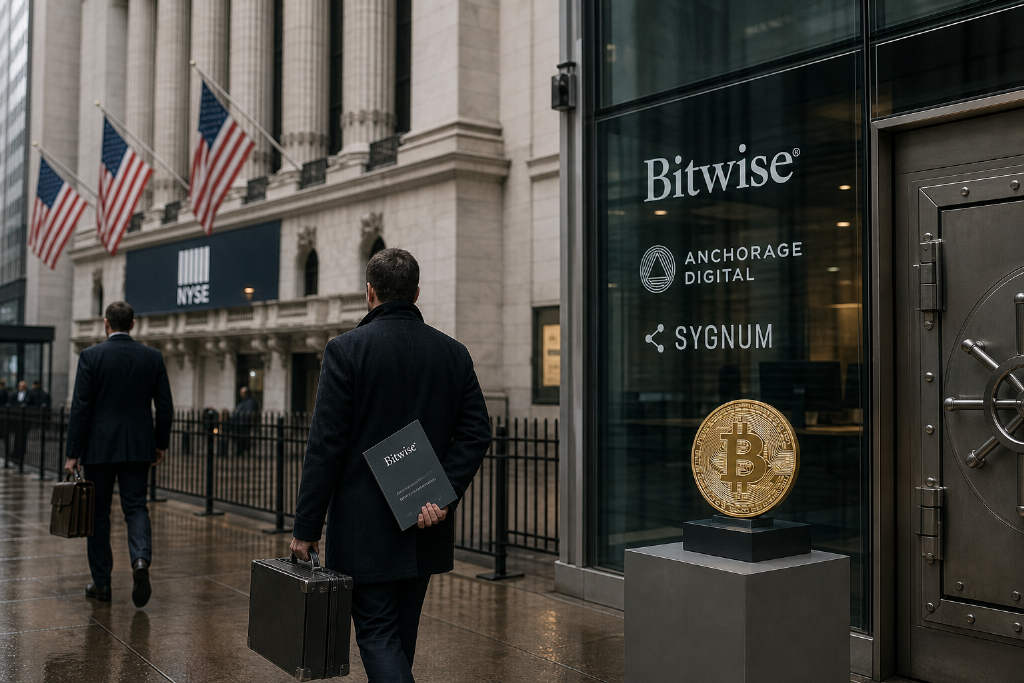
Analysts say the ‘long Bitcoin, short bankers’ trade is fading as trillion-dollar institutions move into crypto

The old framing of Bitcoin as a direct bet against banks is losing ground as major financial institutions expand their presence in digital assets, according to executives cited by CoinDesk and carried by Odaily. Bitwise CEO Hunter Horsley said the era of being “long Bitcoin, short bankers” is over, arguing that banks and large asset managers are no longer standing outside the sector but are now helping distribute crypto exposure to clients. He pointed to two financial institutions with more than $1 trillion in assets under management that approved crypto products this summer even in a bear market, a sign that large firms are widening access rather than pulling back. Others described the shift as structural rather than cyclical. Sygnum chief investment officer Fabian Dori said banks have moved from resisting digital assets to supporting them through custody, tokenization, and compliant trading, driven by rising client demand and clearer regulation. Anchorage Digital CEO Nathan McCauley said client composition over the past two years has increasingly reflected a convergence between traditional finance and crypto finance, with large institutions more likely to partner with specialized crypto infrastructure providers than build their own systems. The report also named firms such as Swissquote, DBS, BBVA, BNY Mellon, Credit Suisse-related entities, Morgan Stanley, and Charles Schwab as part of the broader institutional move into crypto.
490
Analysts say the ‘long Bitcoin, short bankers’ trade is fading as trillion-dollar institutions move into crypto
Policy and Re
2026-08-16 12:05:50

CoinDesk: Wall Street’s crypto push is blurring the line between TradFi and DeFi

According to CoinDesk, the boundary between traditional finance and decentralized finance is becoming less distinct as Wall Street firms and global financial institutions move deeper into digital assets. Bitwise CEO Hunter Horsley said the old trade of being long bitcoin and short bankers is over, arguing that major institutions are now working from the other side of the crypto market and helping expand access to digital assets. He pointed to two financial institutions with more than $1 trillion in assets under management each that approved crypto products this summer despite a bear-market backdrop. Sygnum Chief Investment Officer Fabian Dori said the relationship between banks and the crypto sector has changed in a structural way. In his view, banks have shifted from resisting digital assets to building, supporting, and distributing them through custody, tokenization, and compliant trading. He said rising client demand and clearer regulation, rather than short-term market cycles, are driving the change. Anchorage Digital CEO Nathan McCauley added that client composition over the past two years increasingly reflects convergence between traditional finance and crypto finance, with large institutions preferring to work with specialist crypto infrastructure providers instead of building systems on their own.

360
CoinDesk: Wall Street’s crypto push is blurring the line between TradFi and DeFi
Tokenized Fun
2026-08-13 13:14:03

Tokenized fund race shifts from size to control of digital money rails

Tokenized money market and Treasury funds are moving beyond their original role as yield products and into a new position inside institutional digital cash systems. By May 2026, tokenized Treasury and money market funds had reached about $10 billion in combined assets, with BlackRock’s BUIDL alone accounting for roughly 40% of that total. At the same time, Hong Kong moved tokenized funds from a subscription-and-redemption model toward 24/7 secondary trading, while banks in Singapore began testing tokenized fund shares as collateral for lending and trading activity. The competition is now centered on utility rather than issuance alone. In the United States, tokenized funds are increasingly being tied to stablecoin reserve structures, including JPMorgan’s JLTXX on Ethereum, which is designed for reserve use under the GENIUS Act framework. Europe and the UK are focusing on fitting these products into formal regulatory systems. Singapore is pushing the collateral use case. Hong Kong, meanwhile, is trying to combine issuers, banks, trading venues and settlement infrastructure in one regulated market structure. What is emerging is not simply a new wrapper for traditional money funds. Tokenized fund shares are being tested as assets that can circulate across trading, settlement and credit networks. That raises a broader question for asset managers, banks and crypto platforms alike: in a market where cash management tools, bank deposits and digital currencies start to share the same rails, who will control access to the system itself?

280
Tokenized fund race shifts from size to control of digital money rails
HashKey Excha
2026-08-03 09:39:16

HashKey Exchange cleared by JPMorgan to open client money account

HashKey Exchange, a licensed cryptocurrency exchange in Hong Kong, has received approval from JPMorgan to open a client money account, according to ChainCatcher. HashKey Holdings said the account will use JPMorgan’s banking infrastructure to support segregation and settlement of client funds. The update adds to the exchange’s recent banking arrangements and product changes. On June 30, HashKey Exchange enabled a client money account with DBS Bank in Singapore, allowing fiat deposits, withdrawals, and settlement services. One week earlier, HashKey Holdings merged the previously separate HashKey Exchange and HashKey Global apps into a single entry point. The company was listed in Hong Kong in December last year after raising $206 million in an oversubscribed initial public offering. The latest move links HashKey Exchange with another global bank as it continues to build out account infrastructure tied to customer assets and settlement functions.

970
HashKey Exchange cleared by JPMorgan to open client money account
Federal Reser
2026-07-29 17:48:39

Fed decision preview: most institutions expect no rate change, with markets focused on Waller’s remarks

The Federal Reserve’s interest rate decision is due later on July 30, and several institutions have outlined their expectations ahead of the release. Most see the Fed holding rates steady, while pointing to the policy statement and Chair Waller’s press conference as the main drivers of market volatility. MUFG and Saxo Bank said the U.S. dollar and Treasury yields could strengthen if the Fed delivers a hawkish signal or unexpectedly raises rates. TD Securities took a different view, saying that if the decision draws no dissenting votes, it would suggest Waller has built a degree of internal consensus, which could leave the dollar exposed to heavy selling. DBS said even minor wording changes in the statement could move short-end rates sharply. Goldman Sachs and HSBC said that even if rates stay unchanged for the full year, the drag on the dollar may remain limited, while a fresh upside catalyst for the greenback would likely require an unexpected hike. On gold, ING and SIA Wealth Management said prices should retain near-term support, though any hawkish surprise could cap further gains.

1170
Fed decision preview: most institutions expect no rate change, with markets focused on Waller’s remarks
Global Paymen
2026-07-26 14:40:53

Why More Indian Executives Are Showing Up Across Global Payments

A commentary published by ChainCatcher argues that a growing share of leadership roles across banks, fintech firms and payment companies are now held by Indian-origin professionals, especially in global and regional organizations. The piece says many Chinese professionals initially misread this trend, often assuming these executives are simply stronger at presentations or internal messaging, only to revise that view after working with them on cross-border payments, banking partnerships, account systems, and compliance-heavy projects. The author’s central point is that the advantage often lies less in narrow technical depth and more in organizational capability: stakeholder management, cross-cultural coordination, executive communication, and the ability to move complex institutions toward alignment. The article also points to professional networks and long-term career ecosystems as a force multiplier, and highlights Singapore as a key hub where Indian-origin managers have become highly visible in Asia’s payments sector. The piece does not frame this as a zero-sum contest with Chinese talent. Instead, it argues that Chinese payments professionals already possess rare operational experience shaped by the world’s largest mobile payments market, but may need to add another layer of capability to compete globally: influencing large organizations, building durable industry networks, and making their value legible across multinational structures.

360
Why More Indian Executives Are Showing Up Across Global Payments
Robinhood
2026-07-26 11:22:32

IOSG says Robinhood’s new L2 keeps trading, settlement and tokenized assets inside its own stack

IOSG’s latest deep dive argues that Robinhood is no longer renting blockspace from someone else’s network. By launching its own Layer 2, the company now controls the rails for trading, settlement, collateral, yield and asset circulation, a move the report frames as a direct answer to Coinbase’s Base. Robinhood Chain was built for tokenized equities and broader real-world asset activity, yet its first wave of traction came from meme coins and AI agents rather than stocks. As of July 20, 2026, IOSG said RWA assets still accounted for only about 4% of total value locked. The report lays out a layered structure around the chain, including USDG as the main settlement dollar, USDe as a yield-bearing collateral asset, Wallet as the user entry point, and separate perpetual venues such as Lighter and Arcus. It also spends considerable time on the legal structure of Robinhood’s stock tokens, describing them as tokenized debt securities issued by Robinhood Assets (Jersey) Limited rather than direct ownership of underlying shares. IOSG’s conclusion is that the infrastructure economics already make sense for Robinhood, but the unresolved question is whether meme-driven traffic can be converted into durable RWA activity and whether the company will eventually publish reserve proof for its stock token model.

1610
IOSG says Robinhood’s new L2 keeps trading, settlement and tokenized assets inside its own stack