Dragonfly
Oct 25, 2026

Haseeb Qureshi responds to NEAR Intents threshold ECDSA patent claim

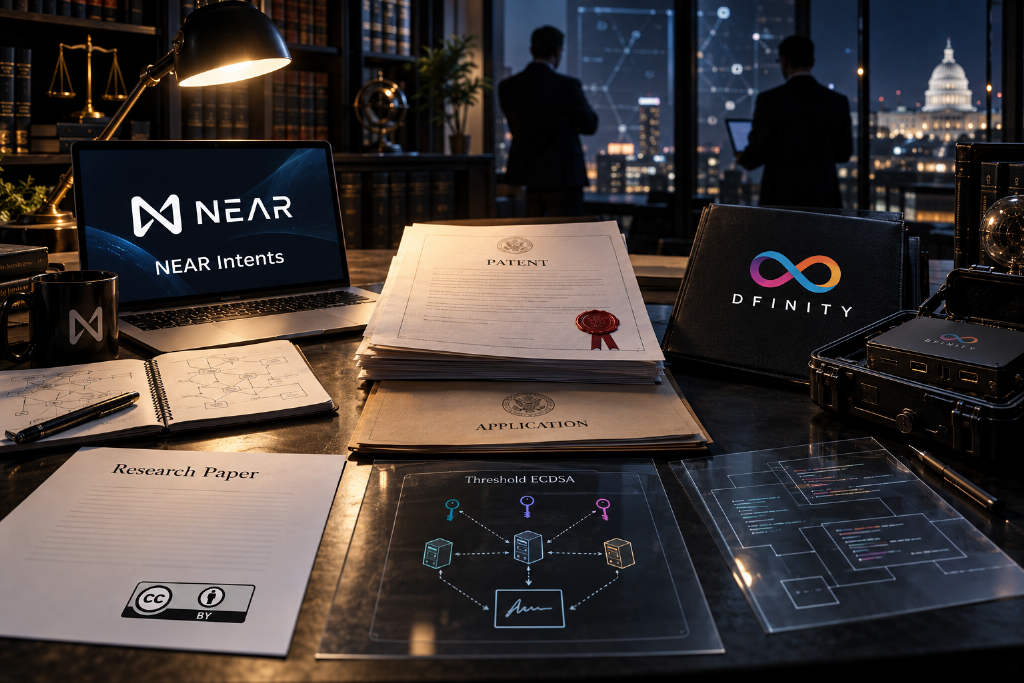
Dragonfly partner Haseeb Qureshi has responded to DFINITY founder Dominic Williams over an earlier accusation that NEAR Intents used threshold ECDSA signing technology without authorization. In his post, Qureshi shared a screenshot of the related patent filing and said the patent was not granted until late July this year, remaining only in "patent application" status before that point. He also said NEAR Intents changed the relevant algorithm in September. Qureshi added that, even under Williams’ own framing, any alleged patent infringement would have covered only about one month. He also argued that the algorithm was first published in an academic paper released under a CC BY license, and that NEAR cited that paper in its implementation. The exchange centers on the timing of the patent approval, the later algorithm change by NEAR Intents, and whether the use in question can be treated as patent infringement on the facts presented by the two sides.

920
Haseeb Qureshi responds to NEAR Intents threshold ECDSA patent claim
Dragonfly
Oct 24, 2026

Dragonfly partner challenges DFINITY’s timeline in NEAR Intents patent dispute

Dragonfly partner Haseeb Qureshi has publicly pushed back on patent infringement claims made by DFINITY founder Dominic Williams over NEAR Intents. Williams had said NEAR Intents’ chain abstraction feature used threshold ECDSA signing technology without authorization, adding that the work was advanced with the involvement of a person dismissed by DFINITY in 2021. Qureshi’s response focused on timing. He said the patent in question was not granted until late July this year, while NEAR Intents changed the relevant algorithm in September. Based on Williams’ own timeline, Qureshi argued, the possible window after the patent grant may have been only about one month. He also said conduct before formal patent issuance should not be directly treated as patent infringement because the application had not yet been granted. Qureshi added that the algorithm first appeared in an academic paper released under a CC BY license and that NEAR cited that paper in its implementation. The dispute now centers on the patent grant date, the basis for using the technology, and whether NEAR’s implementation amounts to infringement. At this stage, the claims remain public statements from the two sides.

1090
Dragonfly partner challenges DFINITY’s timeline in NEAR Intents patent dispute
NEAR
Oct 23, 2026

NEAR-ICP dispute widens as DFINITY founder targets Intents, cryptography and decentralization claims

A public clash between NEAR Protocol and Internet Computer has moved well beyond a routine crypto feud. Between Oct. 21 and Oct. 23, DFINITY founder Dominic Williams used X to challenge NEAR’s Confidential Intents design, then escalated the dispute into allegations involving proprietary cryptographic algorithms, former employees and possible civil and criminal litigation. NEAR and its community pushed back by saying the criticized architecture had already been disclosed in public documentation and by pointing to a fresh update showing its mainnet MPC network had expanded to 17 independent operators with an 11-of-17 signing threshold. At the center of the dispute are several overlapping issues: whether NEAR’s privacy model relies too heavily on permissioned validator shards and trusted execution environments, whether published academic cryptography can be treated as exclusive intellectual property, and how much decentralization is enough for cross-chain signing infrastructure in production. PANews frames the conflict as a broader collision between a cryptography-first approach represented by ICP and a product-driven, engineering-pragmatic approach represented by NEAR. The episode has also drawn attention to the growing overlap between the two networks’ narratives around chain abstraction, multi-chain asset control and AI-related infrastructure.

1460
NEAR-ICP dispute widens as DFINITY founder targets Intents, cryptography and decentralization claims
DFINITY
Oct 23, 2026

DFINITY founder accuses NEAR of using threshold signature algorithm and questions MPC decentralization

DFINITY Foundation founder Dominic Williams has publicly accused NEAR Protocol of using DFINITY’s threshold ECDSA algorithm in its chain abstraction stack without proper commercial authorization. Williams said the core algorithm had been disclosed in a 2022 academic paper, but argued that commercial rights were limited to the Internet Computer ecosystem and were not available to competing networks. He also alleged that NEAR hired a former DFINITY employee who had been dismissed in 2021 to lead signature-related development, pushing the dispute beyond a technical disagreement into questions around intellectual property and employment restrictions. Williams also challenged the decentralization and resilience of NEAR’s underlying multiparty computation, or MPC, network. He claimed the system runs on just eight servers and cited public repository references, including PR #4503 and Issue #4324, to argue that NEAR engineers were moving from a one-round signing design to a slower three-round approach. In his view, that change points to security flaws or deadlock issues in the original implementation. NEAR has not issued a public response so far, and the claims remain one-sided at this stage.

780
DFINITY founder accuses NEAR of using threshold signature algorithm and questions MPC decentralization
DFINITY
Oct 22, 2026

DFINITY founder’s attack on NEAR privacy design draws backlash and fresh scrutiny of ICP’s market position

DFINITY founder Dominic Williams triggered a public dispute on Oct. 22 after questioning the design of NEAR’s Confidential Intents, arguing that its privacy protections appeared to rely too heavily on trust in permissioned nodes rather than deeper technical guarantees. The criticism quickly backfired. NEAR AI lead Cameron Dennis said the points Williams raised had already been disclosed in NEAR Intents’ original announcement and dismissed the post as a FUD campaign. Polygon founder Sandeep Nailwal also sided with NEAR, framing the project as a practical system built to solve real user problems rather than chase theoretical perfection. The clash soon spread beyond the two teams. Community users mocked the criticism, with some saying the “discovery” amounted to information already available in public documentation. Members of the NEAR community even launched a meme coin called IKP, a jab at Internet Computer and ICP. The episode also revived discussion around DFINITY’s weakening market presence. According to CoinGecko and DeFiLlama data cited in the report, ICP was trading near $2.8 on Oct. 22, down 99.6% from its all-time high, while its TVL stood at about $8.62 million and 24-hour chain revenue was under $6,900. Over the same period, NEAR posted stronger price performance and a TVL above $230 million, highlighting the widening gap in momentum between the two ecosystems.

940
DFINITY founder’s attack on NEAR privacy design draws backlash and fresh scrutiny of ICP’s market position
ICP
Oct 12, 2026

ICP Cloud Engines fuels fresh burn narrative, but token re-rating still hinges on real data

Discussion around Internet Computer Protocol, or ICP, picked up over the weekend after DFINITY tied its Cloud Engines product to Mission 70, a deflation plan that routes 20% of Cloud Engines revenue into buying and burning ICP. Under the framework, node providers keep the other 80%. Supporters see a simple chain of logic: enterprise cloud demand could generate revenue, revenue could fund token burns, and lower supply growth could eventually support a re-rating in ICP. The pitch has gained traction because ICP is down 99.6% from its historical peak and its circulating market capitalization has fallen to $1.1 billion, making any fundamentals-based recovery thesis stand out. The article argues that the market is still early in that process. Cloud Engines lets enterprises run private subnets on Internet Computer with control over node providers, deployment geography and replica counts, while keeping the same protocol stack as the public network. Yet some of the most heavily promoted features, including SEV encrypted nodes and operator-controlled upgrades, remain on the roadmap and are not live. Mission 70’s targets are also demanding: current cycle burn runs at about 0.0689 TCYCLES/s, while the plan’s 70% deflation goal would require 0.77 XDR/s, roughly 15 times the current level. Existing deployments in Pakistan and a United Nations Development Programme pilot show the product can run, but the piece says the market still needs the first measurable batch of burn data before treating the thesis as proven.

2060
ICP Cloud Engines fuels fresh burn narrative, but token re-rating still hinges on real data
ICP
Oct 12, 2026

ICP’s Cloud Engines story gains traction, but token re-rating still hinges on real burn data

Discussion around Internet Computer Protocol, or ICP, picked up over the weekend after DFINITY tied its Cloud Engines product to Mission 70, a deflation plan that directs 20% of Cloud Engines revenue to buying and burning ICP. The pitch is straightforward: enterprise cloud spending generates revenue, part of that revenue is used for token burns, and lower supply could support a new valuation framework for ICP. In the article, the projected impact is large. If customer adoption is strong enough, ICP’s inflation rate could fall from 9.72% to 2.92%, a 70% reduction. The report also stresses how early the product still is. Cloud Engines lets enterprises run private subnets on Internet Computer with control over node providers, hardware location and replica count, while keeping the same protocol and smart contract stack as the public network. Yet some of the most heavily promoted features, including SEV-encrypted nodes and operator-controlled upgrades, are still on the roadmap and not live. Existing deployments such as the Pakistan National Cloud Engine, a United Nations Development Programme pilot, and Pakistan’s sovereign communication app ChatT show the product can run, but they do not yet prove broad enterprise-scale adoption. Mission 70’s supply-side changes may arrive sooner. The article says cuts to node rewards and a reduction in minimum subnet size could be decided through governance, while the demand-side burn thesis depends on Cloud Engines producing materially higher revenue than it does today.

1110
ICP’s Cloud Engines story gains traction, but token re-rating still hinges on real burn data
Total 15 items
Go topage